Saturday, July 25, 2009

Wheelmen Take the Corey Hill Challenge

Illustration: Bicyclists climb Corey Hill during their visit to Boston for the annual meeting of the League of American Wheelmen. From Harper's Weekly, June 5, 1886Boston was the Hub of bicycling in the United States in the 1880s. The Boston Bicycling Club, the first in the country, was founded in 1878. Five years later, Outing, a Journal of Recreation labeled the city "the bicycling paradise of America." Wheelmen, as they were sometimes called, came from all over to ride "the beautiful roads that have rendered Boston the metropolis of bicycling."

One of the high points in metropolitan Boston-- literally and figuratively -- for local and visiting riders alike was Corey Hill in Brookline. Wheelmen strove to become the first to make it to the top of the hill and, after that barrier was broken in 1883, to set a new record time or simply challenge themselves to conquer the steep incline.

Bicycle manufacturers and sellers even promoted in advertisements the fact that their bicycles had made it to the top of Corey Hill.

Illustration: This bicycle ad in the June 1884 issue of the Yale Literary Magazine notes that the Rudge Light Roadster is the only bicycle that has ever been ridden up Corey Hill
"The hill is one of the steepest and longest in the vicinity of Boston," wrote the Boston Daily Globe on July 29, 1883, shortly after the first successful ascent "and hundreds of wheelmen have unsuccessfully tried to ride up."

The length of Corey Hill is 2300 feet [continued the Globe article], height 199 feet; average grade, one foot in 11.41. On the last 158 feet the average grade is one feet in 7.85 feet, and for the next 170 feet lower down the rise is one foot in every 7.87 feet


Illustration: a Victor Tricycle, top, and Rudge Light Roadster, bottom, were the first tricycle and bicycle to climb Corey HillW.W. Stall, a Boston bicycle and tricycle dealer, was the first to make it to the top, in July 1883. He rode a Victor Tricycle like the one shown in the ad at left.

Later that month, H.D. Corey (fittingly enough) became the first to make the climb on a bicycle, a Rudge Light Roadster similar to the 1887 model pictured at left below. Corey was a noted Boston wheelman. (The following year he would become one of the first to ride a bicycle down Mt. Washington, the highest peak in New England.)

Annual Corey Hill climbs, organized by the Boston Bicycle Club, were held for the next several years. The 1886 event, part of the League of American Wheelman gathering in Boston, attracted particularly large crowds. (See the Harper's Weekly illustration at the top of this story and one from the Boston Globe below.)

Organized climbs were not the only way to attempt the hill, of course. The 1886 Cyclists' Road Book of Boston and Vicinity included Corey Hill as part of Route Five, starting at Trinity Church in the Back Bay. "The view from the top of the hill well repays for the labor of ascending it, on foot if necessary," said the guide, noting that the final, steepest 158 feet "is what generally bowls over the cyclist."

Illustration: Cyclists climb Corey Hill, Boston Globe, May 28, 1886

Saturday, July 4, 2009

She Was His "Yankee Doodle Gal"

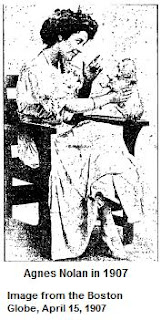
Agnes Nolan in 1907Agnes Nolan was one of 18 children of a Brookline letter carrier and his wife. Her father had his moment in the spotlight in 1905 when no less a figure than President Theodore Roosevelt intervened after John Nolan lost his post office job (and source of support for his large family).

But the real celebrities in the Brookline family were Agnes and three of her eight sisters, all of whom appeared on stage.

Agnes and her sisters Lola, Alice, and Grace were all members of the company of “Yankee Doodle Dandy” George M. Cohan—arguably the most popular entertainer of the period. Agnes' stage career was brief, but she made big news locally and nationally in 1907 when she and Cohan were married.

The marriage—his second and her first—was planned, fittingly enough, for the Fourth of July though it actually occurred on June 29th.

The Nolans of Brookline

John J. Nolan began working for the postal service in Brookline in 1875. He was reportedly the first to deliver mail directly to individual homes in town. (Prior to 1864 postage only paid for post office-to-post office delivery; home delivery began in the big cities and spread slowly to other communities after the Civil War.)

Nolan was also the one to lay out the routes Brookline letter carriers used when free home delivery finally reached town.

In 1899, however, Nolan was dismissed from the postal service for drunkenness. As his son-in-law, Boston American columnist George Holland later described it:

The appropriate figure of speech would be to say that he had crooked his elbow.

Perhaps we could blame it on the monotony of trudging up to the same front doors.

A swinging door was different. Off his route, John Nolan found swinging doors and they opened on a warming atmosphere where, for a time, one could relinquish the responsibilities that came with the largest family in New England.

116 Brooks StreetWhether or not it was the largest in New England, Nolan's family was certainly large. He and his wife Mary had 18 children (17 according to some accounts). Three died very young, but all of the others—with 29 years separating the oldest and youngest—lived with their parents in a succession of Brookline homes.

They were at 116 Brooks Street in 1900 and 38 Gorham Avenue in 1903. Later Brookline addresses for the parents included 149 Winthrop Road and 19 Green Street.

Nolan went to work in the coal business after his dismissal from the postal service, but his plight eventually came to the attention of U.S. Congressman Samuel Powers in whose district the Nolans lived. Powers brought the case to the attention of President Roosevelt in the White House, noting that:

It is claimed that the Department at the time of his discharge promised to reinstate him if his subsequent conduct should justify such action. The accompanying letters and certificates conclusively show that Nolan has been absolutely free from habits of intoxication ever since his discharge.

The congressman also enclosed a photo of the family, which he had advised Nolan to have taken, to show the president that Nolan "is not an adherent to any doctrine of race suicide."

(Roosevelt was said to be obsessed with the concept of "race suicide" a concern that English-speaking whites, through declining birth rates, were not keeping up with immigrants and other minorities. See Chapter VII, "Race Suicide," in Theodore Roosevelt and the Idea of Race by Thomas G. Dyer, LSU Press, 1992).
Nolan Family Portrait
In March 1905, Roosevelt issued an order reinstating Nolan to the postal service. According to Holland, the president telephoned the postmaster personally and Nolan was back on the job the next day.

The Nolan Daughters on Stage

By 1905, Lola, Agnes, and Alice Nolan, who began their performing careers under the stage name of the Merrill Sisters, were part of George M. Cohan's theater company.

Cohan has been called the father of the American musical comedy and "the man who owned Broadway." After beginning his career in vaudeville with his parents and sister, performing as The Four Cohans, he turned to the theater in 1901.

A writer, director, and performer, he produced more than 80 Broadway shows and wrote more than 1,500 songs over four decades.

Pamphlet Promoting Little Johnny JonesLola joined Cohan's company first. Agnes and Alice auditioned for the 1904 New York production of "Little Johnny Jones," Cohan's first Broadway hit. (It was the show that introduced such standards as "Yankee Doodle Boy" and "Give My Regards to Broadway.")

Cohan was reportedly smitten with Agnes' vitality—and the audacity she showed in asking for $25 a week for chorus work, more than the going rate. She and Alice were added to the company. (A fourth sister, Grace, later worked for Cohan as well.)

In February 1907, Cohan divorced his wife, the actress Ethel Levey. In April, it was announced that he and Agnes Nolan would be married on July 4th, Cohan's purported birthday. (Birth records show that he was born on July 3rd, but the "Yankee Doodle Boy" always claimed he was "born on the Fourth of July.")

In the end, the marriage took place a few days ahead of schedule, in Freehold, New Jersey, before a justice of the peace. As the New York Times reported on June 30, 1907:

An automobile accident last Monday detained the couple, who were taking a short trip, for several hours in Freehold, and during that time they decided to get married. They returned to Freehold yesterday and were married by the justice.

Agnes's sister Alice and Cohan's long-time partner, producer Sam Harris, were the only witnesses. Alice Nolan and Sam Harris would marry later that year, and the two couples would build adjacent homes in Great Neck on Long Island.

Agnes Cohan in 1921Agnes Cohan, conforming to the wishes of her husband and her parents, retired from the stage after her marriage. She and Cohan had a son and two daughters.

In 1942, Warner Brothers released Yankee Doodle Dandy, a musical biography of Cohan that won a Best Actor Oscar for James Cagney. Agnes Cohan was not a character in the movie. Cohan had stipulated that the film make no mention of his first wife Ethel Levey, and the filmmakers instead created a composite of the two wives to serve as Cohan's love interest in the picture.

The film was shown to the Cohans in a private screening. George was ill with cancer; he died in November of that year at age 64.

Agnes Cohan outlived her husband by nearly 30 years. She died September 10, 1972 at the age of 89. She had been living in Queens in obscurity and in poor health for 10 years. Neighbors told the New York Times she was devoted to television and had few visitors other than family. Most of the neighbors did not know who she was.

Times reporter Laurie Johnston described Agnes Cohan's funeral. About 60 people attended the service at Our Lady of Martyrs Catholic church in Queens in contrast, noted Johnston, to the thousands who filled the streets around St. Patrick's Cathedral in Manhattan for George Cohan's funeral.

"I wanted to see if there were any celebrities," whispered a woman in purple wool as she slid into a pew and dropped to her knees beside a friend [wrote Johnston]. She was to be disappointed.

A few years before Agnes Cohan's death, the musical biography George M. opened on Broadway. (Joel Grey, like Cagney before him, won a Best Actor award—a Tony—for his portrayal of Cohan.) Agnes Nolan Cohan, as well as Ethel Levey, were restored as characters in the play.

In a 1970 television version of the play, Agnes was played by Blythe Danner, better know to today's audiences, perhaps, as the mother of Gwynneth Paltrow.

Agnes Nolan's mother Mary died in 1921 and her father John in 1929. Several other members of the Nolan family, in addition to the four sisters, had careers or ties to the entertainment industry.
  • Alice Nolan Harris last appeared on stage in a Cohan revue in 1910. She died in 1930 at the age of 42.
  • Loretta (Lola) Nolan, who continued to use the stage name Lola Merrill, married the actor Frank Otto and appeared in an act with him for many years, often in Cohan and Harris productions. The last surviving of the many Nolan children, she died in 1974.
  • Grace Nolan Landy had a brief acting career. She died in 1938 at the age of 47.
  • John F. Nolan, the oldest son, worked in the Boston post office for 28 years before leaving in 1913 to manage the Cohan and Harris Theater in New York. He died in 1923.
  • Raymond Nolan (1893-1967) moved to California and was a still photographer for 20th Century Fox Studios for many years.
  • William Nolan (1892-1953) was an editor at the Douglas Fairbanks Studio and worked on several Fairbanks films including The Thief of Baghdad.
  • Dorothy Nolan Holland (1895-1971), the youngest child, married George Holland who was a playwright and longtime "Boston After Dark" columnist for the Boston American. They continued to live in Brookline.
  • Another brother, Matthew Nolan (1879-1955), also remained in Brookline. He was not in the entertainment business; he was a Brookline firefighter for 45 years before retiring as Acting Deputy Chief in 1947.
Five of the Nolan Sisters

Friday, June 26, 2009

Historical Society Website Wins Award

The website of the Brookline Historical Society has been named a first place winner in the New England Museum Association's 2009 Publication Awards Competition.

The site, designed and maintained by Historical Society volunteer Larry Barbaras, was the top choice of the judges among websites from museums with annual budgets under $250,000.

"The access to great content made this site a standout," said the judges in announcing the award. "The site succeeds because the quantity and quality of the content makes the site feel like a useful destination and encourages engagement. The judges appreciated the straightforward interface that encouraged browsing.

The New England Museum Association's annual Publication Awards Program recognizes excellence in design, production, and effective communication in all aspects of museum publishing. Entries are judged by a panel experienced in publication, design, marketing and communications. Awards are given to those entries which most effectively present their message to the intended audience.

The Brookline Historical Society is a non-profit community organization dedicated to the preservation and interpretation of Brookline's diverse history. The Society's website (http://www.brooklinehistoricalsociety.org) includes hundreds of historic photographs, maps, articles, program highlights, and information about Brookline's past.

Sunday, June 21, 2009

Brookline in the Flu Pandemic of 1918-19 (Part 2 of 2)

From the front page of the Brookline Townsman, October 5, 1918

When the influenza pandemic struck Brookline in the fall of 1918 it affected all aspects of life in town as officials and residents alike struggled to control its spread, to provide care for the ranks of the sick, and to maintain daily life with so many unable to fulfill their usual roles.

Last week, Part 1 of this two-part report looked at Camp Brooks, the open air hospital on Corey Hill where merchant seamen from Commonwealth Pier in Boston were treated. This second part looks at the impact of the pandemic on the town of Brookline in general.

Influenza in the Town of Brookline

Camp Brooks, the tent hospital established by the Massachusetts State Guard to treat some of the worst cases among the merchant seamen, did not serve Brookline townspeople. The camp was isolated from the town. Guardsmen patrolled all approaches, and no visitors were allowed.

Influenza nonetheless spread among the population of Brookline, as it did in communities throughout the state. The first local person to die from the disease, police officer George T. Driscoll, succumbed on September 10th, the day after the camp opened. He had been sick for two weeks, though his illness had not been reported as influenza at first.

The initial outbreak was met with caution but with confidence that it could be kept under control. "To one who is forewarned and prepared, there is no real cause for alarm," said the Brookline Chronicle on September 14th

For the individual, his or her course of action is simple [advised the paper]. Until it is evident that the epidemic has been checked or has run its course, it would be well to avoid crowds, to keep outdoors as much as possible, sleep with windows open, eat sanely and in general lay in just as large a stock of health as possible.

A week later, as it became clear how easily the disease could spread from person to person, debate over how to respond intensified and the paper's tone, while still optimistic, changed.

Whether the schools are kept open or are closed, whether or not the doors of moving picture houses and other places of assembly are shut, there will still be open other avenues of infection. We are in a state of siege and might as well accept it.

On September 24, as the number of deaths continued to rise, the schools were ordered closed, as were the town swimming pool and gymnasium. Shortly after, public gatherings of many kinds -- at churches, meeting halls, billiard parlors, bowling alleys and other places -- were banned. Public funerals could only be held with a permit from the town. A flier outlining how to avoid the disease was circulated to local households.

Health care facilities and medical personnel in town were soon overwhelmed. An emergency call for more doctors and nurses -- "to attend the many patients now suffering for want of the simplest care" -- was issued. There was concern, too, that with whole families afflicted people could not take care of their own. "When hundreds of families are affected at the same time, and this not in a single town but on all towns, we suddenly outgrow our social clothes, and then we suffer from exposure," reported the Chronicle.

The Brookline Friendly Society, a social service agency and the forerunner of today's Brookline Community Foundation, sprung into action. Volunteers cooked broth in a kitchen set up in the Society's headquarters at the corner of Walnut and High Streets. Other volunteers collected "custards, jellies, fresh eggs, and other dainties" made by people in their own homes. These, along with broth and milk, were distributed to needy families every afternoon. Forty-nine automobiles were made available to the Society by local residents to help with the distribution.

Only the sick people themselves can tell what a help this was [reported the Friendly Society in its 1918-19 Report], but the expressions of appreciation were many. Extra food was sent to families where the breadwinner was ill, and extra clothing, particularly underwear, was bought when it was necessary.

In early October, town officials began to quarantine homes where cases of influenza had been found. On October 12th, the Brookline Townsman reported that:

Agent Ward [of the Health Department] assisted by other municipal officials has quarantined several hundred homes in Brookline, placing a red card on the front and rear of every house containing persons suffering from the disease. In addition a white card has been placed on the door of each sickroom which prevents all but doctors and attendants entering. In order to enforce the quarantine authorities have power to station policemen outside the house or seize the buildings but so far such action has not been necessary here.

The number of people who were sick had an effect on all kinds of activities. (There were more than 2,600 cases reported between September 1918 and the end of the year, out of a population of 37,000, although the actual number was probably considerably higher). The police and fire departments, reported the Townsman, were crippled, and dozens of Town Hall and post office employees, as well as those of private businesses, were unable to report to work. The Chronicle urged residents to be patient:

If telephone service is poorer, if the street cars run less often, if only one clerk is behind the counter when there should be two or three, if any of the ordinary daily services that we look for as a matter of course are less well performed than usual, remember the numbers on the sick list and have patience with those remaining who are doing double duty.

Advertisements in the Brookline papers showed how local businesses tried to cope with the crisis, to reassure customers, and, perhaps, in some cases, to take advantage of the situation.


Advertisements, The Brookline Chronicle, September & October 1918

By mid-October the worst of the epidemic seemed to have passed in Brookline. The ban on public gatherings was lifted on the 19th. The schools re-opened on the 23rd. (They were closed an extra week in January, part of an extended Christmas break, as a precaution.)

There continued to be cases, and a few deaths, in November and December and in 1919, though it was uncertain whether later cases were part of the same deadly strain of the flu. Overall, it appears that between 125 and 150 people -- and maybe more -- died. (Precise numbers are hard to come by; some Brookline residents were hospitalized and died in other towns and were not counted in the Brookline numbers, while some who died in Brookline were not residents of the town.)

"That Brookline has suffered no worse may be due in part to the promptness with which the program of prevention was adopted," wrote the Chronicle on October 12th. "Most of these steps were taken here before they were taken in other communities, and they have proved their value."

Then, too, [continued the paper] Brookline has had the very great advantage that its 'congested' districts, its quarters of houses in which families are crowded beyond the minimum requirements of health, are comparatively slight. Although the epidemic, like the agents of Herod, spared no class or quarter, it is essentially a crowd disease, and where the congestion was the greatest its incidence was most heavy.

Such an epidemic as this tests our social institutions, shakes our confidence in their sufficiency. It tries out our organizations for the protection of public health, raises questions as to whether the work of doctor and nurse might not be as much of a public concern as that of soldier and firemen and whether they ought not to be frankly in public rather than in quasi-private service. And it also raises, or should raise, a question or two about public living conditions and housing.


A Flu by Any Other Name....
The deadly flu virus of 1918-19 was widely but inaccurately known as "the Spanish Influenza" and is still frequently referred to by that name today.

According to the book “Hunting the 1918 Flu” by Kirsty Duncan, the misnomer was the result of more reports of the flu coming out of Spain than other countries because Spain was neutral in the World War and did not have the press censorship that other European countries had. But the flu did not originate in Spain nor was it more prevalent there than elsewhere.

(There was also a widespread but untrue belief at the time that the virus had been spread by agents of Germany in the waning days of the First World War.)

Accounts from the period also frequently used the now archaic term "the grippe" or, less frequently, "the grip" in their reporting on the influenza pandemic.

Monday, June 15, 2009

Brookline in the Flu Pandemic of 1918-19 (Part 1 of 2)

The great flu pandemic of 1918-19 killed tens of millions of people worldwide, including an estimated 45,000 in Massachusetts and 675,000 in the United States. Its impact was felt everywhere, including in Brookline.

More than 125 residents of the town died. Schools were closed for four weeks right after the beginning of the school year. Homes of the afflicted were quarantined. Public gatherings at churches, meeting halls, soda fountains, billiard parlors, bowling alleys, and funerals were banned.

At the same time, quick reaction by local authorities was credited with limiting the impact more than in other communities. And at an open air hospital on Corey Hill, new methods of care were developed, methods that medical personnel then took to facilities elsewhere in the state and around the country.

This first of a two-part look at Brookline in the 1918-19 pandemic tells the story of Camp Brooks, the open air hospital on Summit Avenue. Erected literally overnight in September 1918, the camp became a focal point in Massachusetts' battle against the deadly disease.

Part 2 will look at the impact of the flu pandemic on the town of Brookline as a whole.

Camp Brooks and the Influenza Outbreak of 1918

Boston was one of the epicenters of the pandemic. After first appearing elsewhere in the spring of 1918, influenza erupted late that summer in more virulent form among merchant marine trainees in Boston Harbor. (There were major outbreaks around the same time in the port cities of Freetown, Sierra Leone and Brest, France.)

Noted surgeon William A. Brooks had opened the Brooks Hospital at the corner of Summit Avenue and Lancaster Terrace in 1915. At the time of the flu outbreak Brooks was both Surgeon-General of the Massachusetts State Guard and medical director of the recruiting service of the Shipping Board. He was called in to deal with the sick seamen.

I knew that the hospitals in Boston at that time were pretty well congested [he later wrote], and did not see how we could possibly place as many sick persons as we had.

Under Brooks' direction, the Brookline company of the Massachusetts Guard was called out on the afternoon of September 9, 1918 to erect a tent camp on the east side of Corey Hill between the Brooks Hospital and Corey Hill Park. Town Engineer Henry Varney and other town officials also pitched in. By just after midnight, the camp had been laid out, tents had been set up, sewage connections had been made, lights and water had been turned on, and the first patients had been admitted.

Researchers Richard A. Hobday and John W. Cason, writing about Camp Brooks in the May 2009 issue of the American Journal of Public Health, described conditions at the hospital:

The treatment at Camp Brooks Hospital took place outdoors, with “a maximum of sunshine and of fresh air day and night.” The medical officer in charge, Major Thomas F. Harrington, had studied the history of his patients and found that the worst cases of pneumonia came from the parts of ships that were most badly ventilated. In good weather, patients were taken out of their tents and put in the open. They were kept warm in their beds at night with hot-water bottles and extra blankets and were fed every few hours throughout the course of the fever. Anyone in contact with them had to wear an improvised facemask, which comprised five layers of gauze on a wire frame covering the nose and mouth. The frame was made out of an ordinary gravy strainer, shaped to fit the face of the wearer and to prevent the gauze filter from touching the nostrils or mouth. Nurses and orderlies were instructed to keep their hands away from the outside of the masks as much as possible. A superintendent made sure the masks were replaced every two hours, were properly sterilized, and contained fresh gauze.

Other measures to prevent infection included the wearing of gloves and gowns, including a head covering. Doctors, nurses, and orderlies had to wash their hands in disinfectant after contact with patients and before eating. The use of common drinking cups, towels, and other items was strictly forbidden. Patients’ dishes and utensils were kept separate and put in boiling water after each use. Pneumonia and meningitis patients used paper plates, drinking cups, and napkins; paper bags with gauze were pinned to pillowcases for sputum. Extensive use was made of mouthwash and gargle, and twice daily, the proprietary silver-based antimicrobial ointment Argyrol was applied to nasal mucous membranes to prevent ear infection.

Thirty-five of the 351 patients treated at the hospital died, a much lower rate, according to Brooks, than in indoor hospitals despite the fact that the open air hospital took in some of the worst cases. Only eight of the more than 150 doctors, nurses, aids, orderlies, and other workers at the camp developed influenza, and five of those were thought to have been exposed to it outside the camp.

The combination of fresh air, sunlight, and a "high standard of personal and environmental hygiene" employed by the Camp Brooks staff may have played a large part in their success compared to other hospitals, report Hobday and Cason. And, indeed, those same standards and plan of organization were adopted successfully elsewhere. "[A]s members of 'The Brooks Teaching Units,' these doctors, nurses, and aids have established military hospitals in eight other cities in our Commonwealth," reported the Boston Medical and Surgical Journal in December 1918. "The strict adherence of the members of these hospital personnel to these military orders contributed in very large part to the success of the undertaking."

The Camp Brooks tent hospital remained in place for a little more than a month, until the worst of the epidemic had passed in Boston. A year later, with support from throughout the state, Brooks established the Brooks Cubicle Hospital on Corey Hill to provide a more permanent facility to apply the same principles of treatment that had been used at Camp Brooks.

Further Information

The Influenza Pandemic 1918 (The American Experience, PBS)

Saturday, June 6, 2009

Dr. Lydia Clements and the Klondike Gold Rush

The Klondike gold rush of the 1890s must have attracted its share of odd characters, but there probably weren't many like Dr. Lydia R. Clements of Brookline.

Dr. Clements, a graduate of the Boston University School of Medicine and the wife of a prominent dentist in town, set out with a party of men and women in the spring of 1898 determined to make her fortune in the gold fields of the Klondike.

"She thinks the practice of medicine should be profitable in that section," reported the Boston Globe at the outset of her expedition (May 8, 1898), "but if it turns out there is not much demand for medical aid, then she will turn to whatever else will net her gold."

"She may, with other women," continued the Globe, "purchase a claim and hire men, or even attempt themselves, to work the claim."

All of the women and some of the men in her party left the expedition before reaching their goal, but Clements persevered and become one of the first white women -- possibly the first from the East -- to cross the Chilkoot Pass into the Klondike region.

She practiced medicine in the city of Dawson and staked out a number of claims, but returned to Brookline six months later having lost $10,000 yet determined to return.

When she did return, in 1900, the driving force was her association with the occult philosophy of Prof. Charles H. Mackay and his West Gate School of Philosophy in Boston. "He has succeeded in influencing this woman in his theory," reported the Globe at the outset of her second journey to the far north (July 1, 1900), "so that she is willing to risk her life and much of her husband's fortune to exploit the theory."

I have been criticized in some quarters of Boston for what was termed my mad adventure of 1898 [Clements said in the Globe]. The same people, and many of them are influential in scientific and literary circles, will receive me with open arms when I return for the second time from the land of the midnight sun.

Guided by what she called Mackay's "power of mind over mind," Clements established herself in the Nome district of Alaska inside the Arctic Circle where she was certain she would make her fortune.

I do not wish you to think that it is the greed for riches that is sending me north [said Clements]. I have a clearly defined and I think laudable object in taking what some of my friends term a reckless venture in search of gold. It is my intention should I, as I expect, be eminently successful in my present undertaking, with my wealth to found a school of philosophy to disseminate the views of Prof. Mackay. It may take a year, it may take two years, but I am thoroughly convinced I will return to Boston a very wealthy woman.

There is no indication that Clements did make her fortune or founded a school, but she did remain in Nome and elsewhere in Alaska for more than a decade, hiring men and mining tin and gold. She retained a Brookline residence at 11 Davis Avenue and travelled back and forth across the continent many times before returning to Brookline for good.

Lydia Clements died in Brookline in February 1927.

Further Reading

Monday, June 1, 2009

Brookline's Puzzling History

This Wednesday night at the Brookline Public Library, jigsaw puzzle historian Anne D. Williams will explore the story of jigsaws, including how residents of Brookline and the Boston area helped shape puzzle crazes from 1907 to 1910 and again during the Great Depression.

Williams is professor emerita of economics at Bates College. Will Shortz (NPR puzzle master and crossword editor of the New York Times) calls her “the world's foremost expert on jigsaw puzzles."

The program, part of the annual meeting of the Friends of the Brookline Library, begins at 7 pm at the main library at 361 Washington Street. More information.