Wednesday, May 19, 2021

Sealey's: New Images of an Old Business

Back in 2013, there was considerable attention in local media about the closing of a small Brookline restaurant named Sealey's Lunch on Cypress Street just south of Boylston Street. (It is now the location of Rifrullo Cafe.)

Stories in newspapers and on TV reported that the restaurant -- supposedly founded in 1914 as Sealey's Ice Cream by a man named Sealey -- was shutting down after 99 years in the same location.


I dug into the story and found that the business opened in 1936, not 1914, and that there was no Mr. Sealey. I found an ad and an article about the opening in the Brookline Citizen. I found the daughter of the original owner, who provided fascinating details and photos of her parents. I got additional information from the families of two later owners.

You can read all about it in my original 2014 blog post: The Real Scoop on Sealey's Ice Cream / Sealey's Lunch.

The Citizen article described the store this way: "The black and white motif of the booths and tables is followed throughout the shop and gives an air of cleanliness to the whole store".

But I had no images to share of what the original Sealey's Ice Cream looked like. Until now.


Photos by Don Booth, Courtesy of Steve Booth

In December, I was contacted by Steve Booth who found negatives of some photos taken by his late father, Don, and had digital images made from them. Among the photos were several labeled "Sealey's" and dated August 10, 1936 when Don Booth was 19. (That's just a few weeks after the opening of the ice cream shop.) Steve found my article, contacted me, and shared the photos shown here.

The image above shows two young employees behind the counter, with ice cream flavors listed on the wall behind them. A second photo shows these same two with an older couple, the owners of the shop, Lloyd and Rhoda Seaman.


The Seamans are easy to identify thanks to a photo of them, provided by their daughter, from Lloyd's days as a pilot.

A third photo shows an unidentified young man sitting in a booth in the new ice cream parlor.

.

The Seamans sold the store in 1937 and moved to the Panama Canal Zone where they continued to make and sell ice cream. But the name they gave to their shop remained, through multiple owners and 78 years. Read more about them and the long history of Sealey's -- including how it got its name -- in the original blog post.


Saturday, May 15, 2021

What's in a Name? Coolidge Corner

A few years ago there was a driver on the C branch of the MBTA Green Line who liked to embellish the names of the different stops as the train pulled into them. Kent Street became Clark Kent Street. Coolidge Corner became Calvin Coolidge Corner. And others that I can't remember. 


Now I doubt anyone thinks Kent Street was named for Superman's secret identity. But I'm sure many people -- maybe even that driver -- think Coolidge Corner was named for ex-president and one-time Massachusetts governor Calvin Coolidge. 


In fact, that mistaken assumption is most likely behind the not-so-secret identity of one of Brookline's newest buildings. It's an apartment building with retail on the ground floor at 420 Harvard Street, and it's called "The Calvin at Coolidge Corner." The name is prominently displayed on the Fuller Street entrance to the apartments. (Tatte Bakery & Cafe and other businesses are on the Harvard Street side.)

The Calvin at Coolidge Corner
The Calvin at Coolidge Corner, Fuller Street entrance

In fact, as many local people know, Coolidge Corner takes its name from the Coolidge & Brother store that opened at the intersection of Harvard and Beacon Streets in 1857 and was the only business in North Brookline for more than 30 years. (The Brookline Coolidges were distant cousins of Calvin, but the store -- and the name "Coolidge's corner" -- existed even before the future president was born.)

The Coolidge & Brother store stood at the corner of Beacon and Harvard Streets from 1857 to 1892. It was then moved slightly to the west and was torn town with the construction of the S.S. Pierce Building in 1898.

Coolidge & Brother, run by the brothers William and George Coolidge, was a general store selling farm supplies and groceries. It was a popular gathering place, with a watering trough and the town's hay scale outside.

Coolidge & Brother ads from 1868 (top left), 1875 (bottom left) and 1878 (right)

William Coolidge lived above the store with his wife and two children until his death in 1884. The store was then sold to Merrill Brown, who ran it under his own name until selling the business to the S.S. Pierce Company in 1892.


The name "Coolidge's corner" was most likely an informal one at first, a natural way to describe the intersection where there was little else beside the store. That began to change with the late 1880s transformation of Beacon Street from a 50-foot wide country lane to a grand boulevard more than three times the width of that old dirt road. 


Residential and commercial development followed, turning Coolidge's corner into a true neighborhood. The word "Corner" was first printed with a capital C in local newspapers in 1887. The name "Coolidge Corner" first appeared in an advertisement in 1891 and by 1893 was more commonly used than the older "Coolidge's Corner". (The old name did stick around for a while, making its last appearance in an ad in 1916.)


The advertisement at top from the Brookline Chronicle on September 12, 1891, was the first one in the the local newspaper to use the name "Coolidge Corner." The ad at bottom, from the same paper on September 16, 1916, was the last to use the old name "Coolidge's Corner."

The chances of "The Calvin at Coolidge Corner" changing its name to "The William & George" are about as likely as the name "Coolidge's Corner" -- or Calvin himself -- staging a comeback. But this story should at least set the record straight about the name for those who might otherwise be fooled.


For more on the history of the Coolidge Corner retail district, see my video and website, and watch for news of my Coolidge Corner walking tours, resuming soon.

Saturday, April 18, 2020

Crowdsourcing a 19th Century Brookline Diary

Would you like to help bring the story of a 19th century Brookline woman and her family to life?

About five years ago I photographed the 1851-1865 diary of Mary Johanna Wild at the John J. Burns Library at Boston College. Wild lived with her family in a Brookline house that she and her husband, Dr. Charles Wild, built in 1822. It still stands, on Weybridge Road near  the intersection of Washington and Greenough Streets.

Pages from Mary Wild diary
Pages from Mary Joanna Wild diary (click image for larger view)

The Wild house in 1868 and 2016
The Wild House, built in 1822, shown in 1868 (left) and after a 2016 renovation (right)
I started, but never quite completed, transcribing the diary, page-by-page. It was painstaking work, partly because the page images, shot with my iPad camera, were not very good. Some of them were pretty unreadable. Fortunately, the entire diary was digitized by Boston College in 2018 and is available in high resolution, zoomable images online.

Now, I'm asking for your help in bringing this project to fruition. Here is what you can do.
  • I will send each volunteer 1-3 pages of the diary at a time. I'll send you a copy of my transcription and instructions for viewing the handwritten pages online. 
  • Your task will be to read through the original diary pages, confirm or correct errors in my transcription, and fill in parts I was unable to transcribe or was uncertain about.
When it is completed, we will have a crowdsourced transcription of the diary that I will make publicly available online.

But this will be more than just a transcription. I've compiled annotations of the diary noting, among other things, details about the people Mary mentions, the places, events, and objects she describes, books she reads, and more. That will all be included in the final project.

For example, at the bottom of the very first page of the diary, on Saturday,  January 11, 1851, Mary writes: "I went to the musical Fund in the eve with C. Rhodes & Dr. Sen." Here is that entry from her diary and, below it, the program from that concert digitized from the collections of the New York Public Library. (The concert, featuring the Beethoven Pastorale, took place at the Tremont Temple on Tremont Street in Boston.)
Diary entry and program from the Boston Musical Fund Society concert, January 11, 1851

But it all starts with completing a good transcription.

Are you interested in contributing to this project? Let me know— email me at kliss@brooklinehistoricalsociety.org — and I will send you pages and detailed instructions.

- Ken


Thursday, April 2, 2020

Local History in the Time of COVID-19

Like most of us in this time of crisis, I'm working from home and maintaining social distance while worrying about myself, my family and friends, my community, the nation, and the world.

My day job keeps me plenty busy: I'm coordinating the Boston University Libraries support for remote teaching and learning. But as volunteer head of the Brookline Historical Society I haven't stopped engaging—mostly on the weekends—in the local history work I enjoy so much. It's good for my mental health, and I hope it provides some distraction, entertainment, and education for others.

Ken doing research in the kitchen
I've turned two of my neighborhood walking tours—Coolidge Corner and the Beaconsfield Terraces—into video tours you can watch on your computers or other devices. I'm hoping to develop virtual tours you can consult on your phones to learn more about different sites as you go for walks, one of the few external activities we can still enjoy.

I was interviewed last weekend by the Brookline Interactive Group about Brookline in the 1918-19 flu pandemic, which I wrote about back in 2009. (It will air soon on the Web and local cable TV.)

I'll be producing more of these videos and other ways of sharing local history (as time and energy allow). I hope to put together some online guides to doing local history research and other ways of helping others explore the history of our town.

The coronavirus crisis has delayed our usual Brookline Historical Society membership drive, but if you're a current or past member, please renew your membership. And if you're not a member but enjoy local history, please join us. (I confess it feels a little awkward to ask when we are all worried not just about our health but about our financial futures and those of local businesses, government services, and the more vulnerable among us and in society.)

Membership dues and donations provide essential support for our free educational programs, including lectures, open houses, and walking tours, and for the care and maintenance of our collections. As a member you will also receive the Society newsletter, advanced notice of events, and invitations to annual members-only presentations in historic homes and buildings.

Membership information is available on our website (along with historic photos, stories, research sources, and much more.)

In any case, I hope you can enjoy learning about the past even while worrying about the future and, most importantly, taking care of yourselves and others in the present.

Best,

Ken Liss
President, Brookline Historical Society

Sunday, September 29, 2019

Ghosts & Shadows of Automobile Row

If you missed my 9/15 conversation with WBUR’s Sharon Brody about Commonwealth Avenue’s Automobile Row in Boston and Brookline, the talk/slideshow is now available on the station's YouTube channel: https://www.youtube.com/watch?v=XYpoghQ1laU&t=1s

Ghosts & Shadows of Boston's (and Brookline's) Automobile Row

WBUR Talk & Fuller Building

Monday, May 27, 2019

Old Sprinkler Alarms in Brookline & Beyond

As with many of my projects, this one started with a question. I posted this image of a 1930s Brookline storefront (299 Harvard Street) to Twitter and Facebook in July 2018, and a follower asked:

What is the, uh, circle thing, that's on the right side of the building that's been there all along (and is still there today)?
Image from an advertisement for the Cafe de Paris. Brookline Chronicle, November 29, 1934
I found another image of the same location from the late 50s or early 60s, when it was the celebrated deli Jack and Marion's. There was the same round object.

Jack and Marion's
Then I went to the site — now the Gen Sou En Japanese tea house — for a closer look.

Gen Sou En 

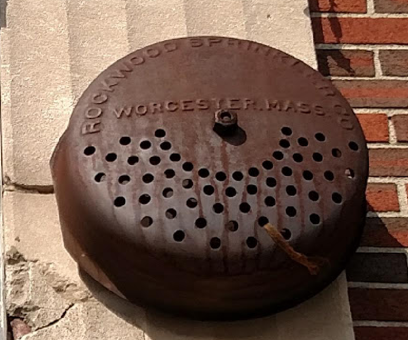
Seeing the object — on a column at the right side of the building — showed that my initial suspicion that it was some kind of an alarm was right. Imprinted around the top edge of the cast iron bell was the name of a Worcester-based company: Rockwood Sprinkler Co.   

Rockwood, founded in 1906, made fire protection sprinkler systems and alarm gongs designed to be set off whenever the sprinklers were activated.  Their Worcester plant is now an arts center called — what else? — The Sprinkler Factory.

Sprinkler alarms are nothing unusual. You'll see plenty of them, in Brookline and elsewhere. Most are solid steel discs, usually  painted red, sometimes with a light as well as a gong.

Modern sprinkler alarms
Modern sprinkler alarms in Brookline

But this was different. It was made of iron. It had a symmetrical pattern of holes, both decorative and designed to help spread the sound. It was an industrial artifact I had passed by thousands of times without noticing it. I was intrigued.

Then I started noticing more of them, of different designs, around town.

Cast iron sprinkler alarms in Brookline. Clockwise from top left: Centre Street Walk,, Coolidge Corner; 209 Harvard Street; 1615 Beacon Street; Durgin Garage, John Street side; 1583 Beacon Street; 17 Station Street.
It turned into a little bit of an obsession. I started looking for them elsewhere, in the Boston area and any other places I visited. I even had my wife pause a movie we were watching on TV when I spotted one on the wall of a building.

Now, almost a year later, I've launched a website featuring my virtual collection of cast iron sprinkler alarms. Take a look — it's at https://bit.ly/sprinkler-alarms — for more about these bits of industrial archaeology in Brookline and beyond.


Sunday, February 17, 2019

Booze on the Border? Brookline Says No

As Brookline's (and metro Boston's) first recreational marijuana dispensary gets closer to opening (see Brookline Patch and Wicked Local Brookline), Muddy River Musings looks back at another local battle over the sale of intoxicating substances.

It happened nearly a century and a quarter ago not far from the site, at the corner of Washington and Boylston Streets, where New England Treatment Access (NETA) is getting ready to add recreational sales to the medical marijuana dispensary it has operated since 2016.

The year was 1895 and the issue was a group of four saloons just over the Brookline border on Heath Street (now South Huntington Avenue) in Boston. Brookline was a dry town at the time, and had been since 1887 when Town Meeting voted 452-268 to ban the granting of licenses for the sale of intoxicating beverages.

The oldest of the disputed establishments, John Devine's tavern and dealership at 368 Heath Street (see the photo below) had been in business for 20 years. James Pendergast's saloon, at 380 Heath, had been around for 15 years. But the presence of these and other saloons so close to a town that had banned liquor sales a few years earlier clearly rankled the town's leaders.
John Devine's saloon
John Devine's saloon, 368 Heath Street, Boston. (Click for a larger view.) John Devine is presumably one of the men in ths undated photograph.  (Credit: Public Library of Brookline via Digital Commonwealth)
Maps of  Heath Street near the Brookline line, 1895
This segment from an 1895 Boston atlas shows the location of a group of taverns at the corner of Huntington Avenue and Heath Street. A Citgo station occupies the corner today with new residential buildings adjacent to it.
Charles H. Utley, who represented Brookline in the legislature, introduced a bill that would ban the granting of liquor licenses within a quarter of a mile of the border of a city or town that had prohibited liquor sales. Utley's measure was defeated, but locals pressed on with an appeal to Boston's Board of Police Commissioners, which oversaw the granting of licenses.

A parade of speakers — including the current and former chairs of the Board of Selectmen and the head of the School Committee — testified before the police board at a hearing in late April.

Newspaper headlines about Brookline's petition to Boston police commissioners
Brookline's petition to the Boston police commissioners for the removal of Heath Street saloons, as reported in the Boston Globe (top left), Brookline Chronicle (top right), and Boston Journal (bottom), April 1895
The speakers raised several objections to the presence of the taverns. They included concerns about their proximity to residential neighborhoods, about traffic, about disturbances by intoxicated patrons, about the cost of care for people made destitute by alcoholism, and about the impact on local property values. (One can hear echoes of some of these concerns in the protests against recreational marijuana shops, in Brookline and elsewhere.)

There was also an underlying, if unspoken, class and ethnic dimension to the protests. The Heath Street taverns were closest to the working class, largely Irish Brookline neighborhoods of The Farm and The Marsh north and south of lower Washington Street (Route 9). As Ronald Dale Karr points out in his 2018 book Between City and Country: Brookline, Massachusetts and the Origins of Suburbia, the arrival of the Irish had changed the emphasis of the local temperance movement "from exhorting individual abstinence to outlawing public drinking."

This was the focus of the local chapter of the Women's Christian Temperance Union, established in 1877. The existence of the taverns just over the border —as well as the existence of illegal rum shops in the Irish neighborhoods — presented a continuing challenge after the local liquor ban was enacted in 1885.

A week after the April 1895 hearing the police board handed down its verdict: the Heath Street saloons would have to go. (There was speculation at the time that the decision was made in part to circumvent a more far-reaching legislative mandate like the one that had been proposed by Brookline's Utley.)

The four tavern owners were granted time to find alternative locations further from the Brookline border. They would be allowed to keep their liquor licenses as long as they found other locations in which to operate.

In early November 1895, after a meeting between the liquor dealers, the Brookline men, and the police board, it was announced that November 9th would be the last day the taverns could operate on Heath Street. Two of the owners had found new locations in Roxbury and one in South Boston. The fourth was still looking for a site.

Boston Globe
November 10, 1895
The local newspaper, the Brookline Chronicle, treated the news as a victory for the town. The Boston Globe was more sympathetic to the tavern owners. In a November 10th article with the headline "Too Close to Brookline People," the Globe noted that

"The proprietors entered 'willingly' into the arrangement, it is stated at police headquarters, but in reality it was very reluctantly, because they had no other resource if they wanted to continue to sell liquor."

John Devine and his wife Annie, whose business is pictured in the  photo shown above, applied in December 1895 to have their liquor license transferred from 368 Heath Street to 80 Longwood Avenue.  The new location (now McGreevey Way) was a couple of blocks southeast of Huntington Avenue near the McCormick and Continental breweries.

It's not clear if the application was granted, but even if it was they were not on Longwood Avenue for long. In March 1896, the Devines (operating as John Devine & Co.) filed successfully for a license "to sell intoxicating liquors as Victuallers of the First Class and Wholesale Dealers of the Fourth Class" at 29 Eustis Street in Roxbury.

Public notice of John and Annie Devine's application for a license to operate a liquor business in Roxbury after being forced to move from Heath Street by objections from Brookline. (Boston Globe, March 28, 1896)

John Devine, however, did not live to long enough to see how well the business would do in its new location. He died in October 1896, less than a year after being forced to move his tavern from its longtime location just across the Muddy River from Brookline. His age was estimated at 62. The business continued under his wife Annie and a woman named Maria O'Brien.

As for Brookline, it continued to vote every year to maintain the ban on the selling of liquor within town boundaries (and, presumably, to oppose such establishments near its borders as well). The town did vote to go "wet" again in March 1920, but that vote was symbolic only; Prohibition had gone into effect nationally two months earlier.

It would be another 13 years until, with Prohibition winding down, Brookline's long liquor ban would come to an end. (See 1933: After 46 Years, Beer Back in Brookline for more on that story.)