Tuesday, November 23, 2010

"Brookline Biscuits" for Thanksgiving

Care to add a little local flavor to your Thanksgiving meal this year?  Try adding Brookline Biscuits to your holiday table as recommended by the Boston Cooking-School a century ago.
Brookline Biscuits as shown in the November 1907 Boston Cooking-School Magazine
Brookline Biscuits as shown in the Boston Cooking-School Magazine in 1907

The November 1907 issue of the Boston Cooking-School Magazine of Culinary Science and Domestic Economics provided Thanskgiving menus for five different settings.  "Brookline Biscuit" was included in two of the five: the "City Home" and "Country Home" Thanksgiving meals.
1907 Thanksgiving Menus with Brookline Biscuit
1907 Thanksgiving Menus (Click for larger view)

Most of the recipes for the menus were provided by the magazine's long-time editor Janet McKenzie Hill.  But the recipe for Brookline Biscuit was attributed to "C.J." This was most likely Charlotte J. Clark (née Wills), a teacher at the Boston Cooking-School and the former assistant to Fannie Farmer when Farmer was the school's principal. (Farmer had left to open her own school in 1902.)

It's not clear what, if any, connection Clark—or the biscuits—had to Brookline.  The recipe (uncredited to Clark) was used again in Janet McKenzie Hill's 1916 Nyal Cook Book ("Practical recipes that have been tested in actual use") published by the Detroit-based Nyal drugstore chain.

Nyal Cook Book cover

Here's the  recipe for Brookline Biscuit, as it appeared in 1907 and again nine years later. Give it a try, and let me know how it works out.

Have a pint of sifted flour in a bowl; into this rub two level tablespoonfuls of butter. Scald one cup of milk and when lukewarm add one-fourth a cake of compressed yeast, dissolved in one-fourth a cup of lukewarm water.  Stir this into the flour and set to rise overnight.

In the morning work in sufficient flour to make a dough and knead it until it is elastic and does not stick to the fingers. Let rise until very light, then take from the bowl to the bread board, without working, and roll out into a rectangular sheet longer than it is wide, and half an inch thick. Spread softened butter upon this and fold the dough evenly, to have three layers.

With a sharp knife, dipped in flour, cut the dough into strips three-fourths an inch wide. Take hold of a strip at the ends, pull gently to lengthen it, then twist the ends in opposite directions and form the shape of the figure eight, joining the two ends underneath. 

Place the biscuits in buttered pans so that they will not touch, and when light bake in a rather hot oven to a delicate brown.  The recipe makes two dozen biscuit.


Links

From "Feeding America" The Historic American Cookbook Project" at Michigan State University


Monday, November 15, 2010

Brookline and the Invention of the Safety Razor

King C. Gillette
King C. Gillette as he appeared in
John William Denehy's bicentennial
history of Brookline (1906)
On this date (November 15th) in 1904, King C. Gillette of Brookline was awarded a patent for a disposable safety razor. He had applied for the patent three years earlier, and first came up with the idea six years before that while shaving in his Brookline home.

Here's how Gillette recalled it in a February 1918 article in the company magazine The Gillette Blade:

I was living in Brookline at No. 2 Marion Terrace at the time [1895], and as I said before I was consumed with the thought of inventing something that people would use and throw away and buy again. On one particular morning when I started to shave I found my razor dull, and it was not only dull but it was beyond the point of successful stropping and it needed honing, for which it must be taken to a barber or to a cutler. As I stood there with the razor in my hand, my eyes resting on it as lightly as a bird settling down on its nest--the Gillette razor was born.

Years of experimentation failed to solve the technical difficulties involved in producing the kind of razor Gillette had in mind.  MIT-trained engineer William Nickerson came to the rescue, joining Gillette in 1901 and perfecting the manufacturing process.  (In the December 1918 issue of The Gillette Blade Nickerson described seeing an early version of Gillette's razor for the first time in the home of Henry Sachs on University Road in Brookline.)

Drawing of Razor for Patent Awarded to Gillette in 1904
Drawing for Patent 775,134 awarded to King C. Gillette in 1904

Sales took off in 1904, the year the patent was awarded, with 90,000 razors sold through the end of the year (according to the Dictionary of American Biography).  With the continued success of the Gillette Safety Razor Company, Gillette and his family moved in 1907 to a large home at 1566 Beacon Street, near Lancaster Terrace.  They lived there for only six years before moving to California in 1913.  King C. Gillette died in Los Angeles in 1932.
Gillette home at 1566 Beacon Street
This house at 1566 Beacon Street was the home of the King C. Gillette family from 1907 to 1913.  It was torn down in 1944.

Further Reading

Friday, October 8, 2010

Separating the Trash a Century Ago

In honor of the first week of single-stream recycling in Brookline, Muddy River Moments offers a look back at how residents of the town a hundred years ago had to separate their trash for pick up.

The following is from the town's health regulations of 1918:

Article III. Waste Material—Garbage
  • Section 1. All waste material set out for removal by the town shall be kept in separate receptacles.
  • Sec. 2. One or more of such receptacles shall be used exclusively for garbage or swill and shall be water-tight, have tight fitting covers, and be kept clean and free from deposits of garbage.  (An underground garbage receptacle is urgently recommended.)
  • Sec. 3. A second receptacle or receptacles, preferably made of iron, shall be used exclusively for ashes, tin cans, bottles, and other noncombustible waste.
  • Sec. 4. A third separate set of receptacles shall be used exclusively for dry combustible waste, such as paper, old shoes, house-sweepings, and other such waste material as it is customary for the town to remove.
  • Sec. 5. No person shall overhaul the contents of receptacles of waste material set upon the sidewalks to be removed by the town.
  • Sec. 6. No person shall throw upon the sidewalk, or into any public street or catch-basin, any paper, tin cans, house-sweepings, lawn-rakings, old shoes, orange peel, banana skin, dead animal, or other waste material.

Sunday, August 15, 2010

Brookline Origins of Skating Magazine

Kat Hasenauer Cornetta has an interesting article on BrooklinePatch about Theresa Weld Blanchard, who started Skating magazine, the official publication of the United States Figure Skating Association, in her Brookline home in 1923 and continued to be involved with it until her death in 1978.  ("National Skating Magazine Started in Brookline Home 87 Years Ago")

Friday, August 13, 2010

Presidents in Brookline: Benjamin Harrison

John F. Kennedy was born in Brookline.  Theodore Roosevelt was married here.  John Adams visited Brookline relatives in the town where his mother was born and raised.

How many U.S. presidents in all were in Brookline at some point in their lives?  I've identified seven nine, so far, though there may be more.  This is the first in an occasional series documenting the presence of these chief executives in town, before, during, or after their presidencies. (See this later post for more on presidents in Brookline.)

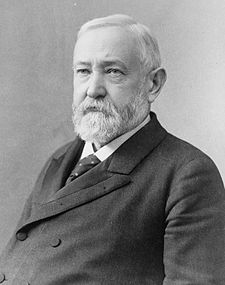
Benjamin Harrison
Benjamin Harrison
(Library of Congress)

The subject today is the 1889 visit of the 23rd president, Benjamin Harrison.

Harrison, a Republican, was elected in 1888 between the two terms of Grover Cleveland.  On August 7, 1889, Harrison arrived in Boston via train from New York as part of a weeklong New England sojourn.

In Boston, Harrison was greeted by admiring throngs, met with invited guests at the Hotel Vendome on Commonwealth Avenue, and attended a reception at Faneuil Hall. 

Late in the afternoon, the President and a large party, riding in carriages and accompanied by mounted officers, set out on a ride through Brighton and Brookline.  A large crowd, including local officials, gathered on Corey Hill awaiting the president.

At one point, a group of carriages was spotted moving east on Beacon Street, and much of the crowd descended the hill to greet Harrison, only to be disappointed.  It was, instead, a group of visiting furniture men returning to Boston from a ride to the Chestnut Hill Reservoir.

John W. Candler
Eventually, the presidential party, having made its way out Commonwealth and Brighton Avenues and Allston Street, reached the top of the hill from the Brighton side.

Congressman John W. Candler of Brookline joined Harrison in his carriage and the ride continued, down the hill to Beacon Street, and then via Park Street, Washington Street, Gardner Road, Tappan Street, Sumner Road, Walnut and Warren Streets to the Ignatius Sargent estate.

From the Sargent estate, the president and his party continued via Chestnut, Walnut, and Irving Streets to the home of Congressman Candler on High Street Hill.

"A bountiful spread here awaited the company," reported the Boston Globe, "during which the mounted escort had an opportunity to fodder up."
Congressman John W. Candler hosted a reception for the president and his party at his home at 99 High Street
Returning to their carriages, Harrison and his party made their way back to the Hotel Vendome by way of High Street, through Brookline Village and up Harvard Street to Commonwealth Avenue.  The next day, the president ended his whirlwind Boston visit, departing for Maine and the home of James G. Blaine, Harrison's Secretary of State and the 1884 Republican presidential nominee.

Sources
  • "Here-----Going.  Awfully Glad You Came; Goodby.  Harrison, Guest of City and State, Saluted by Cannon Upon Arrival. Receptions to Public and Officials. Driven Among Suburban Beauties. " Boston Globe, August 8, 1889, p. 1.
  • "The Chief Magistrate. President Harrison Visits Brookline and is Entertained by Congressman Candler." Brookline Chronicle, August 10, 1889, p. 252.
99 High Street
99 High Street Today
* 99 High Street photos courtesy of the Town of Brookline Preservation Office

    Thursday, August 5, 2010

    Respect for the Law?

    TAB reporter John Hilliard and his colleagues had fun this week putting some of the odder town bylaws to the test.  ("Exploring the banana peel bylaw (and more forbidden fun) in Brookline," August 5th).

    Hilliard and crew batted a ball near Town Hall, played cards at the curbside, even dropped a banana peel on the sidewalk (not to mention dressing up in a banana costume and lying down in the street). And they got away with it, despite the fact that all of these--well maybe not the banana costume--are forbidden under town law.

    But Hilliard and crew are hardly the first to be bemused by some of the no-nos on the books in Brookline.  Back in 1921, the celebrated Brookline-born poet Amy Lowell joined fellow townspeople to protest a range of bylaws they said couldn't and shouldn't be enforced.

    Amy Lowell article, Boston Globe
    Boston Globe, December 22, 1921
    Among the targets of Lowell and other protesters were laws or proposed laws against the following:
    • playing ball in the streets;
    • the drawing of sleds on public footpaths or sidewalks;
    • unrestricted use of velocipedes (bicycles) and roller skates;
    • the playing of musical instruments by anyone other than the member of a regularly organized band without a permit from the chief of police;
    • parking an automobile in any one place for more than 20 minutes;
    • horses traveling at more than eight miles per hour (at a time when automobiles were limited to 10 miles per hour);
    • the use of ungrammatical language by a driver in addressing a horse.
    "Are we going to allow this overregulation when it isn't necessary," said Lowell [as reported by the Boston Globe]. "Are we going to make all our children criminals when they are not criminals.  Are we going to be entirely officialized?"

    In the end some of the bylaws were modified, other were dropped, and others were let go with promises of lax enforcement, not so different, it seems, from today.

    Thursday, May 27, 2010

    Got Milk? Shhhh!

    Town Meeting last night gave Brookline police new powers to control "loud and unruly gatherings," with a measure aimed mostly at parties involving alcohol-fueled college students in rental housing in North Brookline. The new bylaw passed 183-3, capping the efforts of a group of North Brookline residents and their supporters calling themselves "Sleepless in Brookline."

    A little over a hundred years ago, bottled beverages were at the center of another effort to curtail noise in Brookline.  But the liquid culprit on that occasion was not alcohol, but. . .

     . . . Milk.

    Cartoon: The Milkman of Noiseless Town

    A group of citizens -- "the early-morning-sleep-loving fraternity" the Boston Daily Globe called them -- stated their objections to "the rattling of milk wagons over the cobblestones, the shouting from one to another of the milkmen, and the banging of back doors and the unnecessary clanging of milk bottles" (among other nuisances).

    On August 1, 1904, the Board of Health sent letters to every milk dealer who made deliveries in town, asking each

    to carefully inspect and, if necessary, alter his wagons with reference to preventing rattling and other loud noise, and also to instruct the drivers to drive slowly when near dwelling houses, to avoid cobblestone gutters, to handle the cans and bottles quietly, to refrain from shouting, and in all other ways to do their work without unnecessary noise.

    Selectman also heard concerns about the noisy gears of streetcars, the horns of automobiles, and the barking of dogs.  (Dog owners were told to keep their dogs from barking in the early morning which [said the Globe] "will leave the rooster the sole time-honored right to express his sentiments at such a time."

    The newspaper found all the commotion about noise fairly amusing.  The story ("Noise crusade begun by prominent men of Brookline. Milkmen requested not to disturb sleepers") ran on the front page of the August 5th edition with a lightly mocking cartoon ("Brookline, The Silent Suburb") at the top.  (Click on the page below for a larger view.)


    Boston Globe Front Page, August 5, 1904