Sunday, June 23, 2013

Turkey Trouble: 18th Century Style

Turkeys may be a nuisance in Brookline today, but it wasn't always that way.  The theft of 33 turkeys in the summer of 1742 prompted the following advertisement and promise of a reward in the August 2, 1742 edition of the Boston Evening-Post.

1742 ad offering reward for apprehension of thief who stole 33 turkeys in Brookline

Dr. Zabdiel Bolyston, who placed the ad, is famed as the man who introduced smallpox inoculation to America in 1721. His house still stands at 617 Boylston Street.  (The street is named after him.)

"Old Tenor," by the way, refers to paper money issued by Massachusetts prior to 1737. By 1742 these bills had lost considerable value.
The former home of Dr. Zabdiel Boylston on Boylston Street

Sunday, June 16, 2013

Yoo Hoo! Red Cab!

Spend a lot of time looking at old Brookline newspapers, like I do, and your eye will inevitably wander from the articles you're reading to the advertisements for local businesses. These ads, available as far back as the 1870s, paint a picture of the evolving commercial life that has long been a central part of Brookline's identity.

I've been collecting dozens of these ads, taken from newspaper microfilm and from town directories, and plan to feature them from time to time. I'll focus on a theme: a particular time period; a retail location; a category of business; or whatever catches my fancy.

First up, Red Cab and a wonderful series of ads that appeared in the paper beginning in the late 1930/early 1940s.

Red Cab ads from the 1939-1941

The design motif in these Brookline Chronicle ads from 1939-1941 was carried through in a frame used for changing ad messages in subsequent years.

More 1940s Red Cab ads

Here's an earlier Red Cab ad, from 1937, with another below with a similar design.

Red Cab ad, 1937

Red Cab ad: "Be Safe"

Red Cab, of course, is still around—and has even retained the -5000 part of their phone number—as seen in this image from the newer advertising medium of the Web.
Red Cab website image

Friday, May 17, 2013

Brookline Bikes: Sites to See on Beacon Street

The annual Brookline Bikes bicycle parade takes place this Sunday, May 19th.  It's a great event and an opportunity to ride the entire length of the historic Beacon Street boulevard in Brookline unimpeded by automobiles.

The Brookline Historical Society will have a table set up in Amory Park, the starting and ending point for the parade, with information about the development of Beacon Street.  Stop by before or after the ride and check it out.

Shown below are some of the architectural and historical sights you'll see as you ride down Beacon Street. (Photos of Beacon Street landmarks in the past can be viewed on the Brookline Historical Society Web site.)

Pelham Hall (Outbound, at Pleasant Street) Pelham Hall was built as a residential hotel in 1926 as part of a burst of new construction in and around Coolidge Corner.

S.S. Pierce Building (Outbound, at Harvard Street). The S.S. Pierce building, the symbol of Coolidge Corner if not of Brookline itself, was built from 1898-99 on the site of the original Coolidge Brothers store.

The second story of the Pierce Building, now offices, was originally Whitney Hall. Named for Beacon Street developer Henry Whitney, it was used for concerts, lectures, dances, meetings, and other events.  The original tower was taller.  Damaged in a 1944 hurricane, it was remodeled afterward to its current design.  The S.S. Pierce Company continued to occupy the lower floor until the 1960s and the building is still generally called the S.S. Pierce Building, even by residents who didn’t arrive in Brookline until much later.


MBTA Shelters (Both sides at Harvard Street) The tile-roofed shelters for the T, at Coolidge Corner, are the original structures built by Henry Whitney’s West End Railway in 1901. Remodeled a few years ago, they are the only original shelters that remain.

The Stoneholm (Outbound, between Short Street and Lancaster Terrace). The Stoneholm is a magnificent French Renaissance chateau style apartment building that opened in 1909 with such amenities as marble fireplaces, parquet floors, and crystal chandeliers. It was designed by Arthur Bowditch, who lived on Pill Hill.


Chinese Christian Church (Inbound, between Strathmore and Dean Roads). This neo-Gothic church was designed by Shepley, Rutan & Coolidge in 1910. Built for the Leyden Congregational Church, it was bought by the Chinese Christian Church of New England in 1975.


All Saints Church.  (Inbound, at Dean Road). All Saints Church, designed by the architectural firm of Cram, Wentworth, and Goodhue, replaced a temporary wooden church on the site with the completion of the nave in 1899.

The Beaconsfield Terraces (including Richter Terrace,  Inbound at Dean Road and Frances Terrace, Inbound at Tappan Street). 
The Beaconsfield Terraces were one of the more unusual developments to follow the widening of Beacon Street. Built by Eugene Knapp, a wool merchant, in the early 1890s, the terraces were an early condominium arrangement in which people owned their units but shared ownership of 6-acre park, stables, a playhouse (known as the casino), tennis courts, and a playground. A bell system connected the houses to the stables so that people could call for their horse and carriage. A central heating plant heated all of the buildings. Today, only the residence buildings remain.


Athans Building
 (Inbound at Washington Street). This commercial block was built in 1898 with stores, offices, and a hall for dances and concerts.


Richmond Court. (Inbound, east of St. Paul Street). 
Richmond Court was one of the firstpossibly the firstcourtyard apartment buildings in the country. Built in 1898, it is set back and separated from the noise and bustle of Beacon Street by an iron fence, brick and stone posts, a fountain, and private gardens. Richmond Court was designed by Ralph Adams Cram who went on to design All Saints Church, further out on Beacon Street, as well as the Cathedral of St. John the Divine in New York, and many buildings at West Point and Princeton University.


Temple Ohabei Shalom (Inbound at Kent Street). Temple Ohabei Shalom was the first Jewish congregation in Boston, formed in 1842 by immigrant German Jews. The congregation moved to Brookline and this domed temple in 1927.
Amory Park & Hall's Pond (Starting and ending point of parade). Until well into the 19th century, this was the Cedar Swamp. The Swamp and its marshy outflow were largely under-developed until after the Civil War. By stages, Cedar Swamp was filled in until all that remained was a one-acre pond called Swallow Pond that was used largely as a storm drainage pit for the surrounding area.

Today, after being acquired by the Town in 1975 and reborn as the Hall’s Pond Sanctuary, the pond area is what the Boston Globe has called “one of the Boston area's finest examples of green-space restoration,” home to migratory birds, turtles, and a variety of other wetlands wildlife, and “like a little patch of the Everglades in the middle of the city”.

Hall's Pond is named after the Hall Family that settled in the area around 1850 and lived on Ivy Street. Minna Hall, one of the last of the Hall family, was a cofounder of the Boston (later Massachusetts) Audubon Society and a great lover of birds and nature. A great concern of hers was that the pond and its environs be protected.

Monday, May 6, 2013

Remembering Brookline's Civil War Dead

Annual Meeting of the Brookline Historical Society
Remembering Brookline's Civil War Dead
Thursday, May 16, 2013 at 7 pm
American Legion / VFW Post, 386 Washington Street

Two years ago, as the town prepared to rededicate its restored 1884 memorial to 72 local men who died in the Civil War, I helped then Building Commissioner Mike Shephard, who was spearheading the effort, by providing some insight into some of the men whose names were chiseled into the marble of the memorial.

Mike chose to tell the story of Lieutenant Colonel Wilder Dwight whose poignant letter to his mother, written while he lay dying on the battlefield at Antietam, is in the collection of the Massachusetts Historical Society.

A month later, I wrote about Dwight and five other Brookline men who lost their lives serving the Union between 1861 and 1865. But it didn't stop there.

A segment of the design for the 1884 Brookline Civil War memorial
A few of the 72 men whose names appear on Brookline's 1884 Civil War Memorial

In the last two years, I've uncovered as much information as I could about all 72 of the soldiers and sailors listed on the memorial. For some, officers and members of prominent families like Wilder Dwight, it was easy. Photographs and correspondence have been preserved; accounts of their lives and deaths were written at the time and later.

But for other men—barely a handful of the 72 were officers and most were tradesman—it was a matter of piecing together details from regimental histories, remembrances of comrades, military and census records, and whatever I could find.

There was the young teamster who came to the U.S. as a toddler in 1832 from County Armagh, a member of the first Irish family to settle in Brookline.

There was the son of a slave-owning family, born in Texas, whose brother died while serving on the other side in the Confederate Army.

There was the 36-year old machinist whose mother received a letter of sympathy from Abraham Lincoln, one of the most famous—and controversial—writings of the 16th president.

There were the three young friends from Kingston, New Hampshire who came to Brookline together to enlist, went into the same artillery unit, were taken prisoner together, and died in the notorious Confederate prison at Andersonville, Georgia.

Please join me and the members of the Brookline Historical Society on May 16th as I share the stories of these men and some twenty more in this special Civil War Sesquicentennial event.  The program is free and open to the public.  Refreshments will be served.

Saturday, April 13, 2013

1933: After 46 Years, Beer Back in Brookline

On April 7, 1933 Prohibition came to a partial end in the United States with the passage of the Cullen-Harrison Act permitting the sale of 3.2 beer and light wine.  Two days later, the Brookline Board of Selectmen granted 31 licenses to sell or serve beer in town.

For the country as a whole it had been 13 years since the start of Prohibition. But in Brookline the action of the Selectmen brought to an end nearly half a century without alcoholic beverages being legally available.

Brookline had been a dry town since 1887, when Town Meeting voted 452-268 to ban the granting of licenses for the sale of intoxicating beverages. (The town voted to go "wet" again in March 1920, but that vote was symbolic only; Prohibition had gone into effect nationally two months earlier.)

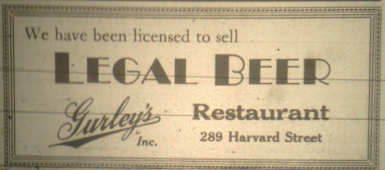
At least one local restaurant wasted no time: Gurley's Restaurant in Coolidge Corner (where Otto Pizza is today) advertised "legal beer" in the April 13 edition of the weekly Brookline Chronicle.

Chronicle ad for "Legal Beer" at Gurley's Restaurant, April 13, 1933
Gurley's Restaurant, where Otto Pizza is today, was one of the first to obtain a license when beer sales came back to Brookline after 46 years.

Beer sellers were notified that their licenses were only temporary until a town-wide referendum could be held to approve or reject the granting of licenses.  That came in June, with the "Yes" votes winning easily: 6,718 to 1,600.  Voters also chose, by an even more overwhelming majority, to send "wet" representatives to the Constitutional Convention voting on ratification of the 21st Amendment to the U.S. Constitution which would repeal Prohibition altogether.

There was one more vote on December 28, 1933, three weeks after the final repeal of Prohibition, on whether to allow sales of hard liquor and stronger beer and wine in Brookline.  That too was approved, although turnout was light.  Two days later, coincidentally, the Coolidge Corner Theatre opened its doors, bringing the movies to Brookline after a 20 year fight against allowing a theater in town.  Brookline was definitely loosening up.

Sunday, April 7, 2013

Cy Young & "Old-Timers' Night" in Brookline

On a June night in 1938 on Brookline Field a 71-year old man  wearing a fake beard and mustache took off his hat and coat and threw a ceremonial first pitch to start an old timers' baseball game.

The wind-up and delivery were familiar to many in attendance, as the septuagenarian hurler was none other than Cy Young, former star pitcher in Boston, Cleveland, and St. Louis and a recent inductee into the Baseball Hall of Fame.

Cy Young in 1939Young, reported the Brookline Chronicle,

went through the customary wind-up to the accompaniment of thundering applause and then let go the pitch to officially start the ball game. Before the diamond battle of the year got underway, however, "Old Cy" mounted the rubber and gave a demonstration of how he used to "burn 'em over" for which he was roundly applauded. 

[Cy Young, right, at the dedication of the Baseball Hall of Fame in Cooperstown in 1939, one year after his appearance at "Old-Timers' Night" in Brookline.]


Old-Timers' Night was an annual event in Brookline from 1936 to 1941, though only in 1938 was it graced by the presence of a figure as celebrated as Cy Young.  A handful of other former major league players took part, including Brookline-born Jack Kelleher who played parts of six seasons with four National League teams between 1912 and 1924.

For the most part, the game was a chance to bring back Brookline ballplayers of years past, from Brookline High School and from the many local clubs that competed with one another and with teams from other towns as much as a half-century before.

Brookline Chronicle article previewing 1939 Old-Timers' Night
The Brookline Chronicle's preview of the 1939 Old-Timers' Night included this picture of the old Brookline Marions team from 50 years earlier. (Click for larger view)
In addition to baseball, Old-Timers' Night typically included a parade of vintage vehicles that, according to the Chronicle,
would have done credit to a museum display, ranging from the aristocratic Beverly wagon down through the brougham, landau, surrey, brake, barouche, tally-ho, stagecoach and Irish jaunting car to the common hayrack and cart and including a "steamer" fire engine, a police ambulance and the once-familiar "Black Maria," also a fleet of tandem and single bicycles and high-wheelers and a group of "horseless carriages."

There were also men and women in vintage clothing, including

top-hatted gentlemen with ruffled and bustled ladies and helmeted guardians of the law and red-shirted fire laddies.

The parade, with local luminaries and marching bands, typically began at the Municipal Gymnasium near the High School and wound its way via Greenough, Washington, Cypress, Boylston, and High Streets and Highland and Jamaica Roads to Brookline Field (now Harry Downes Field) where the game was played.  Crowds estimated at 11,000 to 15,000 turned out each year to watch the events.

Old-Timers' Night in Brookline apparently came to an end with the entry of the United States into the Second World War.


NOTE: It's not clear why Cy Young wore a false beard and mustache on Old-Timers' Night.  It would not have been to make his presence a surprise, as his participation had been announced in the paper a week before. Perhaps it was simply a nod to the throwback spirit of the event, mimicking the more hirsute fashion of an earlier era.  If so, it would have been a nice bit of whimsy from a gentleman of 71 years.

Wednesday, April 3, 2013

Brookline's Town Seal: Adopted April 3, 1848


Town Seal of Brookline
165 years ago today, Brookline Town Meeting voted to accept the now ubiquitous Town Seal, picturing "a group of agricultural and farming implements, a view of the City of Boston in the distance, with a train of cars running between the two places" and bearing the inscription "Muddy River, a part of Boston. Founded 1630. Brookline incorporated 1705."

The design, according to a report from then Town Clerk Artemas Newall, was "intended to be emblematical of the character of the Town from its early settlement, when designated and known as Boston Cornfield & Boston Plantation, to the present time,— the inscription to perpetuate, in a degree, its early historical associations."

The symbolism, according to a report from the town Preservation Office, "asserts that Brookline was not just suburban but prosperously agrarian—a suitable home, perhaps, for the country gentleman."

The seal, engraved on steel, was executed for the town by Francis N. Mitchell of Boston at a cost of $56 which included 100 embossed impressions and a press to be used for copying.


See also this later blog post about one of the object pictured on the seal.