Sunday, January 21, 2024

A Beacon Street Oddity

There is an unusual building on the south side of Beacon Street, just across from the inbound Brandon Hall stop on the MBTA Green Line. It's not particularly noteworthy architecturally. In fact, part of what makes the building stick out is its lack of notable architecture.

1473-1475 Beacon Street today


The small, plain, single-story storefront (1473-1475 Beacon Street) is the only one-story building and only strictly commercial building on Beacon Street between the Coolidge Corner and Washington Square commercial districts. It does stick out literally, extending several feet further toward the street than its taller neighbors.

This nondescript building, currently occupied by the School is Cool Academy, a childcare center, may be easy to overlook today. But it certainly wasn't when it was built, in 1915. In fact, it caused quite the furor in Brookline at the time.

"First Blemish on Beacon Street" headline
Headline and image from an article in the Boston Transcript on May 26, 1915

"The building, jutting out from the others, like a sore thumb, not only completely destroys the symmetry of the street," reported the Boston Transcript, "but is regarded by competent real estate men as of serious effect on property values on either side."


"Nearly everybody who passed this spot by foot or by car," continued the paper, "has wondered how it was possible for the builder to work with such utter disregard for long-standing conditions and with such lack of respect for the dignity and beauty of one of the most excellent home sections of Brookline."
 

Streei view from the early 1920s
The building at 1473-1475 Beacon Street a few years afters its construction

The developer, H. Bertram Finer, had built several residential and commercial buildings in Brookline. When he bought this undeveloped property, a narrow alleyway between two of the apartment buildings, his intent was to construct a three-story apartment building. That would fit in well with the apartment buildings on either side of it, five to the east and two to the west, all built between 1897 and 1903. 


Restrictions imposed on the site by the town and the difficulty of building at the back, where the plot sloped toward todays' Griggs Park, led to a change of plans. 

1913 and 1919 maps
These maps, from 1913 and 1919, show the empty alley and then the new building at 1473-1475 sticking further out on the sidewalk than the other buildings in the block. (The two sides of Beacon Street are at the top of the map, with the black and white lines representing the streetcar tracks.)

Finer, as well as the Board of Selectman that had approved his new plan, came under attack from other Beacon Street property owners. 

Headlines: "Angry at the Selectmen" and "Finer Anxious to Sell"
Headlines in the Boston Transcript on May 31 (left) and June 4, 1915

Finer was surprised. 

"I have never been accused of erecting cheap buildings until the present time," he told the Boston Transcript. "I don't like the accusation. In erecting the one-story building I had no idea of outraging the feelings of the abutters or anybody else who thinks of the city beautiful. If there is any way I can wash my hands of the whole thing. I am anxious to do it."


But the building remained -- and remains today -- an anomaly in this otherwise residential stretch of Beacon Street. Early tenants -- there were two storefronts, later combined into one -- included a plumbing and heating contractor and an upholsterer/interior decorator. 

There were a number of food-related businesses in the 1920s and 1930s, including an unusual (for its time) restaurant called the Community Service Kitchen that offered home-delivery of hot meals in special containers. (That's an interesting story that I'll cover in a separate post next week.)

But for most of its history, the building has been home to rug stores. Brookline Oriental Rugs and, later, Fine Art Rugs occupied all or part of the space from the late 1920s to the early 2010s when it was taken over by the School is Cool childcare center. 

c1920 view
The Community Service Kitchen, an eat-in and delivery restaurant, c1920.

1930s view
The Brand Spa, an ice cream shop, delicatessen, and convenience store in the 1930s. 1473 and 1475 Beacon Street had been combined into one store by this time, but the original separate entrances are clearly visible at left and right.

1951 view
This image from a 1951 ad for the Brookline Oriental Rug Co. shows the then newly installed angled entrance that is still in place today.

2010 view
Fine Arts Rug as seen in Google Street View in 2010, shortly before the space was taken over by the School is Cool Academy

2024 view
School is Cool Academy in 2024


Thursday, January 4, 2024

Cats and Dogs (and Horses and Cows, Too)

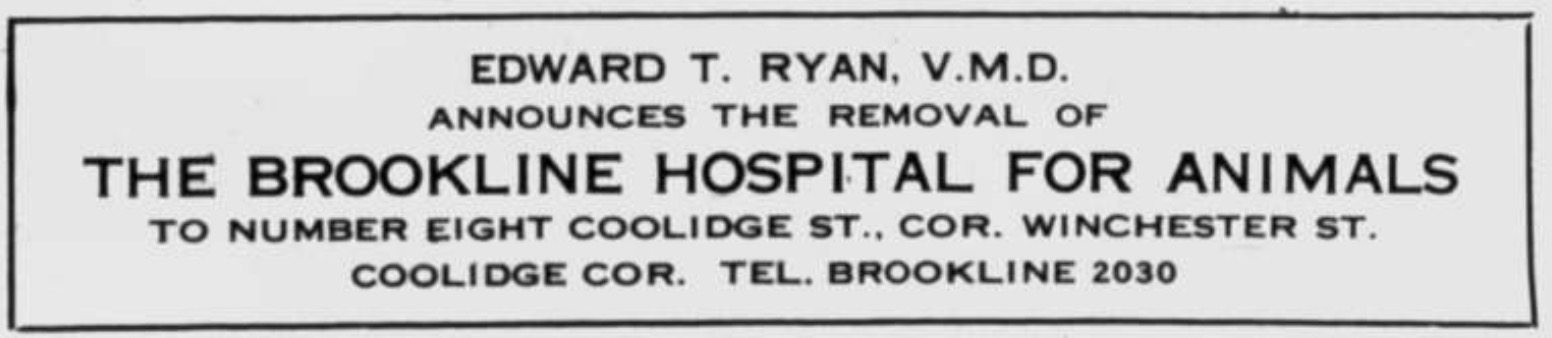
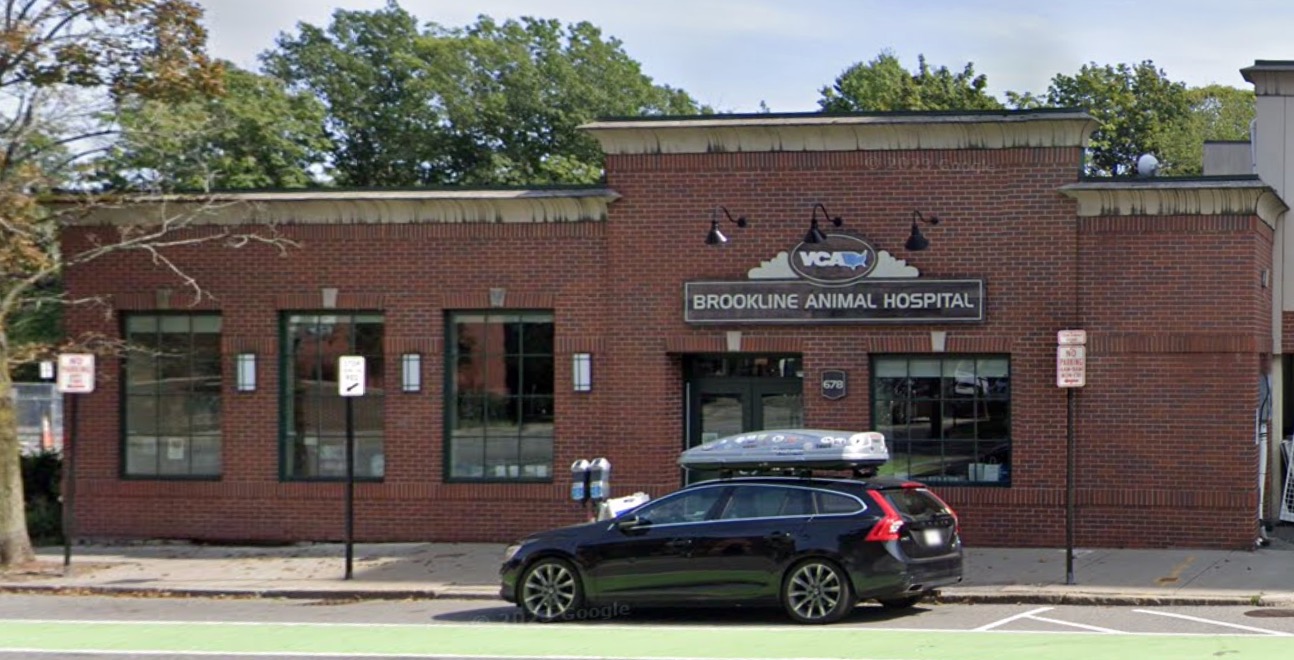
An early advertisement for what is now the VCA Brookline Animal Hospital

You might say 2023 went to the dogs in Brookline. And the cats and the gerbils and the guinea pigs and …. you name it.

Two new (to Brookline) veterinary clinics – Boston Veterinary and Small Door – opened branches in former retail spaces in Coolidge Corner; one at the corner of Beacon and Pleasant Streets and the other on Harvard Street next to Otto Pizza. 

But also on the move in 2023 was a veterinary clinic that's hardly a newcomer to town. It's the Brookline Animal Hospital, which began on Boylston Street in 1909, in the building that's now the restaurant La Morra.


46-48 Boylston Street in the 1980s. Vacant at the time the picture was taken, it had most recently been a restaurant called Open Sesame. The building has been La Morra since 2003

Brookline Animal Hospital's Beginnings

This ad announcing the new animal hospital appeared in the Brookline Chronicle on Christmas Day, 1909. The second address shown, 8 Boylston Street, was in a nearby stable where the vets apparently saw patients.

Articles in the Brookline Press and the Brookline Chronicle from the year the hospital opened provide a detailed description. The hospital, wrote the Press, "is not only a model of neatness, but one of the most commodious and finely equipped in this region."


"There are in the hospital private rooms for cats and dogs, and one large and roomy ward where there are five ways of caring for these animals."

In addition, continued the article,

"proper provisions have been made for all surgical operations and treatment of horses and cattle where conditions at the owners' premises are unfavorable. . . The runs, indoor and outdoor, for the exercise of animals are most complete."  


The veterinarians running the hospital were Edward T. Ryan and Jesse F. Humphreville, both graduates of the veterinary school at the University of Pennsylvania. Humphreville left to open his own practice in Waltham in 1916 or 1917, but Ryan -- and later his son Edward Jr. -- ran what was then called the  Brookline Hospital for Animals for 65 years, until the younger Ryan's death in 1974.

Edward T. Ryan, Sr. (1882-1946) and Edward T. Ryan, Jr. (1916-1974) in their yearbook photos from the University of Pennsylvania School of Veterinary Medicine

In 1913, the elder Ryan moved his hospital to a new commercial building, known as Chase's Block, at the corner of lower Washington Street and Pearl Street. He would remain there for eight years. 

Chase's Block under construction in 1912. The building was torn down in 2015 and replaced by a new multistory office building. It had been home in more recent years to such restaurants as Bertucci's, Skipjack's,  and New England Soup Kitchen.

The Move to Winchester and Coolidge Streets 

In 1919, Ryan and his wife, Julia, bought the house at 143 Winchester Street, at the corner of Coolidge Street, and an adjacent Coolidge Street carriage barn. In 1921 they moved the veterinary practice into the former carriage barn next to their new home.

143 Winchester Street today


Brookline Chronicle, October 1, 1921

During World War II, the older Ryan served as a supply officer stationed at Fort Devens and elsewhere. He became ill during that time and died in 1946. His son, Edward, earned his own degree in veterinary medicine in 1943 and took over the practice.


Edward Ryan, Jr., who was 27 when he got his veterinary license and succeeded his father, continued to run the hospital until his death in 1974.  He no longer lived in Brookline after his marriage in 1948, though his mother, Julia, continued to live in the house next to the hospital. A hospital employee lived there after her death in 1954.

Trouble with Neighbors

Ryan had trouble with the neighbors in the 1960s, facing complaints about "barking and vicious disposition of the dogs."  (The local newspaper found the whole kerfuffle amusing, with headlines like "Barks bite neighbors" and stories about neighbors' complaints being "muzzled" when not enough of them showed up at a hearing.)

This article about a hearing on the Brookline Hospital for Animals appeared in the Boston Globe in 1966.

In 1976, Dr. Rodney Poling, a veterinarian who had come to Boston for an internship at Angel Memorial Hospital, bought the practice from Edward Ryan, Jr.'s widow. Poling, who grew up on a cattle and hog farm in Ohio, received his Doctor of Veterinary Medicine degree from Ohio State University in 1973.


I spoke with Poling, now a vet in Texas. The hospital, he told me, had equipment in it from the Ryans' long tenure on the site, even including a horse stall and a cow stanchion in the basement. (A cow farm on Corey Hill had, at one time, been the Ryans' biggest customer, he said.)

1980 advertisement for the Brookline Animal Hospital

Four years after taking ownership of the hospital, Poling decided to move his growing practice, which he had renamed the Brookline Animal Hospital, to Boylston Street. His plans drew support from some neighbors but vehement opposition from others. Poling modified the plans and, in July 1981, bought the proposed site -- 370-376 Boylston, on the south side of the street -- for $200,000.


Further debate, downsizing of the original plans, and additional modifications continued for two years before Poling gave up and decided to move his practice elsewhere. "It was their contention that it would be a dirty, stinking place," Poling told the Brookline Chronicle Citizen. "I don't think they gave us a fair chance."


Ironically, the location the hospital moved to in 2023 is directly across Boylston Street from the location that Poling was prevented from moving to in the 1980s. (The building on Coolidge Street that had been the hospital was torn down and replaced by a new house. The adjacent house on Winchester Street, now a two-family home, remains.)

The Move to Brookline Avenue

In 1983, Poling purchased the former Back Bay Welding Co. building on Brookline Avenue, near the intersection with lower Washington Street. In March 1984, the hospital moved to its new quarters, where it would remain for 39 years.

The Brookline Animal Hospital in the building that was its home from 1984 to 2023.
"No more lunches on the x-ray table," reported the Chronicle Citizen, "no clambering through the darkroom to get to the bathroom, and hopefully fewer three-ring circuses in the now larger waiting room."

Dr. Rodney Poling in a 1986 ad for the hospital in the Brookline TAB. "Our goal is to show concern for both the animals and their owners," said Poling in the ad, "to use state of the art technology, without some of the impersonal style which sometimes accompanies it."

Poling sold the Brookline practice in the early 2000s and went on to open other veterinary practices in Massachusetts before moving, in 2021, to Texas, where he leads the Prairie Creek Animal Hospital in East Austin.

The Brookline Animal Hospital has been part of the VCA Animal Hospital network since 2007. (VCA also operates the Metro Cat Hospital in Washington Square.) 

Dr. Scott Groper, who started working under Poling in 1995 after earning his veterinary degree from the Tufts University School of Veterinary Medicine, is now the Brookline Animal Hospital's medical director. 


That's one more bit of continuity to a Brookline institution that has been taking care of local animals for more than a century.


Friday, December 15, 2023

250th Anniversary of the Boston Tea Party

The event that later came to be known as the Boston Tea Party took place 250 years ago tomorrow. There are special events marking the anniversary in Boston this weekend, including a reenactment tomorrow night.


I don't know of any Brookline men who took part in the Tea Party. But there's no doubt that Brookline people shared the fervor over policies regarding the importing of tea that culminated in the dumping of the tea in Boston Harbor.


In late November, a meeting of the town had resolved

"That this Town are ready to afford all the Assistance in our Power to the Town of Boston, and will heartily unite with them and the Other Towns in this Province to oppose and frustrate this most detestable and dangerous Tea Scheem and every other that shall Appear to us to be Subversive of the Rights and Liberties of America, and consequently dishonorably to the Crown and Dignity of our Sovereign Lord the King."


If that last phrase of obeisance to the King seemed to take a step back from outright rebellion, the last line made clear how angry the Brookline men were. It said they were resolved

"That hereafter whoever shall presume to import any Teas into this Province while subject to the Odius Duty Shall be considered and treated by this Town as an Enemy to his Country."


Seventeen months later, on April 19, 1775, Brookline men played an active role in the fighting that marked the start of the Revolutionary War.

Tuesday, December 12, 2023

1917: A Water Main Break (and a Flood of Details)

Since May of this year, I've been contributing a regular feature to Brookline News called Then....and Now. It compares old photos of different parts of Brookline with current photos, noting changes over time and offering a little bit of the history of the particular spot.

The latest of these -- you can check it out here -- features photos from a stretch of Boylston Street in 1917 and 2023. The change from then to now is dramatic. 


But a broader version of the 1917 image, from one of a group of photos documenting a water main break between Cameron Street and Cypress Street, has so many fascinating details that I thought I'd do a deeper dive into the scene.


Here is the broader photo, with different parts of it highlighted. 


It may be cliche to say that every picture tells a story, but there are so many little stories in this one photo that I couldn't resist.


Perhaps my favorite detail in this photo -- I've marked it #1 among the highlighted parts of the picture -- is an image of a man and woman watching the scene from a second floor window on Boylston Street. I even think I know who they are.


This and other details spilling out of this one photo call for a bigger format than my usual blog posts, so I've put them in a separate site. 


Check it at https://bit.ly/1917watermain or click on the headlines below for the whole tale.


Tuesday, October 31, 2023

What's in a Name? Zanthus Street

Some of my favorite Brookline research projects originate when someone asks me a question that I don't know the answer to. One recent example was a question about the origin of the name Zanthus Road for a small South Brookline street.


Zanthus Road is one of the shortest streets in town. It runs from Wallis Road to Beverly Road and the back of the ball field at the Baker School Playground.

Aerial view of Zanthus Road (outlined in red) via Google Maps (Click for larger view)

 The person who asked had studied ancient Greek language in college and knew that Zanthus -- usually written in English as Xanthus -- was the gods' name for a river at Troy and also the name of one of Achilles' horses in Homer's Iliad

(Wikipedia says it was also the name of other horses and places, various species of snails and moths, and several actual and mythologic people.)

So how did this classical name end up applied to a street in Brookline? The surprising answer can be traced to a much more modern Xanthus, one who lived in Brookline in the late 19th and early 20th centuries.

The map below is part of a 1927 street atlas of Brookline. The location of Zanthus Road -- which would not be laid out until eight years later -- is marked with a blue circle. Beverly Road comes in from the upper left and stops at the large Whipple property. Wallis Road comes up from the lower right and stops  southeast of the Whipple land. (The dashed lines are planned or proposed new roads.)
Click map for larger view

On the right side are largely undeveloped properties owned by three brothers: Benjamin Franklin Goodnough (known as Frank); Randall Goodnough; and X.H. Goodnough.

X.H., it turns out, is Xanthus Henry Goodnough Jr, named after the father of the three brothers. 

The earlier map shown below, from 1874, shows the land of Xanthus Sr. and his brother George. (A third brother was named Xenephon, so the parents clearly liked ancient Greek names.) Xanthus died in 1905 and his land passed to his three sons. George died in 1907; he had no children, and his land was sold to Sherman Whipple.

Click map for larger view

Zanthus Road was laid out in 1935. That is also the year the second Xanthus Goodnough died. (He had moved to Boston well before that.) The first mention of the road was in February 1935, and Xanthus died in August, so it is not clear if the road, with the spelling variant, was named after him or after his father, or both. (It was on the Whipple land, but so close to Frank Goodnough's property.) 

And that, apparently, is how an ancient Greek name came to be applied to a 20th century Brookline street.

Contemporary street view (Click for larger view)

Contemporary aerial view (Click for larger view)

Street signs for Zanthus Road and Beverly Road with the Baker School Playground on the right
Street signs for Zanthus Road and Wallis Road


Monday, September 4, 2023

Labor Day in Brookline, 1887-1888

Labor Day became a Federal holiday in 1894 when President Grover Cleveland signed a bill making it official, but Brookline had been celebrating since 1887 when Massachusetts was one of four states to make it a state holiday. (That was one year after Oregon became the first.)

Boston Transcript, September 6, 1887

Members of the Brookline local of the Carpenters and Joiners Union took part in the 1887 parade in Boston. The local paper, the Brookline Chronicle, expressed concern, however, about the viability of the new holiday, given that working people would have to give up a day's pay to participate in the activities.

"Too many workmen cannot afford it," wrote the paper. "They already feel the loss of a day's pay, and many of them are inwardly resolving that it will be several years before they turn out again. There is danger, therefore, that the day will be thrown away by actual workingmen, to be picked up by demagogues who earn their bread by the sweat of the jaw...And in that way Labor Day is in great danger of being transformed into Politician's Day."


Despite those fears, Labor Day grew in popularity both locally and nationally. One year later, the Carpenters and Joiners Union held Brookline's first Labor Day parade.

"This organization [reported the Chronicle] turned out with forty-five men, under command of James W. Boyd, and with a police escort marched through the principal streets of the town. Music was furnished by Highland pipers. Afterward the union went to Boston and took part in the great labor parade."


This Boston Globe illustration shows the 1888 Labor Day parade in downtown Boston in which Brookline union members took part.

Brookline did not continue to have its own parade for long, but local union members continued to participate and take leadership roles in the Boston parades in subsequent years. 

Tuesday, July 4, 2023

1919: A "Safe and Sane" Fourth of July

Independence Day 1919 came eight months after the end of fighting in the World War and just six days after the official signing of the Treaty of Versailles. That sequence of events, said the Brookline Chronicle, "has made this day doubly significant and will probably be observed most enthusiastically."

1919 fireworks advertisement
This advertisement appeared in the Brookline Chronicle on June 28, 1919

At the same time, the paper offered advice on keeping the celebration "safe and sane."

"While it is laudable that this day should be observed fully," continued the paper, "it is particularly important that it should be observed sanely. Noise is not an evidence of patriotism nor fireworks of allegiance; and the communities where the day is observed by parades, games, public speaking, etc. rather than by fireworks and noise, will probably at the end of the day be the happier communities."


The Chronicle carried a long list of regulations governing fireworks. These included prohibitions against sales to children under 13 and against setting off certain fireworks on public streets or within 300 feet of a hospital. There were also regulations governing the size of various fireworks and proximity to spectators, as well as the hours they could be set off.

"Those persons who feel that fireworks are necessary on that day should use the utmost care in the handling of them," continued the Chronicle, "to the end that neither life nor property shall be destroyed and that this day which should be one of rejoicing is not marred and homes made desolate because of accidents and fires resulting from the use thereof."


In the end, a day full of official events -- as well as fireworks --  went off without incident. 

Schedule of events
Brookline Townsman, June 28, 1919

Headline: Brookline Had Safe and Sane But Noisy Fourth
Brookline Townsman, July 12, 1919

Here's to a safe and sane Fourth of July 2023.