Showing posts with label Advertising. Show all posts

Wednesday, September 11, 2024

Amateur Photography in 19th Century Brookline

The May 6, 1882 edition of the Brookline Chronicle included a list of 33 books recently added to the collection at the Brookline Library. There were books of history, fiction, science, and travel. 


There were some how-to books, including two guides for would-be painters: A Course of Lessons in Landscape Painting in Oils and Easy Studies in Water-Color Painting.


There was also a how-to book on a relatively new and increasingly popular art form: photography.

How to Make Pictures: Easy Lessons for the Amateur Photographer by Henry Clay Price

"A Sensible Craze"

"Anyone who has undertaken to be his own photographer will tell you there is a great infatuation about it," noted a review of the book in another newspaper. 


"Hence it may be termed a craze," continued the review. "It is also a high art to be able to catch and preserve any little scene of beauty that one may chance to meet with on his summer vacation. Any true art is sensible, therefore amateur photography is a sensible craze."


A year later, the Brookline Chronicle reprinted a lengthy article on "Amateur Photography" from the New York paper The Hour. "The amusement and services that may be had at the cost of a small, cheap photographic outfit are almost numberless," it said.

"Expression, which is the life of a portrait, cannot always be assumed to order in a studio, except by persons whose features are under unusual control, while children's pictures are generally of the variety known as 'wooden.' 


"But at home every expression of countenance may be seen and caught. Poses that do not come willingly amid unfamiliar surroundings and before strange observers, succeed each other rapidly in the unrestraining atmosphere of the family circle." 


Technical Innovation and the Boston Camera Club

The growth of amateur photography was spurred by the technical innovations of George Eastman and Henry Strong in Rochester, NY, beginning with dry emulsion glass plates in 1880. Camera clubs and photographic societies, taking advantage of the new, less complicated method of developing photos, sprung up across the country, including in Boston.


The Boston Society of Amateur Photographers was formed in 1881. Five years later, the name was changed to the Boston Camera Club.

The Photographic Times and American Photographer: Boston Society of Amateur Photographers
Click on image for larger view

Among the early members of the club were several Brookline men, including James Codman (one of the founders), William Hovey, George E. Cabot, John Hubbard, Robert Amory, Percival Lowell, and Edward Philbrick.

This 1886 photo of Cora Codman, age 12, may have been taken by her father, James, one of the founders of the Boston Camera Club. It is one of more than 40 photos of Brookline and Boston children in an album in the collection of the Brookline Historical Society.

The Boston Camera Club is the second-oldest continuously extant amateur camera club in the United States. Headquartered in Boston for most of its existence, it was based in Brookline from 1980 to 2023 before returning to Boston.


The Kodak Camera and the Brookline Camera Club


The next big innovation from Eastman in Rochester -- the Kodak camera -- had a big impact on the growth of amateur photography, including in Brookline. . 

"Anybody can take pictures with this instrument without practice.
Kodak advertisement, Rochester, NY, August 1888

The Kodak did away with glass plates altogether. The photographer could shoot multiple images without reloading, then send the film to Rochester to be developed, with the finished images shipped back to the sender when they were done.

In 1891, the Brookline Chronicle ran an article about effective advertising, reprinted from the Milwaukee Journal. One of the most effective ad slogans the article cited was Kodal's "You press the button, we do the rest."

"The Kodak: You Press the Button. We Do The Rest"
1889 Kodak advertisement

In October 1889, it was announced in the Chronicle that a meeting would be held to form a Brookline Camera Club.

"It is desired that all interested in this most fascinating art be present. The object of the club is for social intercourse and the interchange of views, and there are a sufficient number of photographers here to make it a success."


"Amateurs of both sexes are invited," reported the Brookline Chronicle, adding that "the club's constitution provides that "two of the members of the executive committee shall be ladies."  The club was also looking into setting up a darkroom and studio for its members. The club held exhibitions, discussions, and other events in town.


C.A. Chandler, who wrote about photography for the Boston Globe, had noted the creation of the Brookline club in his column.  But he was not a fan of amateur photography.


"'Amateur' in its original meaning," he wrote, "is 'a lover of,' and as applied to photography would convey that the man to whom it was applied was an enthusiastic lover of, and consequently a skilled adept in, the art.


"Now," he continued, "the meaning is degraded, and the man who buys a detective [a generic name for some 1880s box cameras], presses the button, and sends his paper or plates to be developed and printed from, is an amateur. He knows no more of the art than does the organ-blower [the person who pumped the air into pre-electric pipe organs] know of music."

 
Chandler's criticism notwithstanding, amateur photography continued to grow in popularity with men and women, young and old, including in Brookline, even as professionals came to town.

"The camera craze has secured a good hold on the Brookline boys."
Brookline Chronicle brief, January 4, 1890

Next up: Professional photographers in Brookline into the 20th century. See also the first article in this series: Brookline Photographers: The Early Years.


Thursday, September 5, 2024

Brookline Photographers: The Early Years

In the early days of photography, Brookline people who wanted to have their picture taken traveled into Boston. For example, Mary Wild, in an 1856 entry in her diary, described going with her daughter Laura to have daguerreotypes taken at the studio of J.A. Whipple on Washington Street.

"Whipple's Daguerreotypes...Better Miniatures in Less Time"
This advertisement for John A. Whipple's daguerreotypes was in the Boston Directory published in 1848, eight years before Mary Wild and her daughter had their pictures taken there. (Click image for larger view.)

By the 1870s, Boston photographers were advertising their services to Brookline's growing population in town directories. 

1870s ads for photographers D.K. Presscott, A.C. Partridge, E.B. Dunshee, and George S. Bryant

Cambridge photographers got in on the act as well. In 1887, H. William Tupper, "manager and photographer" at Pach's Studio near Harvard Square, advertised his services in the Brookline Blue Book, an annual directory, noting that his studio was "just a short ride in the horsecar" from Brookline.

We wish to inform the people of this vicinity that it is no longer necessary to go to Boston for their Photographs as a short ride in the horse cars will bring them to the door of Pach's Studio...Where work equal to that made in the best studios in Boston, is guaranteed. There are no stairs to climb, a fact that mothers and elderly people will appreciate.

Boston-area photographers also came to Brookline to take or to show pictures. The famed photographer J.W. Black -- he had taken photographs before the Civil War of John Brown and Walt Whitman as well as the first aerial photograph in the United States -- had come to town in 1872 to present a display of stereopticon images at Town Hall. 

In 1882, a photographer named F.J. Aiken had set up temporarily in town, offering to take photos of local people.

F. J. Allen, photographer, High street, will remain in town but a few days longer, and those in want of good pictures should call early.
This notice appeared in the Brookline Chronicle on October 7, 1882. Seven weeks later, the paper noted that "The daguerreotype saloon on High street has been pronounced a nuisance and its removal ordered." This was presumably Aiken's operation, though there is no further information available.


First Brookline Photo Studio

Finally, in May 1888 a short item in the Brookline Chronicle announced that the town would soon have its own photo studio.

"Mr. W.H. Partridge, the well known photographer...will soon erect a studio on Harvard street opposite the Baptist church. Mr. Partridge is one of the foremost artists in the country and he will doubtless be liberally patronized by the residents of this town."

Partridge's studio on Harvard Street is highlighted on this portion of an 1893 map
William H. Partridge was born in Virginia in 1858, in a part of the state that became West Virginia during the Civil War.  The family moved to Massachusetts, where William's father, Asa, became a photographer. (He is one of the Boston photographers whose 1870s advertisements in Brookline are shown above)

William, with his older brother Edward and later on his own, continued in the photo business in Boston after their father moved to California. "Mr. Partridge's work stands second to none in the country," wrote the Chronicle in September, noting that the studio

"is supplied with the best apparatus and a large variety of desirable accessories. Every kind of photographic work will be artistically executed, from the smallest locket picture to a life-size portrait. If desired, pictures will be taken at residences."
Everything photographic can be had at PARTRIDGE'S STUDIOS, where the utmost care is used in finishing. Under the personal care of W. H. PARTRIDGE.
Partridge ad in the 1889 Brookline directory

Partridge hired others to manage the Brookline branch of his business, starting with a woman named A.E. Perkins who, according to the Chronicle, "has had an extended experience with leading photographers in Massachusetts, and has been very successful with children's pictures."

Enter A.T. Barraud

In 1890, Partridge hired a Canadian landscape and marine painter and photographer named Alfred Thomas Barraud to manage the Brookline studio. (Barraud's father, Francis, was an English painter best known for the 1898 painting His Master's Voice which was used as the longtime symbol of the Victor Talking Machine Company, later RCA Victor.) 

A.T. Barraud would remain in charge of the Brookline studio for more than 30 years, until his death in 1925. 

Alfred and Catherine Barraud, Boston Globe, July 25, 1922

The April 1906 issue of Wilson's Photographic Magazine featured six photos of children taken by Barraud at the Partridge studio in Brookline. (Two of the photos are below. See larger versions of all of the photos here.)

The 1880s were also a significant decade for the growth of amateur photography in Brookline (and elsewhere). That aspect of local photographic history will be the subject of my next post.

Thursday, August 22, 2024

I Scream, You Scream, We All Scream for Ice Cream!

I'm always going down rabbit holes, never knowing where any one thread of Brookline history is going to take me. 

My latest expedition began with a recent article by Celeste Alcalay in Brookline News about Jamie's Ice Cream Co., a small business that was added to the Brothers & Sisters café on Station Street in 2022. 

Jamie's Ice Cream on Station Street
Brookline News photo by Molly Potter.

I'd done some digging into Brookline's ice cream history before, after the 2013 closing of Sealey's Lunch, which began as Sealey's Ice Cream on Cypress Street in 1936. You can read about that in my original post and a later follow up.


But little did I know how long, rich, and flavorful was the history of ice cream in town.


Ice Cream of All Sorts and Flavors


As early as 1870, ice cream was for sale in the "new dining rooms" at J. Anson Guild's Guild Block at the intersection of Washington and Boylston Streets. (The building was later replaced by the Brookline Bank building, now the NETA marijuana dispensary.)

The Guild Block, left in an 1872 photo, and an 1870 Brookline Transcript advertisement featuring ice cream at one of the businesses in the block. (Click image for larger view.)

Five years later, George Perkins advertised his "dining & ice cream rooms" with "ice cream constantly on hand" in the new Colonnade Block between Station Street and Andem Place.

The first two buildings of the Colonnade Block, still standing today, are shown in the 1874 photograph at left. The third building, where the Brookline Village Post Office is today, was built in 1875, the year the advertisement at right appeared in the Brookline Chronicle. (Click image for larger view.)

The bill of fare at the café, wrote the Boston Globe in October 1875, "is served in a manner that would put some of our first-class cafés all in the shade."

"Mr. Perkins," said the paper, "will continue to cater for private parties as usual, and the parties can be supplied with ice cream of all sorts and flavors, in large and small quantities, at short notice."


Other Brookline businesses -- including restaurants and retail food shops -- also included ice cream in their offerings in subsequent decades. 

Advertisements for ice cream in Brookline, 1880s to 1920s
(Click image for larger view.)

The "Quick-Freeze" and A New Ice Cream Era

But the real boom in ice cream -- not just in Brookline, but everywhere -- came in the 1930s, spurred by a new, faster, cheaper, more consistent ice cream making process.  (Clarence Vogt's patent for "An Apparatus for Manufacturing Ice Cream and the Like" was awarded in October 1929.)

In May 1931, the H.P Hood & Sons creamery announced that their first store using Vogt's new "quick-freeze" process would be opened in Coolidge Corner. "Quick-freezing," reported the Brookline Chronicle

"has wrought marvels in preserving the natural flavor and texture of several staple food products and applied to the manufacture of ice cream it has brought astonishing results in the improvement of quality by giving greater smoothness and richness."


The H.P Hood store at 1300 Beacon Street is shown here in 1936, four years after it opened. The space is now occupied by Coolidge Coolidge Corner Wines & Liquors
In the spring of 1932, another new business, "presenting for the first time [according to the Chronicle] a new idea in the field of merchandising ice cream," opened at 326 Harvard Street.

Named simply the Ice Cream Shop, it was the first in Brookline to sell only ice cream. (Hood's sold all kinds of dairy products.)  "As nothing else is handled," reported the paper, "a remarkable product is made and this is sold at an unusual price."

"Home-made ice cream" "Home-delivered" and "At the store"
Brookline Chronicle, September 1932. The Ice Cream Shop occupied the space that is now Cold Brew.

Also opening in the spring of 1932 was a branch of Brigham's ice cream and confectionary store on Beacon Street at the corner of Williston Road. (The space is now occupied by the Sanela hair salon, next door to the Barcelona wine bar and tapas restaurant.)
Brigham's Ice Cream and Candy advertisement
Brookline Chronicle, January 26, 1933

Sealey's Ice Cream began its long run in Brookline in June of 1936. Six months later and two miles west on Boylston Street, Brookline's first Howard Johnson's restaurant -- as noted for its 28 flavors of ice cream as for its food -- opened  in Chestnut Hill near the border with Newton. (A second Brookline HoJo's opened in Coolidge Corner in the 1950s.)
"Howard Johnson's On the Turnpike"
Brookline Chronicle, December 12, 1936. The Chestnut Hill building, greatly modified, is now occupied by the Charles Schwab investment firm.

The Modern Pied Piper: The Good Humor Truck

Children lining up at the Good Humor truck, as seen in a 1932 advertisement

Howard Johnson and Sealey's were not the only ice cream newcomers in 1936 Brookline. That year also saw the introduction of Good Humor ice cream trucks to New England. Their base of operation? A large garage on Dummer Street just south of Commonwealth Avenue. 

Good Humor ice cream had started in Youngstown, Ohio, in 1923. Thirteen years later, its Massachusetts operation began with a fleet of refrigerated trucks that left the Brookline garage each day to sell the ice cream on a stick treat all over the streets of the Boston area.

"Each morning," reported the Brookline Chronicle, "the 40 little trucks are ammonia-ized and ice cream-ized, & off they go all over Metropolitan Boston to put people into good humor, but more important, to put Good Humor into people."


76 Dummer Street today

Good Humor trucks no longer operate, though the ice cream brand is still distributed through stores. And ice cream, introduced to Brookline more than 150 years ago, is as popular as ever in town today.

Sunday, February 11, 2024

1924: Electric vs. Gas (and Coal and Oil, Too)

Ads: "Gas for Industrial Heat" and "Electricity is No Longer A Luxury"

Brookline in 2024 is a leader in moving away from fossil fuels. See, for example, the town's Sustainable Buildings page, its Electrify Brookline how-to guides, and other pages on the town website.


It's a transition period, with new local and state regulations and incentive programs paving the way toward a cleaner energy future. (As I write this, we are preparing to have heat pumps installed in our house, built in 1933 as part of the Blake Park development. See my Blake Park website for more on that development.)


One hundred years ago, Brookline (and other communities) were also in a period of energy transition, as evidenced by ads and news articles appearing in the Brookline Chronicle in 1924.

Brookline Chronicle banner


Electric and gas companies (and local businesses) promoted the benefits of their different means of powering appliances.

Ad: "Gas is Boston's Fuel"
January 5, 1924

Ad: "The  Friendly Glow. Try It in Your Home"
June 26, 1924

Gas companies also duked it out with oil and coal suppliers in ads, fighting for consumers' home heating dollars.  (Thomas Edison had invented an electric heating system as early as the 1880s, but it was not really a viable option in the 1920s.)
Ad. Clean, Efficient Heat Direct to Your Boiler"
April 10, 1924

Ad: "Radiant Heating Service"
January 5, 1924

Ad: "Coal is Foolproof and the Safest Fuel Known"
October 2, 1924

The local paper even had competing ads for gas and electric irons!

Ad: "Double Point IWANTU Comfort Gas Iron"
March 1, 1924

Ad: 'Now she can iron to her heart's content, with unburned fingers and back not bent."
February 23, 1924
 
There were still some Brookline homes with gas lighting in 1924, but that market was rapidly disappearing with increasing use of electric lights. Electric companies and suppliers also had their eyes on the kitchens of American homes.

In February 1924, the Edison Electric Light Company held a weeklong exhibition in Beacon Hall, on the second floor of the Beacon Universalist Church in Coolidge Corner. (Nine years later, the church building would be converted into the Coolidge Corner Theatre, Brookline's first move theater.)

Ad: The Brookline Electrical Exposition
February 2, 1924 (Click image for larger view)

A highlight of the exhibition was a demonstration of an all-electric kitchen put on by the Modern Methods Kitchen, an organization headquartered on Boylston Street in Boston.

"The four women in charge [reported the Chronicle] duplicated as nearly as possible the work that is done in the Boylston Street Kitchen -- that is the education of women in the use of electrical appliances. They washed clothes in an electric washing machine and dried them in a drier that drove air through them so fast that in ten minutes they were dry and as sweet and white as if they had been hanging out of doors in a high wind. Then they put them in an ironing machine that smoothed out every wrinkle.


"They baked biscuits and cakes on the electric range and served them with varied and delicious fillings with a cup of S.S. Pierce coffee made in an electric percolator or in a Silex percolator made entirely of glass." 


The demonstration, reported the paper, also included waffles cooked on an electric waffle iron.

These photos of the Modern Methods Kitchen in Boston appeared in the magazine Electrical Merchandising in July 1923. "Not until a Boston housewife has brought her favorite recipe and had it actually cooked at the 'Modern Methods Kitchen' is she really convinced that the electric range will do all that is claimed for it!" read the caption on one. (A similar photo appeared in the Brookline Chronicle.)
(Click image for larger view)

Despite that optimism, the electric kitchen did not really take off. Annual reports from Brookline's Supervisor of Wires and Lights reported no more than two dozen installations of electric ranges per year throughout the 1920s, while thousands of electric lights and outlets were being installed annually. 

(There were also a handful of installations of electric waffle irons, as well as a few electric doorbells, time clocks, and even a couple of permanent wave machines.)

from 1924 Town Report

1924 did prove to be a big year for electric applications in general in Massachusetts, in part due to the opening of a huge new electricity generating station serving the metropolitan region. That plant, on the Fore River in Weymouth,  had a Brookline connection. 

The man behind its development was Brookline resident Charles L. Edgar of 259 Kent Street. An apprentice to Thomas Edison in the 1880s, he served as president of the Edison Electric Illuminating Co. in Boston from 1900 to his death in 1932.


Friday, November 17, 2017

Billboards of Brookline

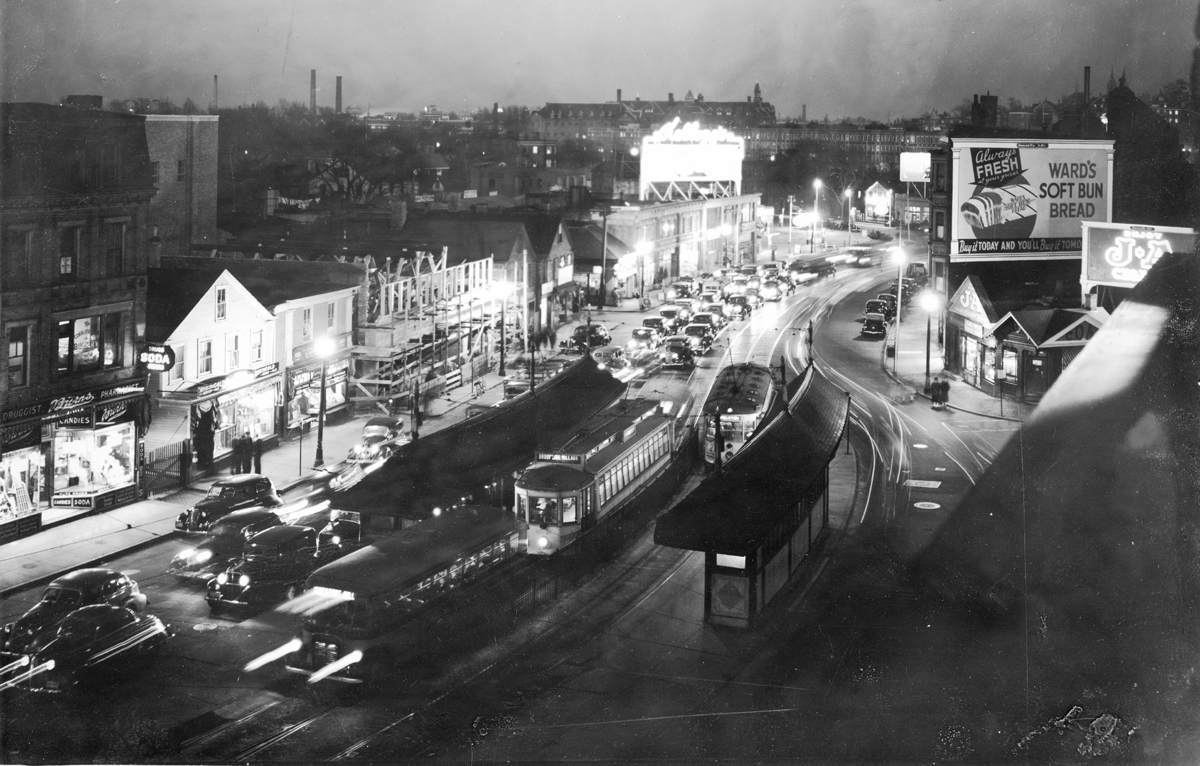
The new movie Three Billboards Outside Ebbing, Missouri opens today at the Coolidge Corner Theatre. But did you know there were once billboards right outside the Coolidge Corner Theatre?

In fact, it was 50 years ago today—November 17, 1967—that Town Meeting passed a measure giving the town control over billboards. Prior to that only the state's Outdoor Advertising Board could regulate the large advertising signs. Four years later the Town banned billboards altogether.

Lengthy lawsuits tied up the new measure and it wasn't until 1975 that the signs were removed after the State Supreme Court upheld the right of Brookline and other municipalities to ban billboards from their communities. Until then billboards were common in Coolidge Corner, Brookline Village, and other parts of town

This night view from 1956 shows a huge billboard advertising "GAS HEAT" looming over the marquee of the theater.  (The Disney movie Westward Ho, the Wagons, starring Fess Parker, and the adventure film Manfish, starring Lon Chaney Jr., were showing that night.)

Coolidge Corner Theatre at night, 1956, with billboard

In the wider view below you can just make out another, unlit, billboard with a clock on it across the street, just above the neon sign for Jack and Marion's deli. (Click on the image for a full, zoomable version at Digital Commonwealth.)

Coolidge Corner at night 1956

Below are other views of Brookline billboards before the ban. Click on each image for a larger, zoomable view.

Washington Street (Route 9) looking toward Boston, 1937
Route 9 looking west
Route 9 looking west, 1956. Gulf Station is between entrance to Riverway and Brookline Avenue
Coolidge Corner 1950s
Coolidge Corner, 1950s
Coolidge Corner, 1940s
Hearthstone Plaza under construction with inset showing close up of billboards on top of one-story buildings
Hearthstone Plaza (where Washington Street meets Route 9) under construction with inset showing close up of billboards on top of one-story buildings
Washington Street (Route 9) looking east, 1930s
(Photos from the Public Library of Brookline and the Brookline Historical Society)

Sunday, April 12, 2015

Blacksmith Shop to Auto Garage to Teen Center

New Life and an Old Story at 40 Aspinwall Avenue
40 Aspinwall Avenue before and after
40 Aspinwall Avenue before and after its conversion to the Brookline Teen Center
Brookline’s 2014 Preservation Awards ceremony took place last November at the Brookline Teen Center on Aspinwall Avenue. The Teen Center itself was one of the recipients, recognized for its adaptive reuse of a nearly century old garage. If you haven’t seen it, you should. It’s a gem, inside and out, a tribute to all who worked on it: founders Paul and Saskia Epstein and their community supporters; the architects and builders; the staff; and the Brookline teens who helped design it.

Their efforts have given new life to an old garage built in 1916 for Frank Turner, a blacksmith and horseshoer who may himself have arrived in Boston as a teenager, a stowaway from Northern Ireland on a British cargo ship in 1883.

Turner was born Francis Turner in Drumnavaddy, near Belfast, in 1866, the son of a weaver and his wife.  It can't be said for certain when he arrived in Boston, but the only immigration record matching his name, age, and birthplace was that of a Frank Turner, 17, one of four stowaways on the S.S. Illyria arriving from Liverpool in October 1883.
Turner ship's manifest
Frank Turner, age 17, is the last of four passengers marked "Stowaways" on this 1883 ship's manifest
By 1892 he was living in Boston’s South End and working as a blacksmith near Castle Square.  He was the co-owner of the Turner & Lyons blacksmith shop on Ferdinand Street (now the southern part of Arlington Street).

Listing for Frank Turner in 1899 Boston Directory
He married another Irish immigrant, Nora Cronin, a dressmaker, in 1901 and became a U.S. citizen in 1902.

Nora and Frank Turner
Nora and Frank Turner in an undated studio photograph
Photo courtesy of Ronald Turner
The Turners had moved to Roxbury by 1906. That year, Turner’s partner, Joseph H. Lyons, died and Turner came to Brookline to work in the blacksmith and horseshoeing shop of P.J. Burns in Brookline Village.

P.J. Burns blacksmith shopAd for P.J. Burns blacksmith shop

The Burns shop stood at 152 Washington Street next to the firehouse at the foot of High Street. It moved down the street to 87 Washington when the current firehouse was built on the site in 1908.

Four years later, Turner was in business for himself again, and he and his wife and their son Harold became Brookline residents. In January 1912 they purchased the 42 Aspinwall Avenue home of blacksmith T. W. Burlingame and the wood frame blacksmith shop behind it.

Turner home with sign in alley
Frank and Nora Turner’s home at 42 Aspinwall Avenue (right) with the alley leading to the wood frame blacksmith shop at #40. The sign says “Frank Turner. Scientific Horseshoeing. Carriage and Wagon Repairing.” (Photo courtesy of Ronald Turner)

1913 Frank Turner, Horseshoer ad
Advertisement from the 1913 Brookline Blue Book directory
Construction notice for 40 Aspinwall Avenue garage
Notice in The American Contractor, February 26, 1916
By this time the automobile was rapidly replacing horse-drawn wagons and carriages. In 1916 Turner replaced the wood frame shop with the brick auto garage that houses the Teen Center today. The architect was George Nelson Meserve, a prolific designer of commercial and residential buildings in Boston, Brookline, and elsewhere.

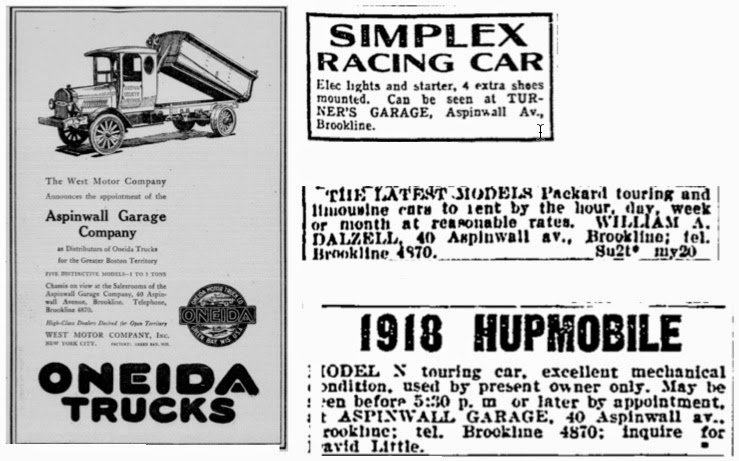
The garage, known variously as Turner’s Garage and the Aspinwall Garage, offered automobile storage and repairs and sold Socony (Standard Oil Co. of NY) gasoline.  Manufacturers and private owners also offered vehicles for sale and lease through the garage, as seen in the ads below.
Ads for Turner's Garage
Ads from Boston Post (left), 1919, and Boston Globe (right) top to bottom 1917, 1917, 1919
Frank and Nora Turner sold the house and garage in 1924 and moved to 29 Auburn Street. Frank then worked as an auto mechanic at the Hinchcliffe Motor Car Co. (900 Commonwealth Avenue in Brookline), New England distributor for Jordan automobiles.

Nora died of pneumonia in 1926. The following year, Frank moved to California with his two sons. He owned an oil well in southern California with his son Harold for a time. Frank Turner died in 1944 at the age of 78.

Dexter Garage ad, 1932
Brookline Directory ad, 1932
The garage passed through two owners in five years after Turner before being purchased by Frank S. Dexter in 1928. He would own it for a decade and a half. Dexter was also the first proprietor of the garage who did not live in the house in front of it at 42 Aspinwall.
     
Later businesses in the garage building included the B&B Corrugated Box Co. after World War II; the Hayes & Shea auto service company in the 1960s (they tore down the house in front of the garage); and International Tire in the 1980s. Brookline Auto Body and Kenmore Auto Sales were the most recent occupants before the conversion to the Teen Center.

Ads from businesses at 40 Aspinwall Avenue

Frank Turner and his successors may be long gone, but the Teen Center renovation has retained several links to the building’s past in place (below), including an “Auto Body Repairs” sign on one wall, an original steel beam (hanging over the “Auto Body Café”) with the inscription “From the A.L. Smith Iron Works, Chelsea”, and yellow parking space lines on the floor by the pool table.

Auto repair sign in Teen Center
Steel beam in Teen Center

Parking spot lines on Teen Center floor
(A version of this article appeared earlier in the Brookline Historical Society members newsletter)