Showing posts with label People. Show all posts

Wednesday, September 11, 2024

Amateur Photography in 19th Century Brookline

The May 6, 1882 edition of the Brookline Chronicle included a list of 33 books recently added to the collection at the Brookline Library. There were books of history, fiction, science, and travel. 


There were some how-to books, including two guides for would-be painters: A Course of Lessons in Landscape Painting in Oils and Easy Studies in Water-Color Painting.


There was also a how-to book on a relatively new and increasingly popular art form: photography.

How to Make Pictures: Easy Lessons for the Amateur Photographer by Henry Clay Price

"A Sensible Craze"

"Anyone who has undertaken to be his own photographer will tell you there is a great infatuation about it," noted a review of the book in another newspaper. 


"Hence it may be termed a craze," continued the review. "It is also a high art to be able to catch and preserve any little scene of beauty that one may chance to meet with on his summer vacation. Any true art is sensible, therefore amateur photography is a sensible craze."


A year later, the Brookline Chronicle reprinted a lengthy article on "Amateur Photography" from the New York paper The Hour. "The amusement and services that may be had at the cost of a small, cheap photographic outfit are almost numberless," it said.

"Expression, which is the life of a portrait, cannot always be assumed to order in a studio, except by persons whose features are under unusual control, while children's pictures are generally of the variety known as 'wooden.' 


"But at home every expression of countenance may be seen and caught. Poses that do not come willingly amid unfamiliar surroundings and before strange observers, succeed each other rapidly in the unrestraining atmosphere of the family circle." 


Technical Innovation and the Boston Camera Club

The growth of amateur photography was spurred by the technical innovations of George Eastman and Henry Strong in Rochester, NY, beginning with dry emulsion glass plates in 1880. Camera clubs and photographic societies, taking advantage of the new, less complicated method of developing photos, sprung up across the country, including in Boston.


The Boston Society of Amateur Photographers was formed in 1881. Five years later, the name was changed to the Boston Camera Club.

The Photographic Times and American Photographer: Boston Society of Amateur Photographers
Click on image for larger view

Among the early members of the club were several Brookline men, including James Codman (one of the founders), William Hovey, George E. Cabot, John Hubbard, Robert Amory, Percival Lowell, and Edward Philbrick.

This 1886 photo of Cora Codman, age 12, may have been taken by her father, James, one of the founders of the Boston Camera Club. It is one of more than 40 photos of Brookline and Boston children in an album in the collection of the Brookline Historical Society.

The Boston Camera Club is the second-oldest continuously extant amateur camera club in the United States. Headquartered in Boston for most of its existence, it was based in Brookline from 1980 to 2023 before returning to Boston.


The Kodak Camera and the Brookline Camera Club


The next big innovation from Eastman in Rochester -- the Kodak camera -- had a big impact on the growth of amateur photography, including in Brookline. . 

"Anybody can take pictures with this instrument without practice.
Kodak advertisement, Rochester, NY, August 1888

The Kodak did away with glass plates altogether. The photographer could shoot multiple images without reloading, then send the film to Rochester to be developed, with the finished images shipped back to the sender when they were done.

In 1891, the Brookline Chronicle ran an article about effective advertising, reprinted from the Milwaukee Journal. One of the most effective ad slogans the article cited was Kodal's "You press the button, we do the rest."

"The Kodak: You Press the Button. We Do The Rest"
1889 Kodak advertisement

In October 1889, it was announced in the Chronicle that a meeting would be held to form a Brookline Camera Club.

"It is desired that all interested in this most fascinating art be present. The object of the club is for social intercourse and the interchange of views, and there are a sufficient number of photographers here to make it a success."


"Amateurs of both sexes are invited," reported the Brookline Chronicle, adding that "the club's constitution provides that "two of the members of the executive committee shall be ladies."  The club was also looking into setting up a darkroom and studio for its members. The club held exhibitions, discussions, and other events in town.


C.A. Chandler, who wrote about photography for the Boston Globe, had noted the creation of the Brookline club in his column.  But he was not a fan of amateur photography.


"'Amateur' in its original meaning," he wrote, "is 'a lover of,' and as applied to photography would convey that the man to whom it was applied was an enthusiastic lover of, and consequently a skilled adept in, the art.


"Now," he continued, "the meaning is degraded, and the man who buys a detective [a generic name for some 1880s box cameras], presses the button, and sends his paper or plates to be developed and printed from, is an amateur. He knows no more of the art than does the organ-blower [the person who pumped the air into pre-electric pipe organs] know of music."

 
Chandler's criticism notwithstanding, amateur photography continued to grow in popularity with men and women, young and old, including in Brookline, even as professionals came to town.

"The camera craze has secured a good hold on the Brookline boys."
Brookline Chronicle brief, January 4, 1890

Next up: Professional photographers in Brookline into the 20th century. See also the first article in this series: Brookline Photographers: The Early Years.


Monday, February 20, 2023

Dr. Cornelius Garland in Brookline

Dr. Cornelius N. Garland, a pioneering Black physician and the founder of the first and only Black hospital in Boston, spent the last 24 years of his life in Brookline, where he lived on Corey Hill from 1928 to 1952. 


Garland's story was featured earlier this month in a piece on Cognoscenti, WBUR's ideas and commentary site, and an interview aired on Radio Boston. The author of the Cognoscenti article, Lisa Gordon, was joined on Radio Boston by Garland's great grandson Dan Reppert.

Dr. Cornelius N. Garland, as shown in the 1912 book The Negro in Medicine, published by the Tuskegee University Press (left); 12 East Springfield Street in the South End, former site of Garland's Plymouth Hospital (center); and Garland's one-time residence on Mason Terrace in Brookline (right)

Gordon began digging into the story while living in an apartment in the South End building that had been Garland's hospital. She and Reppert told how the Alabama native founded Plymouth Hospital in 1908. The hospital employed Black doctors and included a training program for nurses at a time when city hospitals would neither employ Black physicians nor admit Black women to their nursing programs.

The Plymouth Hospital and Nurses Training School continued to operate until 1928. Garland hoped to expand his efforts with a second hospital and had support from the community. His plan was opposed, however, by influential Boston Guardian publisher William Monroe Trotter. Trotter, reported Gordon, "believed a second Black-only hospital would perpetuate existing racial problems" and, instead, "vehemently advocated to integrate city hospitals, starting with Boston City Hospital."

The debate over separate Black hospitals and their effect on the effort to integrate Boston city hospitals drew coverage in Black newspapers around the country, including these in the Pittsburgh Courier, left, and the New York Age, right.

Garland, added Gordon, "recognized that he and Trotter had a similar goal: equity for the Black community." He joined Trotter in lobbying for the integration of Boston City Hospital, "perhaps believing both plans could work in tandem." In 1928, he closed Plymouth Hospital. One year later, City Hospital admitted its first Black students, although it would be 20 years before the first Black physician was added to the staff.


Dr. Garland in Brookline

Cornelius and Margaret Garland lived on West Canton Street in the South End, on the edge of the Back Bay and a 15 minute walk from Plymouth Hospital. In December 1928, after the closing of the hospital, they purchased a newly-built home at 173 Mason Terrace in Brookline. (The deed was in Margaret's name.)


Their daughter, Thelma, then 26, was a French teacher in Baltimore at the time and did not live with her parents in Brookline. (Thelma married James Kelly Smith in August 1929.)


Garland continued to practice medicine in Boston out of an office at the West Canton Street brownstone, while renting the rest of their former home to tenants. He was also involved in many health, social, business, and political organizations and activities, both before and after moving to Brookline.


He was heavily involved in the work of the Boston Tuberculosis Association, promoting good home hygiene practices as a way of combating the disease. (The Boston Globe, in 1937, reported that one section of Roxbury "at one time had the highest mortality rate in the country for Negroes suffering from tuberculosis," but had seen a big improvement in recent years.)

An annual contest sponsored by the Boston Tuberculosis Association gave prizes as a way of encouraging clean yards, attractive gardens, and general sanitary conditions. The first place winner in the 1936 contest, on which Dr. Garland was a judge, just happened to live across the street from his office on West Canton Street. (Boston Globe, October 3, 1936) 

Garland served on boards of many Boston civic associations during his time in Brookline, including the Urban League of Greater Boston and the Boston Chapter of the NAACP.  Locally, he was involved in the medical division of Brookline's civil defense organization during World War II. He continued in medical practice after the war. (A 1948 photograph of him with his granddaughter in Ebony magazine referred to him as "Boston's richest physician.")

His wife, Margaret, was vice president of the League of Women for Community Service in Boston, an organization that grew out of an earlier group that advocated on behalf of Black soldiers returning from service in World War I. (Florida Ruffin Ridley, who moved from Brookline not long before the Garlands arrived, had been on the board of the League with Margaret several years earlier.)

Margaret Garland died in 1945, at the age of 69. Cornelius Garland died in 1952. He was 75.


You can learn much more about Cornelius Garland, his family, and Plymouth Hospital from the following sources:


Thursday, February 2, 2023

Douglass Day: Frederick Douglass in Brookline

February 14th is Douglass Day, an annual celebration of the life of Frederick Douglass. This year the Public Library of Brookline is participating by hosting a public transcribe-a-thon, where community members can help bring different aspects of Black history to light.


This year's project is working on the papers of Mary Ann Shadd Cary (1823-1893), an activist, journalist, publisher, teacher, and lawyer, and one of the earliest Black women to edit a newspaper. Volunteers can join the project anytime between 12 and 3 pm on February 14th, in person at the library or online. For details, see the library website.

Photo of Frederick Douglass
Frederick Douglass in 1879. (National Archives)

Frederick Douglass spoke in Brookline in December 1874, as part of a lecture series at the then new Town Hall, which had been dedicated one year earlier. The series was organized by James Redpath, a journalist and, before the Civil War, an anti-slavery activist. Redpath formed a well-known, Boston-based speaker's bureau that was active across the U.S. for many years after the war.

This advertisement for James Redpath's lecture series at Brookline Town Hall appeared in the Boston Journal on August 22, 1874. 

Local cotton merchant Zenas Brett, whose 1874 diary was transcribed by students at the then Edward Devotion School (now the Florida Ruffin Ridley School) in 2005, attended Douglass' lecture and made this note in the diary:

"Wife + I went to hear Frederick Douglass lecture this eve in our Town Hall subject. 'John Brown' "


Though Brett's description is brief (and typical of his diary entries), there is a lengthy description of the same speech as given by Douglass three months earlier in Rochester, NY, where he lived for many years. Douglass, according to the Rochester Democrat and Chronicle, said he came to vindicate Brown

"....a great historic character of our own time and country--one with whom it had been his fortune to be well acquainted and whose friendship it had been his pleasure to share. And in so doing he would  endeavor to throw a more favorable light on the great event of the Harpers Ferry raid ... [and its role in] the thirty years struggle between slavery and liberty...."


Douglass had taken to the lecture circuit to help with what historian John R. McKivigan has described as an existential and vocational post-war crisis brought on by "a pressing need for revenue, not just to support himself, but to assist his four adult children and their growing families financially." 1


At the same time, Douglass was concerned that audiences came to see him as almost what we would describe today as a novelty act. "I shall never get beyond Fred Douglass the self educated fugitive slave," he wrote to Redpath in 1871, adding that

"I shall endeavor not to forget that people do not attend lectures to hear statesmanlike addresses, which are usually rather heavy for the stomachs of young and old who listen. People want to be amused as well as instructed. They come as often for the former as the latter, and perhaps as often to see the man as for either."


Sketch of Brookline's 1873 Town Hall, where Frederick Douglass spoke as part of James Redpath's Brookline Lyceum lecture series.

1 - John K. McKivigan, "“A New Vocation before Me”: Frederick Douglass’s Post-Civil War Lyceum Career." Howard Journal of Communication, 29 (3), 2018 

Wednesday, September 14, 2022

3 Doctors & Their 19th Century Brookline Houses

If you stand on the northeast side of Washington Street about halfway between its intersections with Greenough Street and Weybridge Road you'll be in one angle of a triangle formed by three Brookline houses from three different eras of the 19th century.

Aerial view via Google Maps showing: 1) 26 Weybridge Road (formerly 446 Washington Street); 2) 447 Washington Street; and 3) 432 Washington Street. All three are visible from the spot marked with a star.
Dating these houses based on their architectural styles can be confusing:
  • #1 -- 26 Weybridge Road -- is in the style of the Colonial Revival of the late 19th-early 20th century and appears to be the newest of the three but is actually the oldest, built in 1822. It was redesigned in 1868 and again, as a Colonial Revival home, in 1922. A more recent (2016) renovation restored elements of that 1920s design that had deteriorated or been removed in later years.
  • #2 -- 447 Washington Street -- was built smack dab in the middle of the century, c1850.
  • #3 -- 432 Washington Street has the look of a pre-Revolution house, but only because it was designed as a replica of John Hancock's Beacon Hill mansion, built by his uncle in the 1730s and torn down in 1863. It is actually the newest of the three, built in 1895. 

When the most recent of these -- the Hancock replica -- was built, there was very little around them on the now densely built-up section of this busy thoroughfare between Brookline Village and Washington Square.


The three houses shown on the 1900 Brookline atlas

All three houses were originally the homes of doctors and their families. But the three doctors -- Charles Wild, Charles Wheelwright, and Benjamin Blanchard -- were as different from one another as are their still-standing houses. 

Left to right: Drs. Charles Wild (1795-1864), Charles Wheelwright (1813-1862), and Benjamin Blanchard (1856-1921)

The Wild-Sargent House (1822)

The oldest of the three houses, now known as the Wild-Sargent House, was built in 1822 for Dr. Charles Wild and his wife Mary Johanna (Rhodes) Wild. There are no known photographs of the house showing how it originally looked. The oldest known photo shows the house in 1868, after a post-Civil War renovation by it's fourth owner.

Today's 26 Weybridge Road as it appeared from Washington Street in 1868 after a major redesign. It retained this design for more than 50 years.

The house was remodeled again as part of the Blake Park development of the 1920s.


Image credit:

Public Library of Brookline

Charles Wild (1795-1864) was born in Boston, graduated from Harvard in 1814, and was granted a medical degree in March 1818. (His dissertation was on delerium tremens.) Harriet Woods in her Historical Sketches of Brookline, published in 1874, presented a lengthy profile of Dr. Wild.


Those who can remember the doctor in his prime [wrote Woods], can well recall his tall, well-formed figure, his firm tread, his deep voice which seemed to come from cavernous depths, and eyes which seemed to look from behind his spectacles into and through one.


Woods described the doctor's typical way of announcing his arrival to see a patient:

He had a breezy way of entering a house, stamping off the snow or dust with enough noise for three men, throwing off his overcoat, untying a huge muffler that he wore around his neck, and letting down his black leather pouch with emphasis. There was an indescribable noise he made sometimes with that deep gruff voice of his which cannot be represented in type.


Dr. Wild, widely respected in town for his knowledge, abilities, and advice, was skilled in the mixing and administering of potions, in bloodletting, and in other techniques practiced by the physicians of his day. In 1839, he became interested in the emerging ideas of homeopathy.

The second meeting of New England physicians interested in this new kind of practice took place at the house on Washington Street in 1841. It led to the formation of the Massachusetts Homeopathic Fraternity.

The Wilds' second son, Edward Augustus Wild, was also a doctor, until he lost an arm serving in the Civil War. He later returned to service as a general commanding troops of formerly enslaved African American soldiers.

For much more on the life of the Wild family in their Brookline home, see the 1851-1865 diary of Mary Johanna Wild, digitized by Boston College and annotated by the Brookline Historical Society.


The Candler Cottage (1850)

In 1847, Mary Johanna Wild wrote to her oldest son, Charles, then in Shanghai where he was engaged in the China trade, that

As I sit at the old desk in the study now, I can look out and count more than 30 new houses put up in the last year.


Three years later, another new house, directly across Washington Street from the Wild house, appeared.  A sketch of the house, designed by architect Richard Bond, was included in a book, American Cottage and Villa Architecture. published in 1850. It shows open land around around the house, with Aspinwall Hill rising in the distance on the left.


Image credit: Historic New England

The first owners of the house were Susan Candler and her brother Dr. Charles Wheelwright. They were joined by Susan's five children, ranging in age from 24 to 11, and two Irish-born servants. Susan's husband had died in 1842.


Writing to a nephew in February 1850, Wheelwright said the family, then living in Boston, was looking to find a country house to purchase:

We have concluded to seek placdium quietam in rure felice. There we must be near railroad and omnibuses, we must have open fields and sunny hills....We have found a beautiful place exactly eighteen minutes distant from Worcester Railroad Depot in Boston. It is nearly opposite the Aspinwal place on the road from Brookline to Brighton. It is very expensive but land is increasing in value so rapidly that if we can get it at a fair market price we think we shall buy, Susan and myself conjointly.

 
Family members, wrote Wheelwright, had visited the house and were much pleased with it:


It is really a beautiful place, well back from the road. A cottage with two arched towers and quite high and really airy chambers, fifteen rooms in all, barn, etc., and 300 fruit trees. I shall offer 9500 dollars and fear it will not bring it. I will be sorry to lose it as it offers so many facilities and conveniences not to be found in other places.

Dr. Charles Wheelwright

In the end, they were able to purchase the house and land for $8,500.

Charles Wheelwright was born in Boston in 1813. He graduated from Harvard in 1834 and earned a medical degree there in 1837. In 1839, he joined the U.S. Navy as a surgeon and would remain in naval service for the rest of his life, serving in the Atlantic, the Pacific, and the Gulf of Mexico. In 1859, he was part of Commodore Matthew Perry's expedition to Japan.


At the outbreak of war, Wheelwright was serving in the Brooklyn Navy Yard on a board examining men for their fitness to serve in the Navy. Despite his own poor health, he applied for active duty. He served in Virginia and, later, as fleet surgeon for the Gulf Fleet. He was then assigned to a hospital near the mouth of the Mississippi River in Louisiana, treating troops of the River Squadron.


Suffering from poor working conditions, exhaustion, diarrhea, and general poor health, he died of disease in Pilot Town, Louisiana, on July 30, 1862. He was 49 years old. He is buried in Mount Auburn Cemetery in Cambridge. The house remained in the Candler family through the end of the war.


The Blanchard House (John Hancock House Replica) (1895)

In 1863 the Beacon Hill land containing the former home of John Hancock was sold. Plans to move the house to the Back Bay fell through. Protests against its demolition went unheeded. In August the house was demolished, replaced by two townhouses. (In 1917, the townhouses were replaced by an extension to the State House.)


The former Hancock mansion on Beacon Hill and a  June 1863 broadside that was printed and distributed in Boston in a failed attempt to save the building from demolition. (Credits: house photo, Boston Public Library; broadside, Historic New England)


The loss of the former home of one of Boston's and the nation's Founding Fathers was a factor in the growth of the historic preservation movement. In the decade after its demolition, another landmark of the Revolution, the Old South Meeting House, which had barely survived the Great Boston Fire of 1872, was saved from demolition after the church moved to a new building in the Back Bay. 


At the World's Columbian Exposition in Chicago in 1893, the Massachusetts State Building, designed by the noted Boston firm Peabody & Stearns, was modeled after the demolished Hancock mansion. At the dedication of the building in October 1892, Massachusetts governor William Russell spoke of the symbolic importance of the design:

I think there is something grand and most instructive in these historic buildings. They link the past with the present, with lessons of patriotism, suffering and sacrifice; they speak of men who were patriotic, events which were epoch making and the beginning of a great nation....

This building comes close to the heart of Massachusetts, not merely because it is beautiful in design and correct in proportion, but because it speaks of Hancock, his life and his services, and recalls a great agitation, a struggle for liberty and independence, in which Massachusetts and her ideas were leading to form and develop a great and majestic republic


The Massachusetts building at the World's Columbian Exposition in Chicago, as shown in Campbell's Illustrated history of the World's Columbian Exposition (1894)

The Massachusetts building was itself demolished after the Exposition. (Another building from the Exposition, built for the Van Houten Cocoa Company as a replica of a 16th century Dutch town hall, was purchased by a Brookline resident, Charles Appleton. It was taken apart, brick by brick, and reconstructed on a new street in Brookline. Now known as the Dutch House, it stands on Netherlands Road, near the Muddy River.)


Two years after the end of the Exposition, architect Joseph Everett Chandler designed a new home, also modeled on the Hancock mansion, at the corner of Washington and Greenough Streets in Brookline for Benjamin and Clara Blanchard.


Chandler was an important figure in the Colonial Revival style of architecture that flourished in the U.S. in the late 19th and early 20th centuries. The Blanchard House was the first of four houses he designed that were modeled on the Hancock house and the one that most closely followed the design of the original. 

This photo and floor plan were included in Joseph Chandler's 1916 book The Colonial House

The original stone facade, which Chandler described as "the best of Colonial stonework," was replicated in wood as closely as possible.


The other Chandler houses modeled on the Hancock house include 58 Allerton Road in Brookline and homes in Weston and in Chandler's native Plymouth. He also designed several other buildings in Brookline, including an art gallery for the Blanchards' neighbor Desmond Fitzgerald, now the Church of Christ at 416 Washington Street.


Chandler is probably best known for his restoration of historic buildings, including the Paul Revere House in the North End of Boston and the House of Seven Gables in Salem. (For much more on Chandler and his work, see his 1922 book The Colonial House.

Another still-standing building modeled on the Hancock mansion -- though not designed by Chandler -- is the stone headquarters of the Ticonderoga Historical Society in Ticonderoga, NY, built for the New York State Historical Society in 1926.


Photo credit:
HUP Blanchard, Benjamin S. (1).
Harvard University Archives.

Benjamin Seaver Blanchard graduated from Harvard in 1877 and from Harvard Medical School in 1882. He practiced for a year in Roxbury where, as he later wrote,

 [I] had a fair amount of work, little pecuniary recompense, but plenty of blessings, some curses, and good opportunities to study human nature.


Blanchard came to Brookline in 1883. He lived and had an office at 18 Davis Avenue in Brookline Village. In 1887, he married Clara Fessenden Barnes, and eight years later they bought land from the Blake estate to build their new house.


Blanchard maintained his medical practice out of the Washington Street house. He was also active in town affairs, serving as a Town Meeting Member and a member of the school committee, and as a medical inspector for the schools and the Gymnasium and Baths Committee.

He was a leading figure in the town's efforts to combat various epidemics and threats to community health through inspections and vaccinations. Blanchard died at home of rheumatic fever in 1921. He was 64 years old.


Saturday, April 18, 2020

Crowdsourcing a 19th Century Brookline Diary

Would you like to help bring the story of a 19th century Brookline woman and her family to life?

About five years ago I photographed the 1851-1865 diary of Mary Johanna Wild at the John J. Burns Library at Boston College. Wild lived with her family in a Brookline house that she and her husband, Dr. Charles Wild, built in 1822. It still stands, on Weybridge Road near  the intersection of Washington and Greenough Streets.

Pages from Mary Wild diary
Pages from Mary Joanna Wild diary (click image for larger view)

The Wild house in 1868 and 2016
The Wild House, built in 1822, shown in 1868 (left) and after a 2016 renovation (right)
I started, but never quite completed, transcribing the diary, page-by-page. It was painstaking work, partly because the page images, shot with my iPad camera, were not very good. Some of them were pretty unreadable. Fortunately, the entire diary was digitized by Boston College in 2018 and is available in high resolution, zoomable images online.

Now, I'm asking for your help in bringing this project to fruition. Here is what you can do.
  • I will send each volunteer 1-3 pages of the diary at a time. I'll send you a copy of my transcription and instructions for viewing the handwritten pages online. 
  • Your task will be to read through the original diary pages, confirm or correct errors in my transcription, and fill in parts I was unable to transcribe or was uncertain about.
When it is completed, we will have a crowdsourced transcription of the diary that I will make publicly available online.

But this will be more than just a transcription. I've compiled annotations of the diary noting, among other things, details about the people Mary mentions, the places, events, and objects she describes, books she reads, and more. That will all be included in the final project.

For example, at the bottom of the very first page of the diary, on Saturday,  January 11, 1851, Mary writes: "I went to the musical Fund in the eve with C. Rhodes & Dr. Sen." Here is that entry from her diary and, below it, the program from that concert digitized from the collections of the New York Public Library. (The concert, featuring the Beethoven Pastorale, took place at the Tremont Temple on Tremont Street in Boston.)
Diary entry and program from the Boston Musical Fund Society concert, January 11, 1851

But it all starts with completing a good transcription.

Are you interested in contributing to this project? Let me know— email me at kliss@brooklinehistoricalsociety.org — and I will send you pages and detailed instructions.

- Ken


Friday, June 16, 2017

Gillette & Sias Mansions, Beacon Street

This stretch of land on the north side of Beacon Street just west of Lancaster Terrace would be unrecognizable today except for the stone wall, which still stands. It is now the site of the apartment building at 1550 Beacon, built for senior housing in the 1970s, and Temple Beth Zion at 1566 Beacon, completed in 1948.

(Note: This article first appeared in Brookline Patch as part of a biweekly series of historical images of Brookline from the Brookline Historical Society and the Public Library of Brookline.)

Gillette & Sias Mansions
 
The two large houses formerly on the site were associated, at different times, with the heads of two well-known consumer product companies. The house on the left was the home from 1907 to 1913 of King C. Gillette, inventor of the safety razor and founder of the company that bears his name. It was torn down in 1944. The house on the right was built by Charles D. Sias, a senior partner in the Chase & Sanborn coffee company. A later owner moved it up the hill to Mason Terrace, where it remains today.

A present-day view of the site, via Google Street View, is below.

1550-1566 Beacon Street Today

Both houses were built after the 1880s expansion of Beacon Street from a narrow country lane to a wide boulevard, designed by Frederick Law Olmsted and with trolleys providing easy access to Boston. The older of the two is the Sias house, built in 1889 for Charles Sias, who began as a salesman with Chase & Sanborn before rising to become senior partner with the firm. It was designed by Arthur Vinal who was also the architect of the Richardsonian Romanesque High Service Building at the Chestnut Hill Reservoir, now condominiums and the Waterworks Museum, and the gatehouse at what is now Fisher Hill Reservoir Park.

The next owner, lumber company executive Frederick McQuestern, had the house moved up the hill to 41 Mason Terrace, shown below.

King Gillette

The Gillette house was built in 1892 for Benjamin Lombard Jr., a banker and real estate executive. It was designed by the architectural firm of Little, Brown, & Moore, which also designed the main house of the Brandegee Estate in South Brookline. King Gillette purchased the house for his family in 1907 and lived there until 1913 when they moved to Los Angeles.

Gillette had first come to Brookline in 1895 when he was a salesman for the Crown Cork Company, maker of disposable bottle caps. It was while living here that he came up with the idea for the safety razor, as described by Gillette himself in a company magazine in 1918:

"I was living in Brookline at No. 2 Marion Terrace at the time [1895],” he wrote, "and as I said before I was consumed with the thought of inventing something that people would use and throw away and buy again. On one particular morning when I started to shave I found my razor dull, and it was not only dull but it was beyond the point of successful stropping and it needed honing, for which it must be taken to a barber or to a cutler. As I stood there with the razor in my hand, my eyes resting on it as lightly as a bird settling down on its nest—the Gillette razor was born.”
It took years of experimentation to solve the technical difficulties involved in producing the kind of razor Gillette had in mind, but a patent was granted in 1904 and sales took off, making Gillette a great financial success and a household name. Three years later he bought the Beacon Street house.

A close look at a section of the stone wall in the old and new photos (below) makes it possible to pick out individual stones. This section is to the right of the tree in the modern image and further to the right in the older one.

Stone Wall

Monday, May 30, 2016

Civil War Photos of Brookline Soldiers

On April 22, 1861— ten days after the attack on Fort Sumter — the men of Brookline gathered to sign their names on a document promising to "enroll themselves for the purpose of acquiring a knowledge of military drill and discipline, under the orders of the Military Committee of the Town."

When it came time for 24-year old Julius A. Phelps to sign he added, next to his signature, "Ready to go."

Phelps signature

The next man to sign added ditto marks next to his name, and several more townsmen followed Phelps' example, indicating they too were "Ready to go."

Fourteen months later Phelps was dead, one of the first of the Brookline men to give his life in defense of the Union. His name is one of 72 on the Civil War memorial installed in the old Town Hall in 1884 and now on display in the lobby of the current Town Hall.

Phelps memorial


Until recently, I knew of no photos of Phelps. In fact, I had come across photos of only one of the 63 enlisted men whose names are on the Brookline memorial. (The nine officers, from more prosperous and prominent families, were more well documented.)

I was pleased, then, to find Phelps and four other Brookline men in this montage of soldiers from Company A of the 1st Massachusetts Infantry. It's from the collections of the Brookline Library and has been digitized and made available on the Digital Commonwealth website. (Click on the image for a zoomable version.)

Company A, 1st Massachusetts

Who were these men? Here is what I have been able to learn about them.

Julius Phelps
Julius Augustus Phelps was born December 27, 1836 in Leominster, the son of Sumner and Dolly Phelps. His father was a farmer. By 1860, Phelps was living in Brookline with his older brother David and David's wife and young son. Both brothers were carpenters.

Phelps enlisted as a private on May 23, 1861 and was mustered into Company A of the 1st Regiment Massachusetts Volunteer Infantry, organized at Camp Ellsworth in Cambridge. The 1st was engaged at the First Battle of Bull Run (Manassas) and was deployed in the Peninsula Campaign in Virginia in the spring of 1862, seeing action at Yorktown, Williamsburg, Eltham's Landing, and Seven Pines.

Phelps was shot and killed at the Battle of Glendale on June 30th. He was 25 years old. His name is on the family gravesite at Evergreen Cemetery in Leominster although it is not clear if he was buried there or somewhere in Virginia.

Frank Getchell
Lewis Getchell
Brothers John Franklin (Frank) Getchell and Lewis (or Louis) Gould Getchell were born in Hallowell, Maine, sons of Isaiah and Dorcas Getchell. Their father was a stonecutter. John was born December 21, 1838 and Lewis March 24, 1841.

Both brothers were living in Brookline at the outbreak of war, as was an older married brother, Isaiah. Frank, a carpenter, and Lewis, a blacksmith, enlisted together as privates in Company A on the same day as Phelps.

Lewis was shot and killed at the Battle of Seven Pines on June 25, 1862. He was 21. He was buried at the Seven Pines National Cemetery.

Frank survived the Peninsula Campaign and was promoted to corporal in November 1862. He died of disease in Falmouth, Virginia on February 3, 1863. He was 24. He was originally buried at Fitzhugh's Farm and was later reinterred at the Fredericksburg National Cemetery.

Another older brother, George, an officer with the 1st Maine Infantry, also died in the war. Their brother Isaiah continued to live in Brookline along with his family and his widowed mother. He had a carpentry shop at the corner of Beacon Street and Summit Avenue.

Joseph Turner
Joseph W. Turner was born in Derby, England in 1835, the son of Joseph and Sarah Turner. The family emigrated to the United States in 1842 and settled in Philadelphia. In 1854, they moved to Brookline where the father established a knit goods business. It was one of two manufacturing concerns in the town, according to Harriet Woods' 1874 Historical Sketches of Brookline.

Joseph and his younger brother Fergus both worked in the family business, Joseph Turner & Sons. The two brothers enlisted on May 23, 1861. Joseph died at Fair Oaks, Virginia of typhoid fever on June 21, 1862. His body was returned to Brookline and he was buried in the Old Burying Ground on Walnut Street.

Fergus Turner survived the war and continued to live in Brookline until his death in 1909.


William Trowbridge
William H. Trowbridge was born March 5, 1842 in Newton. He was the son of William W. and Sarah Trowbridge (sometimes spelled Trobridge.) His father was a soap and candle maker.

Trowbridge worked as an expressman. (Express companies delivered packages, by horse-drawn vehicles and later by rail.) He enlisted in Company A on the same day as the other men here.

He was on picket duty on July 1, 1862 after the battle of Malvern Hill when he fell dead. Death was attributed to "disease of the heart" (possibly a heart attack). He was 20 years old. His burial place is unknown.


For stories of other Brookline men listed on the Civil War memorial in Town Hall, see my earlier post Remembering Brookline's Civil War Dead.

Tuesday, December 15, 2015

Ralph Waldo Emerson in Brookline

Ralph Waldo Emerson is most famously associated with Concord and Boston. But did you know that this leading figure in the Transcendentalist movement lived in Brookline for a brief time early in his career?

In May 1830, Emerson, then a young pastor at the Second Church in Boston, moved with his wife Ellen and his mother Ruth to the old Aspinwall House. (The house stood where the Billy Ward Playground, on Aspinwall Avenue opposite St. Paul’s Church, is today.)

Emerson described the lodgings in a letter to his brother William:

“I expect mother in town Thursday or Friday & she will go to Brookline & take possession of our lodgings at Mrs. Perry’s — (in old Aspinwall House where Uncle Ralph lived one summer long ago) where we have a parlor & 3 chambers one for mother one for wife & one for you when you will come & welcome. “ 

It was hoped that the new home would help Ellen recover from tuberculosis, with Emerson’s mother there to keep house. Emerson, however, found it inconvenient “traveling four miles out & home daily” to and from his position at the church. In September, after only four months in Brookline, they moved into Boston. (Ellen would die of tuberculosis in February at the age of 19.)

The old Aspinwall House on Aspinwall Avenue, shown more than half a century after Ralph Waldo Emerson, his wife, and his mother occupied four rooms there in the spring and summer of 1830.
(Brookline Historical Society photo)

Sunday, April 12, 2015

Blacksmith Shop to Auto Garage to Teen Center

New Life and an Old Story at 40 Aspinwall Avenue
40 Aspinwall Avenue before and after
40 Aspinwall Avenue before and after its conversion to the Brookline Teen Center
Brookline’s 2014 Preservation Awards ceremony took place last November at the Brookline Teen Center on Aspinwall Avenue. The Teen Center itself was one of the recipients, recognized for its adaptive reuse of a nearly century old garage. If you haven’t seen it, you should. It’s a gem, inside and out, a tribute to all who worked on it: founders Paul and Saskia Epstein and their community supporters; the architects and builders; the staff; and the Brookline teens who helped design it.

Their efforts have given new life to an old garage built in 1916 for Frank Turner, a blacksmith and horseshoer who may himself have arrived in Boston as a teenager, a stowaway from Northern Ireland on a British cargo ship in 1883.

Turner was born Francis Turner in Drumnavaddy, near Belfast, in 1866, the son of a weaver and his wife.  It can't be said for certain when he arrived in Boston, but the only immigration record matching his name, age, and birthplace was that of a Frank Turner, 17, one of four stowaways on the S.S. Illyria arriving from Liverpool in October 1883.
Turner ship's manifest
Frank Turner, age 17, is the last of four passengers marked "Stowaways" on this 1883 ship's manifest
By 1892 he was living in Boston’s South End and working as a blacksmith near Castle Square.  He was the co-owner of the Turner & Lyons blacksmith shop on Ferdinand Street (now the southern part of Arlington Street).

Listing for Frank Turner in 1899 Boston Directory
He married another Irish immigrant, Nora Cronin, a dressmaker, in 1901 and became a U.S. citizen in 1902.

Nora and Frank Turner
Nora and Frank Turner in an undated studio photograph
Photo courtesy of Ronald Turner
The Turners had moved to Roxbury by 1906. That year, Turner’s partner, Joseph H. Lyons, died and Turner came to Brookline to work in the blacksmith and horseshoeing shop of P.J. Burns in Brookline Village.

P.J. Burns blacksmith shopAd for P.J. Burns blacksmith shop

The Burns shop stood at 152 Washington Street next to the firehouse at the foot of High Street. It moved down the street to 87 Washington when the current firehouse was built on the site in 1908.

Four years later, Turner was in business for himself again, and he and his wife and their son Harold became Brookline residents. In January 1912 they purchased the 42 Aspinwall Avenue home of blacksmith T. W. Burlingame and the wood frame blacksmith shop behind it.

Turner home with sign in alley
Frank and Nora Turner’s home at 42 Aspinwall Avenue (right) with the alley leading to the wood frame blacksmith shop at #40. The sign says “Frank Turner. Scientific Horseshoeing. Carriage and Wagon Repairing.” (Photo courtesy of Ronald Turner)

1913 Frank Turner, Horseshoer ad
Advertisement from the 1913 Brookline Blue Book directory
Construction notice for 40 Aspinwall Avenue garage
Notice in The American Contractor, February 26, 1916
By this time the automobile was rapidly replacing horse-drawn wagons and carriages. In 1916 Turner replaced the wood frame shop with the brick auto garage that houses the Teen Center today. The architect was George Nelson Meserve, a prolific designer of commercial and residential buildings in Boston, Brookline, and elsewhere.

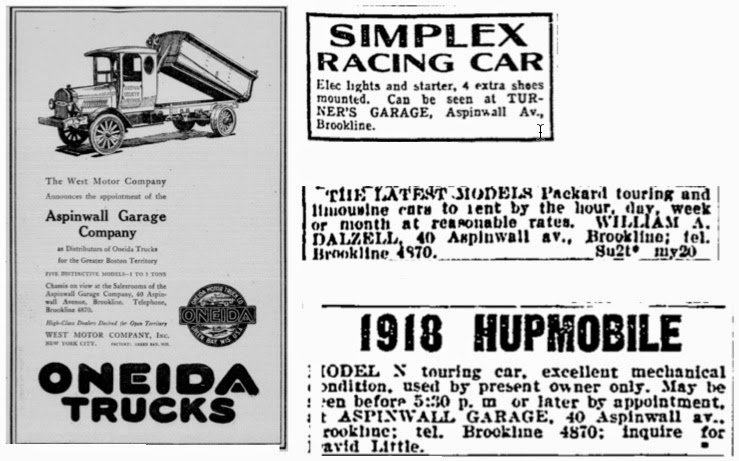
The garage, known variously as Turner’s Garage and the Aspinwall Garage, offered automobile storage and repairs and sold Socony (Standard Oil Co. of NY) gasoline.  Manufacturers and private owners also offered vehicles for sale and lease through the garage, as seen in the ads below.
Ads for Turner's Garage
Ads from Boston Post (left), 1919, and Boston Globe (right) top to bottom 1917, 1917, 1919
Frank and Nora Turner sold the house and garage in 1924 and moved to 29 Auburn Street. Frank then worked as an auto mechanic at the Hinchcliffe Motor Car Co. (900 Commonwealth Avenue in Brookline), New England distributor for Jordan automobiles.

Nora died of pneumonia in 1926. The following year, Frank moved to California with his two sons. He owned an oil well in southern California with his son Harold for a time. Frank Turner died in 1944 at the age of 78.

Dexter Garage ad, 1932
Brookline Directory ad, 1932
The garage passed through two owners in five years after Turner before being purchased by Frank S. Dexter in 1928. He would own it for a decade and a half. Dexter was also the first proprietor of the garage who did not live in the house in front of it at 42 Aspinwall.
     
Later businesses in the garage building included the B&B Corrugated Box Co. after World War II; the Hayes & Shea auto service company in the 1960s (they tore down the house in front of the garage); and International Tire in the 1980s. Brookline Auto Body and Kenmore Auto Sales were the most recent occupants before the conversion to the Teen Center.

Ads from businesses at 40 Aspinwall Avenue

Frank Turner and his successors may be long gone, but the Teen Center renovation has retained several links to the building’s past in place (below), including an “Auto Body Repairs” sign on one wall, an original steel beam (hanging over the “Auto Body Café”) with the inscription “From the A.L. Smith Iron Works, Chelsea”, and yellow parking space lines on the floor by the pool table.

Auto repair sign in Teen Center
Steel beam in Teen Center

Parking spot lines on Teen Center floor
(A version of this article appeared earlier in the Brookline Historical Society members newsletter)