Showing posts with label Business. Show all posts

Saturday, July 12, 2025

Brookline Record Stores: From Edison's Phonograph to Village Vinyl

In 2024, I sold my collection of a few hundred vinyl record albums to Jonathan Sandler of Village Vinyl & Hi-Fi in Coolidge Corner. They were mostly jazz albums I'd bought in the 1970s and 1980s, including quite a few older albums I'd picked up in used record bins during those pre-CD years.

The covers of the album, as well as the music on them, carried a lot of sentimental value for me. But I hadn't actually owned a turntable for years, and I was glad that, in addition to providing me some extra cash, the music would find new owners/listeners, especially amid a growing appreciation for vinyl.


I also gave Jonathan a printout of a 1955 Brookline Citizen ad for Rhythm Row, a record store in the exact same Harvard Street storefront to which he moved his then year-old shop -- originally in Brookline Village -- in 2018.


Brookline Citizen, January 5, 1955

307 Harvard Street is one of a row of single-story storefronts built just south of Babcock Street in 1928. Tenants over the years have included various restaurants and clothing shops. The Rhythm Row music shop was there for just a couple of years in the mid-1950s. 

(The 1955 ad highlighted a visit from noted jazz disc jockey "Symphony Sid" Torin. (One the albums I sold, by jazz singer King Pleasure, included a song -- "Jumpin' With Symphony Sid" -- with music by Lester Young and lyrics by Pleasure.)

The presence of two record shops in the same spot six decades apart is mere coincidence, one Jonathan had been unaware of. But it did set me off on a journey to learn about the history of music stores in Brookline, the subject of this extended post.

Edison and Sound Recording 

Thomas Edison's earliest work with sound recording caught the attention of Brookline. As early as 1878  the Brookline Chronicle carried a query from a reader asking "Can you tell me anything about the early life of Edison, the inventor of the phonograph?" By the late 1880s, Edison had moved from cylinder recordings to discs and the Brookline papers were paying attention.

In February 1889, a brief item in the Chronicle noted an entertainment at the Corey Hill home of Jerome Jones. "The subject," reported the paper, "was Edison's inventions, with both the phonograph and the gramophone instruments and an expert to demonstrate the marvelous power of them."

Newspapers, including Brookline papers, continued to report on Edison's technical innovations, and advertisements promoting commercial applications were not far behind. In December 1893, the Chronicle carried an ad from the New England Phonograph Company in Boston promoting their new device as an "ideal stenographer" but as also promising that 

"As a Christmas gift nothing can be purchased for the same amount of money that will begin to compare with the Edison Phonograph."
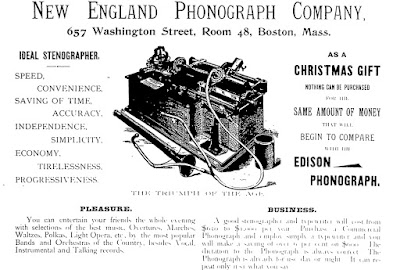
Brookline Chronicle, December 16, 1893 (Click ad for larger view)

The ad called the new device "The Triumph of the Age." In addition to using it for business, it said,

"You can entertain your friends the whole evening with selections of the best music. Overtures, Marches, Waltzes, Polkas, Light Operas, etc. by the most popular Bands and Orchestras of the Country besides Vocal, Instrumental, and Talking records."


Public Programs

There were examples noted in Brookline newspapers in the 1890s of public programs using the phonograph to present sermons, speeches, election returns, and music to live audiences in town. By the fall of 1899, it seemed the gramophone craze at had truly taken off in Brookline. 

See, for example, these notices in the local papers:

Brookline Chronicle, September 30, 1899

Brookline Suburban, October 26, 1899
 
Brookline Chronicle, December 9, 1899

Phonograph Sales Spread

Brookline papers also started advertising sales by Boston stores of phonographs or gramophones for home use, along with records to play on these new machines.

Brookline Chronicle, September 16, 1899

Brookline Chronicle, October 21, 1899

Brookline Chronicle, June 9, 1900
 
Prices of record players started to drop as manufacturers started to realize they could make bigger profits by selling more records if the cost of the machines to play them on came down. 

"It is confidently believed that this substantial price reduction will have the effect of placing gramophones...in the hands of thousands of persons who have hitherto been restrained from purchasing by reason of the comparatively high prices heretofore prevailing," reported the Chronicle. (June 30, 1900)

It was the same principle behind King C. Gillette's sales of razors at low cost with the real money to be made on repeated sales of razor blades. (Gillette, by the way, came up with this idea while living in Brookline in the same period. See that story in another of my blog posts.)

As early as 1903, one enterprising person took out an ad in the Chronicle offering for sale a phonograph with a collection of "about fifty records."

Brookline Chronicle, November 21, 1903


A little more than two years later, Henry Savage's real estate concern, with a branch in Coolidge Corner, advertised listening rooms "to hear and select your Phonograph Records."

Brookline Chronicle, January 27, 1906 (Click image for larger view)
"Under these new conditions selecting records becomes a pleasure," said the ad. "We sell every good make record and machine. Edison, Columbia Disc and Cylinder, Victor, and American Disc."
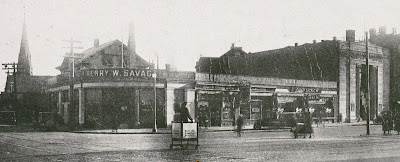
Henry Savage's real estate office stood at the southwest corner of Beacon and Harvard Streets. The building was later torn down and replaced with a new building at the same location. (Click image for a larger view.)   

Four years later, in 1910, Martin Barrett, who had a cigar store on Washington Street where it crosses over the train tracks in Brookline Village, advertised Edison phonographs for sale as a Christmas gift.
Brookline Press, December 24, 1910

Four years after that, the business, taken over by John J. Williams, gave equal prominence to cigars and phonographs in its listing in the 1914 town directory...


...while also hosting a record exchange that local people could take part in.

In 1915, a new store called the Brookline Talking Machine Shop opened at 1336 Beacon Street, in a new building called the Pierce Block, just west of the S.S. Pierce store. (That storefront is now home to a branch of the national-wide hair-cutting chain Supercuts.)
Brookline Townsman, July 10, 1915

The new business advertised the sale of both records and record players.

Click image for larger view

Local organizations, in Brookline and elsewhere, starting acquiring records and record players.

Brookline Chronicle, July 15, 1919

Brookline Chronicle, June 18, 1921

Brookline Chronicle, April 1, 1922

Brookline Record Stores

Recorded music may have made its first appearances in Brookline through special event announcements and ads from Boston-based music stores. But stores selling records soon began to appear in town.

In December 1922, a store called Kammler & Hamilton at 229 Washington Street in Brookline Village (the storefront is now the Shared Tea) was billing itself as "Brookline's Exclusive Music Store," offering "all the latest 'Hits' to select from."

Brookline Chronicle, December 12, 1922

Chester E. Kammler would run the Kammler Radio Company until his death in 1935. (His original partner, Hamilton, was with him for just the first year.) Born in 1892, the son of German immigrants, Kammler had worked for a Boston-based piano manufacturer before serving in the army in World War I.

Kammler would continue sell records, along with phonographs, sheet music, and other items in the same location for a little over a decade.
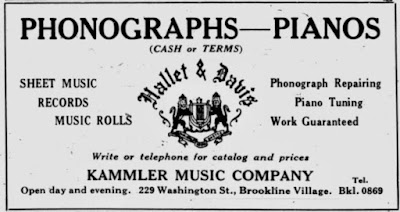
Brookline Chronicle, November 24, 1923

Brookline Chronicle, December 16, 1926

A 1932 Chronicle article -- "Kammler Music Company Celebrate Their Tenth Year Here" -- noted that 

"The phonograph is well represented through a complete stock of Victor, Columbia and Brunswick recordings of the latest dance music and vocal selections."


Chester Kammler died in November 1935. The store remained oven for a short time after his death, as seen in the ad below, but soon closed.

Brookline Chronicle, February 6, 1936

There were many more Brookline stores selling records over the next half-century, (See the end of this post for ads and articles about many of these.) But by the 1990s, cassettes and CDs had far overtaken LPs as the most popular format for recorded music, as seen in this chart produced by Recording Industry Association of America.

(Click image for larger view)

The rise of online music formats led to a further decline in all physical media. (According to one news account, more than three thousand record stores closed their doors in the United States between 2003 and 2008.)

The Vinyl Revival and Village Vinyl & Hi-Fi

The decline of vinyl records and record shops was closely followed in the mid-2000s by a movement that's been called the Vinyl Revival, And  Brookline's Vintage Vinyl & Hi-Fi, with which I began this post, is a successful part of the movement, as featured recently in the Boston Globe.

"This Coolidge Corner spot" wrote the Globe "is the place to find that record you never knew you needed until you got there."
Boston Globe, July 2025

Vintage Vinyl & Hi-Fi began in a basement storefront at 58A Harvard Street in Brookline Village in 2017.
Vintage Vinyl & Hi-Fi in its original Brookline Village basement location at 58A Harvard Street where it opened in 2017. (Image via Google Maps)

Jonathan Sandler in his original Brookline Village location at 58A Harvard Street in 2017

In 2018, Village Vinyl & Hi-Fi moved to its current location in Coolidge Corner. The store expanded in 2024, taking over the adjacent storefront formerly occupied by branches of flower and plant seller Kabloom and then Vom Fass, a German-based seller of gourmet olive oils and other food products.

Village Vinyl & Hi-Fi in 2020, before it expanded into the adjacent space previously occupied by Kabloom and then Vom Fass


Village Vinyl & Hi-Fi in 2025 after expanding into the adjacent storefront

Jonathan Sandler, center, with two other employees of Village Vinyl. (Brookline News photo by Sam Mintz accompanying audio profile of Village Vinyl.)


Sunday, March 16, 2025

Brookline's Oldest Restaurant (Or Is It?)

Three years ago, I wrote a blog post about Brookline's oldest restaurant, the Busy Bee, which opened on Beacon Street just east of Carlton Street in April 1955.

Ad announcing the grand opening of Busy Bee. Brookline Citizen, April 14, 1955, p7.
Busy Bee has now closed, as reported in Brookline News. So which restaurant gets to wear the crown as Brookline's oldest?

Well, it depends.

By one measure, Martin's Coffee, which replaced Muldoon's Luncheonette at 35 Harvard Street in Brookline Village in November 1955, gets boasting rights. 

Ad in Brookline Citizen, November 24, 1955
But wait. The Martin's website says "Local Fresh Food Since 1918."


And a mural on the inside of the restaurant also says 1918.


Could it be that Muldoon's, the luncheonette that, according to that 1955 ad, was replaced by Martin's, was a restaurant in that space as far back as 1918?

No. Muldoon's opened at 35 Harvard Street in 1948, moving from the nearby building at the corner of Harvard and Linden Street where it had started in 1946, not 1918. 

Brookline Citizen, December 2, 1948. (Click image for larger view)

In fact, there was no retail space at all at 35 Harvard Street in 1918. The three-story building was constructed as an apartment building in the 1890s and the first floor wasn't converted to retail space until 1926. It was then occupied by a series of drugstores -- no restaurants -- until after World War II.

So where does that 1918 date come from? Nobody at Martin's seems to know. (Every time I've asked, I've been told the owner is in his native Albania and is unavailable for comment.)

Still, though Martin's dates to 1955, not 1918, it is -- with the closing of Busy Bee -- now Brookline's oldest restaurant.

Sort of.

As I noted in that 2022 blog post, there is one Brookline storefront that has been a restaurant  -- but not the same restaurant -- longer than Martin's. It's the space at 1016 Commonwealth Avenue at the corner of Babcock Street, now occupied by T. Anthony's.

That storefront, which -- like the Martin's space -- was added to the front of an existing apartment building in the 1920s, was occupied by the Hawthorne Lunch restaurant from 1923 to 1933. Later restaurants include a branch of the Walnut Lunch chain and the Babcock Luncheonette. T. Anthony's took over the space in 1964. 

Adding to the confusion, the T. Anthony's website says "Established in 1976," not 1964! (Turns out that when the current owner took over the then-12-year-old restaurant.)


The Brookline News story on the closing of Busy Bee noted that the Christakis family, which operated the restaurant and still owns the building, is negotiating with a prospective new restaurant tenant. "We’re looking for somebody to keep it the way it is, keep it similar,” Chris Christakis told the paper. A future tenant, he added, might not even change the name.

If that turns out to be the case, if the restaurant that opened in April 1955 comes back, with a new owner in the same location, but with the same name and kept "the way it is," will Busy Bee reclaim the title of Brookline's oldest restaurant.

As always, it depends on how you look at it.


Thursday, September 5, 2024

Brookline Photographers: The Early Years

In the early days of photography, Brookline people who wanted to have their picture taken traveled into Boston. For example, Mary Wild, in an 1856 entry in her diary, described going with her daughter Laura to have daguerreotypes taken at the studio of J.A. Whipple on Washington Street.

"Whipple's Daguerreotypes...Better Miniatures in Less Time"
This advertisement for John A. Whipple's daguerreotypes was in the Boston Directory published in 1848, eight years before Mary Wild and her daughter had their pictures taken there. (Click image for larger view.)

By the 1870s, Boston photographers were advertising their services to Brookline's growing population in town directories. 

1870s ads for photographers D.K. Presscott, A.C. Partridge, E.B. Dunshee, and George S. Bryant

Cambridge photographers got in on the act as well. In 1887, H. William Tupper, "manager and photographer" at Pach's Studio near Harvard Square, advertised his services in the Brookline Blue Book, an annual directory, noting that his studio was "just a short ride in the horsecar" from Brookline.

We wish to inform the people of this vicinity that it is no longer necessary to go to Boston for their Photographs as a short ride in the horse cars will bring them to the door of Pach's Studio...Where work equal to that made in the best studios in Boston, is guaranteed. There are no stairs to climb, a fact that mothers and elderly people will appreciate.

Boston-area photographers also came to Brookline to take or to show pictures. The famed photographer J.W. Black -- he had taken photographs before the Civil War of John Brown and Walt Whitman as well as the first aerial photograph in the United States -- had come to town in 1872 to present a display of stereopticon images at Town Hall. 

In 1882, a photographer named F.J. Aiken had set up temporarily in town, offering to take photos of local people.

F. J. Allen, photographer, High street, will remain in town but a few days longer, and those in want of good pictures should call early.
This notice appeared in the Brookline Chronicle on October 7, 1882. Seven weeks later, the paper noted that "The daguerreotype saloon on High street has been pronounced a nuisance and its removal ordered." This was presumably Aiken's operation, though there is no further information available.


First Brookline Photo Studio

Finally, in May 1888 a short item in the Brookline Chronicle announced that the town would soon have its own photo studio.

"Mr. W.H. Partridge, the well known photographer...will soon erect a studio on Harvard street opposite the Baptist church. Mr. Partridge is one of the foremost artists in the country and he will doubtless be liberally patronized by the residents of this town."

Partridge's studio on Harvard Street is highlighted on this portion of an 1893 map
William H. Partridge was born in Virginia in 1858, in a part of the state that became West Virginia during the Civil War.  The family moved to Massachusetts, where William's father, Asa, became a photographer. (He is one of the Boston photographers whose 1870s advertisements in Brookline are shown above)

William, with his older brother Edward and later on his own, continued in the photo business in Boston after their father moved to California. "Mr. Partridge's work stands second to none in the country," wrote the Chronicle in September, noting that the studio

"is supplied with the best apparatus and a large variety of desirable accessories. Every kind of photographic work will be artistically executed, from the smallest locket picture to a life-size portrait. If desired, pictures will be taken at residences."
Everything photographic can be had at PARTRIDGE'S STUDIOS, where the utmost care is used in finishing. Under the personal care of W. H. PARTRIDGE.
Partridge ad in the 1889 Brookline directory

Partridge hired others to manage the Brookline branch of his business, starting with a woman named A.E. Perkins who, according to the Chronicle, "has had an extended experience with leading photographers in Massachusetts, and has been very successful with children's pictures."

Enter A.T. Barraud

In 1890, Partridge hired a Canadian landscape and marine painter and photographer named Alfred Thomas Barraud to manage the Brookline studio. (Barraud's father, Francis, was an English painter best known for the 1898 painting His Master's Voice which was used as the longtime symbol of the Victor Talking Machine Company, later RCA Victor.) 

A.T. Barraud would remain in charge of the Brookline studio for more than 30 years, until his death in 1925. 

Alfred and Catherine Barraud, Boston Globe, July 25, 1922

The April 1906 issue of Wilson's Photographic Magazine featured six photos of children taken by Barraud at the Partridge studio in Brookline. (Two of the photos are below. See larger versions of all of the photos here.)

The 1880s were also a significant decade for the growth of amateur photography in Brookline (and elsewhere). That aspect of local photographic history will be the subject of my next post.

Thursday, August 22, 2024

I Scream, You Scream, We All Scream for Ice Cream!

I'm always going down rabbit holes, never knowing where any one thread of Brookline history is going to take me. 

My latest expedition began with a recent article by Celeste Alcalay in Brookline News about Jamie's Ice Cream Co., a small business that was added to the Brothers & Sisters café on Station Street in 2022. 

Jamie's Ice Cream on Station Street
Brookline News photo by Molly Potter.

I'd done some digging into Brookline's ice cream history before, after the 2013 closing of Sealey's Lunch, which began as Sealey's Ice Cream on Cypress Street in 1936. You can read about that in my original post and a later follow up.


But little did I know how long, rich, and flavorful was the history of ice cream in town.


Ice Cream of All Sorts and Flavors


As early as 1870, ice cream was for sale in the "new dining rooms" at J. Anson Guild's Guild Block at the intersection of Washington and Boylston Streets. (The building was later replaced by the Brookline Bank building, now the NETA marijuana dispensary.)

The Guild Block, left in an 1872 photo, and an 1870 Brookline Transcript advertisement featuring ice cream at one of the businesses in the block. (Click image for larger view.)

Five years later, George Perkins advertised his "dining & ice cream rooms" with "ice cream constantly on hand" in the new Colonnade Block between Station Street and Andem Place.

The first two buildings of the Colonnade Block, still standing today, are shown in the 1874 photograph at left. The third building, where the Brookline Village Post Office is today, was built in 1875, the year the advertisement at right appeared in the Brookline Chronicle. (Click image for larger view.)

The bill of fare at the café, wrote the Boston Globe in October 1875, "is served in a manner that would put some of our first-class cafés all in the shade."

"Mr. Perkins," said the paper, "will continue to cater for private parties as usual, and the parties can be supplied with ice cream of all sorts and flavors, in large and small quantities, at short notice."


Other Brookline businesses -- including restaurants and retail food shops -- also included ice cream in their offerings in subsequent decades. 

Advertisements for ice cream in Brookline, 1880s to 1920s
(Click image for larger view.)

The "Quick-Freeze" and A New Ice Cream Era

But the real boom in ice cream -- not just in Brookline, but everywhere -- came in the 1930s, spurred by a new, faster, cheaper, more consistent ice cream making process.  (Clarence Vogt's patent for "An Apparatus for Manufacturing Ice Cream and the Like" was awarded in October 1929.)

In May 1931, the H.P Hood & Sons creamery announced that their first store using Vogt's new "quick-freeze" process would be opened in Coolidge Corner. "Quick-freezing," reported the Brookline Chronicle

"has wrought marvels in preserving the natural flavor and texture of several staple food products and applied to the manufacture of ice cream it has brought astonishing results in the improvement of quality by giving greater smoothness and richness."


The H.P Hood store at 1300 Beacon Street is shown here in 1936, four years after it opened. The space is now occupied by Coolidge Coolidge Corner Wines & Liquors
In the spring of 1932, another new business, "presenting for the first time [according to the Chronicle] a new idea in the field of merchandising ice cream," opened at 326 Harvard Street.

Named simply the Ice Cream Shop, it was the first in Brookline to sell only ice cream. (Hood's sold all kinds of dairy products.)  "As nothing else is handled," reported the paper, "a remarkable product is made and this is sold at an unusual price."

"Home-made ice cream" "Home-delivered" and "At the store"
Brookline Chronicle, September 1932. The Ice Cream Shop occupied the space that is now Cold Brew.

Also opening in the spring of 1932 was a branch of Brigham's ice cream and confectionary store on Beacon Street at the corner of Williston Road. (The space is now occupied by the Sanela hair salon, next door to the Barcelona wine bar and tapas restaurant.)
Brigham's Ice Cream and Candy advertisement
Brookline Chronicle, January 26, 1933

Sealey's Ice Cream began its long run in Brookline in June of 1936. Six months later and two miles west on Boylston Street, Brookline's first Howard Johnson's restaurant -- as noted for its 28 flavors of ice cream as for its food -- opened  in Chestnut Hill near the border with Newton. (A second Brookline HoJo's opened in Coolidge Corner in the 1950s.)
"Howard Johnson's On the Turnpike"
Brookline Chronicle, December 12, 1936. The Chestnut Hill building, greatly modified, is now occupied by the Charles Schwab investment firm.

The Modern Pied Piper: The Good Humor Truck

Children lining up at the Good Humor truck, as seen in a 1932 advertisement

Howard Johnson and Sealey's were not the only ice cream newcomers in 1936 Brookline. That year also saw the introduction of Good Humor ice cream trucks to New England. Their base of operation? A large garage on Dummer Street just south of Commonwealth Avenue. 

Good Humor ice cream had started in Youngstown, Ohio, in 1923. Thirteen years later, its Massachusetts operation began with a fleet of refrigerated trucks that left the Brookline garage each day to sell the ice cream on a stick treat all over the streets of the Boston area.

"Each morning," reported the Brookline Chronicle, "the 40 little trucks are ammonia-ized and ice cream-ized, & off they go all over Metropolitan Boston to put people into good humor, but more important, to put Good Humor into people."


76 Dummer Street today

Good Humor trucks no longer operate, though the ice cream brand is still distributed through stores. And ice cream, introduced to Brookline more than 150 years ago, is as popular as ever in town today.