Showing posts with label Recreation. Show all posts

Friday, June 27, 2025

Brookline's Fisher Hill Reservoirs

Mention “the reservoir” to people in Brookline today and they will probably think of one of two bodies of water: the Chestnut Hill Reservoir or the Brookline Reservoir.


But the Chestnut Hill Reservoir is actually in the Boston part of Chestnut Hill, just over the Brookline border.  


And the much older Brookline Reservoir, while in Brookline, was built as part of Boston’s water supply, not Brookline's.


This presentation is not about those reservoirs, but about three other Brookline reservoirs, all on Fisher Hill. These reservoirs no longer exist as bodies of water, but they have left their mark on the landscape and the town.


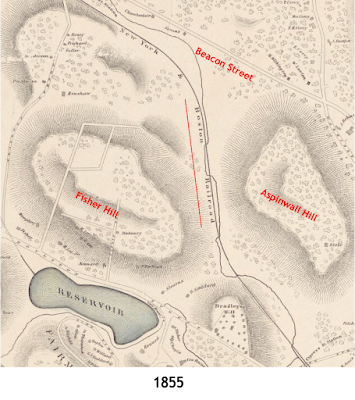
The map below at left, a portion of an 1855 map of Brookline, shows Fisher Hill at center left, north of the Brookline Reservoir.  The map at right shows more or less the same location today.


The older map was made 11 years after the Brookline Reservoir was built as part of the system bringing water from Lake Cochituate through Brookline to Boston. 

The New York and Boston Railroad, introduced in 1845, runs through the low-lying valley in the center of the map, between Fisher Hill and Aspinwall Hill. 

That, today, is the route of the D branch of the Green Line.

Beacon Street, laid out as a narrow, unpaved country lane in the 1850s, is to the north.

A few streets have been laid out across Fisher Hill, though houses are still largely confined to the lower slopes and would remain so for another 30 years.


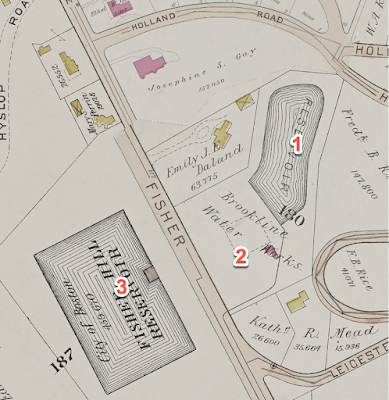
By 1874, when the view below (part of a larger map) was produced, Brookline was in the process of building its own reservoir on Fisher Hill to serve the town. 


A natural pond, shown in the circle in the center of this view, had been converted into an earthen basin to hold water that could flow through pipes from the high elevation of Fisher Hill to other parts of the town.


The water came from the Charles River, at the Dedham/West Roxbury border, four miles away.

“The Town of Brookline,” reported the Boston Globe, “is now actively engaged in laying down pipes, constructing reservoirs, and setting up the machinery for a supply of water from Charles River.” 

“The water is to be raised to an elevated point near the river….whence it will flow by its own gravity to the summit of Fisher's Hill…. 240 feet above tidewater.”

“From this point it is distributed through service pipes to the consumers.”

The pumping station in West Roxbury, shown below, was built on land owned by the Town of Brookline. It sent the Charles River water through through pipes up to Fisher Hill.


In 1888, the City of Boston built the Fisher Hill Reservoir, across Fisher Avenue from Brookline’s reservoir, as part of Boston’s own water supply


In 1893, Brookline added a second, smaller, covered reservoir to its own water system. It is under the dashed lines, marked “Brookline Water Works," between Fisher Avenue and the town’s older, open reservoir, on the map below.


The trade journal The Engineering Record presented sketches of the unusual covered reservoir. 

But to really get a sense what that looked like, here are underground photos from a few years ago, before a new development was built on the site of the long-unused covered reservoir.
 

By the time of the 1907 map below, the older, open reservoir of the Brookline Water Works had also been covered.
A brick house, owned by Josephine and Frederick Gay, had been built just north of the reservoirs.


This aerial view below, from 2025, shows new housing, outlined in pink, in the area once occupied by the Brookline reservoirs.


Fisher Hill Reservoir Park occupies the space of the former Boston reservoir.

The former Josephine and Frederick Gay house is now Mitton House, named for a later owner and now part of a new senior housing complex called The Newbury at Brookline.

The following views show some of the varied landscapes of today’s Fisher Hill Reservoir Park, opened in 2016…


...while some of the brickwork from the old town reservoir can be seen in the lawn of a new, town-built mixed-income housing development....


...along with an historical marker telling the history of the site.


Wednesday, September 11, 2024

Amateur Photography in 19th Century Brookline

The May 6, 1882 edition of the Brookline Chronicle included a list of 33 books recently added to the collection at the Brookline Library. There were books of history, fiction, science, and travel. 


There were some how-to books, including two guides for would-be painters: A Course of Lessons in Landscape Painting in Oils and Easy Studies in Water-Color Painting.


There was also a how-to book on a relatively new and increasingly popular art form: photography.

How to Make Pictures: Easy Lessons for the Amateur Photographer by Henry Clay Price

"A Sensible Craze"

"Anyone who has undertaken to be his own photographer will tell you there is a great infatuation about it," noted a review of the book in another newspaper. 


"Hence it may be termed a craze," continued the review. "It is also a high art to be able to catch and preserve any little scene of beauty that one may chance to meet with on his summer vacation. Any true art is sensible, therefore amateur photography is a sensible craze."


A year later, the Brookline Chronicle reprinted a lengthy article on "Amateur Photography" from the New York paper The Hour. "The amusement and services that may be had at the cost of a small, cheap photographic outfit are almost numberless," it said.

"Expression, which is the life of a portrait, cannot always be assumed to order in a studio, except by persons whose features are under unusual control, while children's pictures are generally of the variety known as 'wooden.' 


"But at home every expression of countenance may be seen and caught. Poses that do not come willingly amid unfamiliar surroundings and before strange observers, succeed each other rapidly in the unrestraining atmosphere of the family circle." 


Technical Innovation and the Boston Camera Club

The growth of amateur photography was spurred by the technical innovations of George Eastman and Henry Strong in Rochester, NY, beginning with dry emulsion glass plates in 1880. Camera clubs and photographic societies, taking advantage of the new, less complicated method of developing photos, sprung up across the country, including in Boston.


The Boston Society of Amateur Photographers was formed in 1881. Five years later, the name was changed to the Boston Camera Club.

The Photographic Times and American Photographer: Boston Society of Amateur Photographers
Click on image for larger view

Among the early members of the club were several Brookline men, including James Codman (one of the founders), William Hovey, George E. Cabot, John Hubbard, Robert Amory, Percival Lowell, and Edward Philbrick.

This 1886 photo of Cora Codman, age 12, may have been taken by her father, James, one of the founders of the Boston Camera Club. It is one of more than 40 photos of Brookline and Boston children in an album in the collection of the Brookline Historical Society.

The Boston Camera Club is the second-oldest continuously extant amateur camera club in the United States. Headquartered in Boston for most of its existence, it was based in Brookline from 1980 to 2023 before returning to Boston.


The Kodak Camera and the Brookline Camera Club


The next big innovation from Eastman in Rochester -- the Kodak camera -- had a big impact on the growth of amateur photography, including in Brookline. . 

"Anybody can take pictures with this instrument without practice.
Kodak advertisement, Rochester, NY, August 1888

The Kodak did away with glass plates altogether. The photographer could shoot multiple images without reloading, then send the film to Rochester to be developed, with the finished images shipped back to the sender when they were done.

In 1891, the Brookline Chronicle ran an article about effective advertising, reprinted from the Milwaukee Journal. One of the most effective ad slogans the article cited was Kodal's "You press the button, we do the rest."

"The Kodak: You Press the Button. We Do The Rest"
1889 Kodak advertisement

In October 1889, it was announced in the Chronicle that a meeting would be held to form a Brookline Camera Club.

"It is desired that all interested in this most fascinating art be present. The object of the club is for social intercourse and the interchange of views, and there are a sufficient number of photographers here to make it a success."


"Amateurs of both sexes are invited," reported the Brookline Chronicle, adding that "the club's constitution provides that "two of the members of the executive committee shall be ladies."  The club was also looking into setting up a darkroom and studio for its members. The club held exhibitions, discussions, and other events in town.


C.A. Chandler, who wrote about photography for the Boston Globe, had noted the creation of the Brookline club in his column.  But he was not a fan of amateur photography.


"'Amateur' in its original meaning," he wrote, "is 'a lover of,' and as applied to photography would convey that the man to whom it was applied was an enthusiastic lover of, and consequently a skilled adept in, the art.


"Now," he continued, "the meaning is degraded, and the man who buys a detective [a generic name for some 1880s box cameras], presses the button, and sends his paper or plates to be developed and printed from, is an amateur. He knows no more of the art than does the organ-blower [the person who pumped the air into pre-electric pipe organs] know of music."

 
Chandler's criticism notwithstanding, amateur photography continued to grow in popularity with men and women, young and old, including in Brookline, even as professionals came to town.

"The camera craze has secured a good hold on the Brookline boys."
Brookline Chronicle brief, January 4, 1890

Next up: Professional photographers in Brookline into the 20th century. See also the first article in this series: Brookline Photographers: The Early Years.


Sunday, February 20, 2022

19th Century Tobogganing on Corey Hill

A winter storm in Brookline today brings sledders to local hills, carrying all manner of conveyance for children and adults alike: classic Flexible Flyers; modern plastic models in a variety of shapes and colors; even cardboard boxes and purloined cafeteria trays.

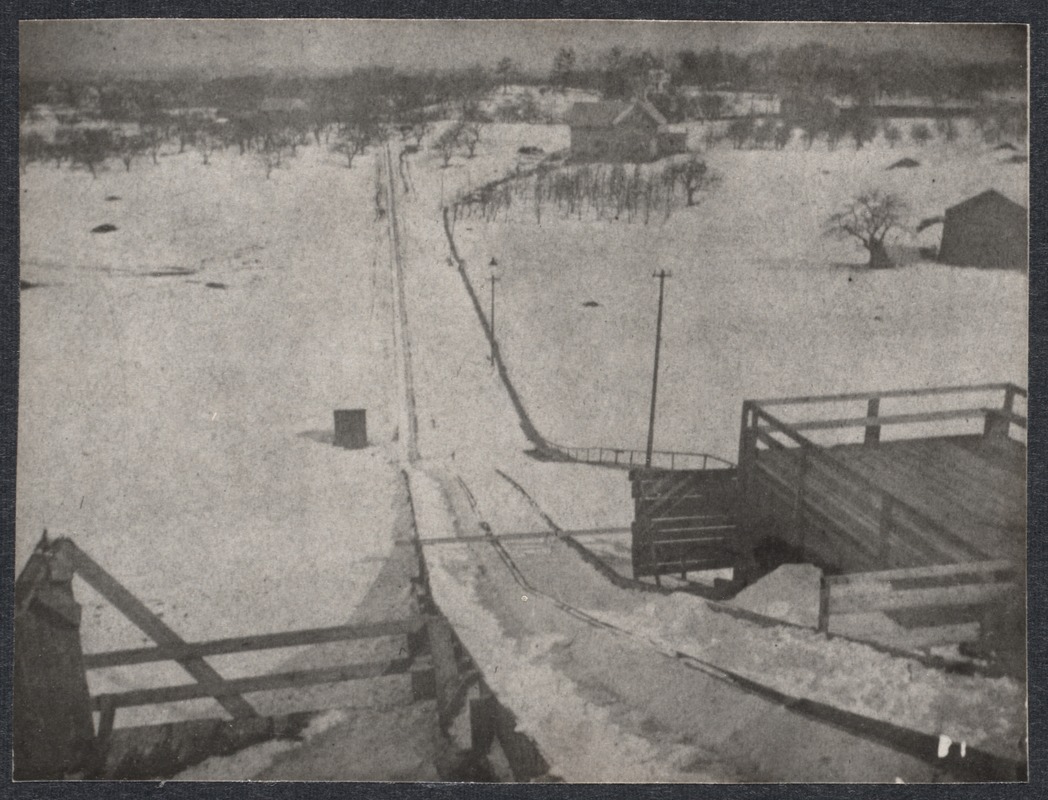
130 years ago, it also brought tobogganers to go whizzing down the most celebrated toboggan run in the Boston area: the steep chutes of the Corey Hill Toboggan Club.


Operating each winter, from December 1886 to February 1895, chutes ran from a clubhouse on Winchester Street across the then undeveloped lower slope of Corey Hill to a spot on Harvard Street approximately where the Chabad Center of Brookline (496 Harvard Street) is today.

Corey Hill toboggan chute, 1886
The toboggan chutes of the Corey Hill Toboggan Club. Looking from Winchester Street toward Harvard Street, 1886. Photo courtesy of the Public Library of Brookline. (Click on image for larger, zoomable view.)

A Canadian Import Comes to Brookline 


Toboggans – and the word toboggan – originated with indigenous peoples of North America, who used them to transport items across snowy landscapes. Recreational tobogganing began in Canada, most notably on Mount Royal in Montreal where the Montreal Toboggan Club opened three slides in 1879.


Tobogganing soon spread across the U.S. border. The Corey Hill Toboggan Club was formed in November 1886, and quickly became known as the best facility in the northeast. 


Construction of a clubhouse and chutes began immediately after the formation of the club. The clubhouse stood approximately where 197-199 Winchester Street is today. By December 1886 there were three chutes in place, one of the three starting from a platform at the top of the clubhouse 12 feet above the level of Winchester Street. That made for a rapid 42-foot drop to the level of the meadow that ran to Harvard Street. 


In early December, the club successfully petitioned the Brookline Electric Light Company to have poles places along Harvard Street to provide power to light the chutes at night. By Christmas, the electric lights were in place.


When a 300-strong contingent of the Montreal snowshoe and toboggan club Le Trappeur  visited Massachusetts in February 1887, members of the three-month old Corey Hill Toboggan Club were their main escort in a large parade through the streets of Boston. 


The Le Trappeur club of Montreal marching down Beacon Street in Boston from the State House as shown in Frank Leslie's Illustrated Newspaper, February 12, 1887


A lack of snow prevented the Canadians from trying the Brookline slides, but they did take back to Montreal an oil painting showing two club members, Massachusetts governor Oliver Ames and 20-year old Florence Peck of Boston, flying down the Corey Hill chute on a toboggan. Peck, whose father was on the executive committee of the club, presented the painting to Montreal mayor HonorĂ© Beaugrand at a State House reception.  


A month later, several members of the Brookline club visited their one-time guests for the winter carnival in Montreal. 
 

The “Best and Most Expensive” Slide  


By the winter of 1887-88, there were at least five toboggan slides in the Boston area. They included a slightly older Brookline club at Wright’s Hill, near Boylston Street and Reservoir Lane, and facilities in Dorchester, Cambridge, and Malden. But, reported the Boston Globe in a lengthy article on tobogganing, “the Corey Hill slide is by far the best and most expensive one.”  


The chutes, reported the Globe, were not as long as some of the others in the area, “but the management finds that it is more pleasing to the members to have them short and steep instead of long and gradual.” In fact, wrote the Globe reporter, the Corey Hill chute was the steepest in the country. 

Tobogganing on Corey Hill, as seen in a later article in the Boston Globe (January 15, 1893)


The club grew to more than 300 members that second winter of its existence, including residents of Brookline, Back Bay, and other parts of Boston and neighboring communities. The clubhouse was enlarged to include a waiting room with a fireplace on the lower floor, a smoking room, bathrooms, a kitchen for preparing meals and refreshments, and a storage area for toboggans so that club members did not have to carry them to the site each time.  


The chutes themselves had water poured on top of the packed snow where it would freeze and provide a smooth sliding surface. A well was sunk and pipe was laid along the length of the chutes to keep them watered. Innovations in later years includes a tilting platform at the top and a motor-driven return chute to bring toboggans back up the hill for additional runs or storage.  


Articles in the Brookline and Boston newspapers described the thrill of taking a toboggan down the Corey Hill chutes. Here’s how the Boston Globe described it in December 1887:


“A push, a rush of cold air, and you fall through space more like a meteor than anything else. It is not a slide; it is a flying hop-step-and-jump to the foot of that 100-foot slope. Even then the speed seems to increase, but the novice feels that the toboggan is sliding over something solid, and that is a crumb of comfort. In quicker time than it takes to read, much less write it, the toboggan flies straight out over the dip or second fall and comes down with a flop, but without wavering in its wild career continues scurrying down the incline.”


Novices, said the Globe, find “their sensations of fright and delight so inextricably mixed that they can’t tell which is uppermost. And the beauty of the whole thing is the sensation does not wear away as your trips become more frequent.”  


An 1893 article in the Boston Post, written under the pseudonym “Amy Robsart,” described one woman’s experience going down the Corey Hill chute this way:  


“I took a long breath and shut my eyes. – ! – !
There were two consecutive bumps half way down that made me open them, and I saw flying bits of Biela’s comet and thousands of starry dazzlements in a flight through the air. That is probably the nearest I shall ever approximate to flying….
My bangs stood up straight, my hat flapped wildly on the firm pivot of my hat pin, there was a trail of hairpins in my wake.
‘Where am I at?’ I inquired a little ruefully when I had been picked out of the snow and had smoothed my ruffled plumage.
But it was fun!
Fun with the keen edge of fear that gives it the fascination that it is.” 


Clothing, Class, and Gender  


Toboggans, toboggan slides or chutes, and the thrill of participating were not the only elements of this popular recreational activity to cross the border from Canada.  Tobogganing fashion also followed the Canadian model. Members of the Corey Hill club, and other clubs, wore outfits modeled on those of Canadian clubs, with each club having its own colors.  

The c1880 photo at left shows men and women of a Montreal toboggan club in their club outfits. (Photo courtesy of the McCord Museum). Similar outfits can be seen in an 1886  advertisement in the Brookline Chronicle, top right, and an illustration of Corey Hill tobogganers in an 1888 story, bottom right. (Click image for a larger view)


More significant were class and gender elements of tobogganing that were common in Canada and were replicated in Brookline and other American communities. As Canadian scholar Gillian Poulter wrote in a 1999 dissertation (later turned into a book) on sport, spectacle, and identity in Montreal:  


“Forming clubs and building slides and club houses was a means by which club members differentiated and separated themselves from the poorer classes. By demarcating specific areas as club property, and by adopting blanket suit costumes, the professional and commercial middle-class tobogganers were in no danger of having to share their slides with ‘the great unwashed,’ who in any case probably had little time and energy to spare for such diversions.”


At Corey Hill, a club membership cost $3, later increased to $5. Club members had to wear their club badge – an example is shown below – to use the toboggan chutes. The club outfits – not required, but common – and the toboggans themselves added additional costs. The club drew members – including at least two Massachusetts governors -- from Brookline as well as the Back Bay and other areas.  

Photo courtesy of the Public Library of Brookline

It’s not known if there were specific ethnic restrictions in the club’s bylaws, but it is worth noting that although Brookline had a substantial, largely working class, Irish-American population by this time there are no Irish surnames shown in the many articles in the Brookline and Boston newspapers that listed officers and participants in the club’s activities  


(The Country Club in Brookline, which was started just four years before the Corey Hill Toboggan Club and had its own history of restrictive membership policies, also had its own toboggan slide during this period.) 


Men and Women Together on the Slopes  


The thrilling ride down a toboggan chute presented opportunities for a kind of closeness not usually considered proper for young couples. As the Toronto literary magazine The Week put it in an 1885 article:  


“When Florence or Charlotte has to be tightly encircled in the grasp of an admiring pilot, down the glittering descent, the pair feel the mutual dependence and responsibility, which often leads them to courtship in earnest.”  


In her dissertation, Gillian Poulter notes that Canadian newspapers sometimes described the sensation of tobogganing for women in what she described as “surprisingly eroticised terms”. The Brookline News, in an article on tobogganing published on Christmas Day, 1886, was more circumspect:. “There are some things about it [tobogganing],” wrote the News, “that never will and never can get into any newspaper.”   


The same article in the News did include a description of another part of tobogganing with particular appeal for young couples: the climb together back up the hill. The article quoted a pamphlet on tobogganing, together with an illustration of “The Uphill Road,”:


"Uphill we clambered, and as I felt the gloved hand of Dick’s younger sister upon my sustaining arm, I wished the climb might have been twice the distance; and right here I want to say that if ever a woman looks fresh and young and irresistibly lovely it is when at the top of a climb up a toboggan slide she stops with her cheeks flushed, her lips parted, and her eyes shining with the exertion [of the climb].”


In January 1888, the Brookline News shared what a couple of magazines had to say about what was on the minds of young couples on the Corey Hill slopes:


"Puck [a humor magazine) says if you have the right kind of girl, the walk up the toboggan slide is just as exciting as the ride down. And sometimes more so. It's a glorious sport both ways."
- Brookline News, January 14, 1888

“Ethel: Which toboggan slide do you like best, Corey’s Hill or Wright’s Hill?
Mabel: Oh ! Corey’s Hill, don’t you? It’s so much steeper that the men have to hold on to – er – the toboggans ever so much tighter.” 
- Brookline News
, January 21, 1888 (Reprinted from the Harvard Lampoon)

Tobogganing Seasons Come and Gone  


Club members and their guests continued to climb Corey Hill to use the club’s chutes through the winter of 1894-95. Many more came out to watch.  As many as 500 people were reported on the slopes at times, with as many as 150 actually going down the chutes.  


A good tobogganing season depended, of course, on having enough snow. Activity rarely began before January, and there were years where very little tobogganing took place. (A January 28, 1888, Brookline Chronicle article noted there had been 30 nights of tobogganing so far that season and that they hoped to break the previous records of 55 nights.)  


Social events at the clubhouse were a big part of the Corey Hill Toboggan Club’s activities, whether there was actually tobogganing or not. There were musical performances by club members, “smokers” (probably male-only social gatherings) and “ladies’ nights.”   


There were carnivals on the slopes, modeled on those that were held in Montreal and elsewhere. (The 1893-94 season, for example, included an “Illumination Night,” with fireworks, fire balloons and bonfires, and a “Fancy Dress Carnival.”) In the last years of the club, these social events received more attention in the local press than the actual tobogganing.  


The winter of 1894-95 was the last to see tobogganing on the chutes of the Corey Hill Toboggan Club. In December 1895, the Brookline Chronicle reported that the club was planning several elaborate entertainments for the next three or four months. But on January 18, 1896, the Chronicle asked “What is the matter with the Corey Hill Toboggan Club this winter? Will the gentle art of harmless chuteing [sic] be allowed to become extinct?”  


That same week, the Boston Post, in a brief article titled “Tobogganing on Corey Hill,” reported:  


“The lovers of tobogganing in the city will probably not have a chance this winter to enjoy the sport at the Corey Hill Toboggan Club. The chute is all falling to pieces and ditches are dug through the field where the chute makes its course.  


A meeting of the directors of the Corey Hill Club was held last Christmas, but nothing definite was done in regard to fixing up the slide. "


The demise of the Corey Hill Toboggan Club was no doubt due to growing residential development in this part of Brookline in the wake of the laying out of the Beacon Street boulevard and the coming of the streetcar a decade earlier.   


By 1897, the club, it’s clubhouse, and its celebrated toboggan chutes were no more. (See the maps below for a detailed view of the change.)  

These segments from the 1893 (top) and 1900 (botom) Brookline atlases show the northwest side of Corey Hill. The approximate location of the toboggan chutes has been added as an orange line. The clubhouse of the Toboggan Club is at the high point on Winchester Street in the 1893 map. 

By 1900, Verndale, Kenwood, Henry (now Russell), and Columbia Streets have been added and there are houses on the lower part of the hill with plots laid out higher up, including on both sides of Winchester Street. The clubhouse is gone. (Click image for a larger view)


Friday, July 7, 2017

Birds & Birdhouses at the Library, 1914

The current building of the Brookline Library was less than four years old when the photograph below was taken in April 1914. It shows a room on the lower level of the library (where the Children’s Room is now) filled with a display put together by the Brookline Bird Club with help from the town’s Forestry Department.

(Note: This article first appeared in Brookline Patch as part of a biweekly series of historical images of Brookline from the Brookline Historical Society and the Public Library of Brookline. A larger, zoomable view of this photo and two others from the exhibit is available on the Digital Commonwealth site.) 
 
Birds and birdhouses in the library

The Bird Club itself was new, having been formed one year earlier at a meeting in the library. The club organized walks, lectures, round table discussions, and exhibits on bird life. It welcomed both adults and children.

A special Junior Department, described in a centennial history of the club, offered "birding-by-bicycle in Brookline and Cambridge, lessons in drawing birds and conducting a bird census, field contests in naming birds, and visits to the Harvard Museum of Comparative Zoology and the recently opened aviary at Franklin Park Zoo.”

The library exhibit featured an arbor made of trees limbs with various kinds of nesting, feeding, and shelter boxes attached to them. Many of these were made by club members and staff of the Forestry Department. There were others made by students in the Manual Training School. Some of these, reported the Boston Globe, were made from ordinary boxes, tin cans, or old flower pots “to demonstrate how cheaply a bird house or box can be made."

Simple and complex birdhouses and birdfeeders

The exhibit also included bird eggs, nests, photographs, charts, and a variety of stuffed birds. Many of the latter were from a collection of Edward W. Baker, the longtime Town Clerk and the president of the club who, noted the Brookline Chronicle, was “a man who long ago learned that it is better to hunt birds with opera glass and the camera and who consistently devotes his energies to the spreading of that gospel.”

The club’s interest in birds had an economic, as well as aesthetic and scientific purpose. The town’s trees had been devastated by insect infestation. “Brookline has been as hard hit by the work of the gipsys, brown-tail, leopard moths and elm beetle as any of her neighbors,” the club’s vice president Charles B. Floyd wrote in American Forestry magazine in 1915. “In 1908 the town was the worst gipsy moth infested district in New England. Today the gipsys are well under control and due recognition of the work of the birds is made.”

Charles B. Floyd (left), one of the original officers of the Brookline Bird Club, did much to share news of the club and its activities through articles in publications like American Forestry and Bird-Lore, the predecessor to today’s Audubon magazine. He was later a longtime Newton alderman.

(Photo credit: Blackington, Alton H. Charles B. Floyd, bird expert, ca. 1930. Alton H. Blackington Collection (PH 061). Special Collections and University Archives, University of Massachusetts Amherst Libraries)

Although the club was unsuccessful in establishing an official bird sanctuary in town, it did persuade owners of several large estates to post signs prohibiting shooting on their property. Officers of the Forestry Department helped enforce the prohibition.

Brookline Bird Club logo
The Brookline Bird Club rapidly expanded beyond Brookline, attracting members from throughout Massachusetts and beyond and organizing trips throughout the eastern part of the state and further afield. Today, the connection to Brookline is largely in name only, but the 1100-member club is the largest and one of the oldest of the many bird clubs in Massachusetts.

Sunday, July 10, 2016

A Long History of Girls Basketball at BHS

I saw a notice in my Facebook feed today that the Brookline High Girls Basketball coaching staff is kicking off its version of Basketball Night—coaching sessions for 3rd through 12th grade girls—at Schluntz Gym tomorrow night. By coincidence, just yesterday I had come across the picture below, showing BHS girls practicing basketball way back in 1902.

BHS Girls Basket Ball 1902
Image credit: Harper's Weekly (Click here for larger view)

The image is from an article on "College Girls and Basket-Ball" in the February 22, 1902 issue of Harper's Weekly. BHS is the only high school pictured, along with images from Wellesley, Smith, Bryn Mawr, and Newcomb College in New Orleans.

The location is uncertain. My best guess is that it's behind the 1893 high school building, the first built on the current site. That would put it approximately where the courtyard and the auditorium wing are today. (The rise in the background would be the beginning of Aspinwall Hill.)

Basketball was "the most popular sport with women across the United States in the first years of the twentieth century," wrote Paul John Hutchinson in a recent doctoral dissertation at Boston University.1 That certainly appears to have been the case at BHS.

An 1898 report from the Committee on Physical Training of the Brookline Education Society reported that

The game of basket ball is at present very popular. It is a game which both sexes may play, but is especially appropriate for the girls. Several outfits for this game have been provided. The committee is not yet ready to report on the benefits of this plan.

In February 1898—just seven years after the game was invented by James Naismith in Springfield— an exhibition of BHS girls basketball was the closing event at a Town Hall demonstration of games and gymnastics engaged in by students in the Brookline schools.

By the early 20th century, the Brookline girls basketball team was playing in competition against other local high schools and even occasionally against college teams. 

Brookline - Dedham Girls Basketball 1904, Boston Globe
Boston Globe, February 19, 1904
BHS - Radcliffe Basket Ball Game 1904
Boston Globe, December 14, 1904


Apparently, not everyone was in favor of girls playing basketball. In 1901, Prof.William F. Bradbury of Cambridge Latin School, responding to a favorable report by BHS teacher Arthur W. Roberts, spoke in opposition:

I have had some experience in Cambridge with basket ball [said Bradbury], and I find it makes the girls rough, loud-voiced and bold.

Let's be thankful his view did not prevail, and look forward to more loud-voiced, bold, straight-shooting girls on and off the court.


Tuesday, June 16, 2015

Mini Golf in Brookline: Past & Present

Did you know that Brookline once had an indoor miniature golf course designed by perhaps the most famous golf course architect of all time?

Littlputt Links, designed by Donald J. Ross, opened in 1930 on the second floor of the building at 308-312 Harvard Street in Coolidge Corner. That’s the space now occupied by Michael’s Salon, above Magic Beans and the Regal Beagle restaurant.

Chronicle Ad
Brookline Chronicle, 11/27/1930
Ross, according to the World Golf Hall of Fame, “was, and still is, considered the Michelangelo of golf.” He was the first architect (and one of only five to date) inducted into the Hall of Fame.

Among the best known of the more than 400 courses he designed over a half-century career are Pinehurst #2 in Pinehurst, North Carolina, Seminole in Juno Beach, Florida, Oak Hill in Pittsford, New York, and Oakland Hills in Bloomfield Township, Michigan. Ross was also a successful golfer, playing in seven U.S. Opens and finishing as high as fifth (in 1903).

Ross designed what was to be a second 18-hole course for The Country Club in Brookline in 1921 but it was never built. He was also invited to submit a design for the municipal course that eventually became the Robert T. Lynch Golf Club at Putterham Meadows, but he declined. (He reportedly was opposed to entering design competitions.)

Boston Globe, 10/26/1930
But despite these setbacks, Brookline did have its Donald Ross-designed course, if only in miniature and only for a short time. In October of 1930, Ross took out a lease on the second floor of the commercial building next to the Coolidge Corner Arcade. Littlputt Links announced its November 15th opening with an ad in the Brookline Chronicle promising “features that appeal to the experienced golfer as well as the miniature golf fan.”

Chronicle Ad
Brookline Chronicle, 11/13/1930
 The course does not appear to have lasted long; the last ad for Littlput ran in the Chronicle less than three weeks after the opening and it was not listed in the town directory the following year. Later occupants of the second floor included the Oriental Restaurant (with a band and dancing) and, as seen in the photo below, 20th Century Billiards.

Photo of building with billiard parlor on second floor
Photo from Town of Brookline Preservation Office
I contacted the Donald Ross Archives in North Carolina to learn more about Ross’ design for the Brookline mini-course. But despite extensive collections of plans and other documentation of Ross’ work, they had no record of Lillputt Links. It remains an oddity and a bit of a mystery from Brookline’s past.

There may no longer be a Donald Ross-designed miniature golf course in Brookline, but mini-golf fans can have fun, test their skills, and help support the Public Library of Brookline at the main library on Washington Street this Saturday, June 20th. See Tee Off @ the Library for details.

Monday, December 30, 2013

Happy 80th Birthday Coolidge Corner Theatre!

The Coolidge Corner Theatre opened on this date in 1933 after years of opposition that kept Brookline theaterless long after movies had come to neighboring communities.

Read more about the 20-year fight to keep motion pictures out of Brookline in this two-part post from 2009.
Ad for opening of theater, 1933
Ad in Brookline Chronicle, December 21, 1933