Showing posts with label Women. Show all posts

Wednesday, January 31, 2024

Pages of the Past: Diaries of Two 19th Century Brookline Readers


Step into the past and explore the lives of two 19th century Brookline women and the books they read. This presentation will take place at the Larz Anderson Auto Museum on Saturday, February 10th, from 12:30 to 2:00 pm.

Proceeds ($15 per person) help support the non-profit museum, which is hosting the event. Register here.


Mary Wild raised six children in her home on what is now Weybridge Road, where she lived from the 1820s to the 1850s. Adelaide Faxon lived nearby, on Linden Street, as a teenager in the 1850s. Both houses are still standing. 

The 19th century homes of Mary Wild, left, and Adelaide Faxon, both still standing today.

One thing they had in common is that both were avid readers who documented what they were reading. The Brookline Historical Society has painstakingly transcribed and annotated the diaries of these women, providing insights into the tapestry of life and society in Brookline during the 1850s.


This program offers a look at the books they read and what they tell us about mid-19th century literature and two people who made it a part of their lives.


Diary entries from Mary Wild, top, and Adelaide Faxon, about books they read.

Sunday, August 7, 2016

Virginia Aiken, Teenage Dealer of Electric Cars

On Memorial Day in 1912 a parade of 125 electric cars and trucks made its way from Brookline Avenue through the Back Bay to downtown Boston. At the head of the parade, as she had been in a smaller procession the year before, was 17-year old Virginia E. Aiken of Brookline.

Aiken was the niece of Day Baker, the head of the Electric Vehicle Club of Boston, with whom she lived on Winthrop Road. But the former Runkle School student was no mere figurehead. She was New England representative of the Buffalo-based Babcock Electric Carriage Company, responsible for sales throughout the six-state region.

Virginia Aiken promotional postcard
Promotional postcard for Virginia Aiken, Babcock Electrics
(Click image for larger view)
Aiken operated out of the Brandon Garage at 643 Washington Street, where she maintained an office, employed a stenographer and a bookkeeper, and kept several models of Babcock Electrics to demonstrate to prospective buyers.

1912 ad for Virginia Aiken's Babcock Electrics
Ad for Virginia Aiken's Babcock Electric dealership, Boston Post, May 9, 1912
1913 Map showing location of the Brandon Garage
The Brandon Garage at 643 Washington Street was Virginia Aiken's base of operation.
Source: WardMaps LLC
How did a teenage Brookline girl arrive at such an unusual situation for her age and gender more than a century ago?

Virginia Aiken
The Automobile Journal, 1912

Virginia Elise Aiken was born in Philadelphia on April 10, 1895, the daughter of Frank E. and Ada (West) Aiken. Her father was a freight inspector and her mother was a stenographer. Her father's father, Frank Eugene Aiken Sr., was a well-known actor and theater owner active mostly in Chicago, but at other times in Philadelphia and New York.

Aiken spent most of her childhood in Chicago. In 1910 or 1911 she moved to Brookline to live with her father's sister Viola and Viola's husband Day Baker and to take advantage of the better educational opportunities in the Boston area. They lived at 145 Winthrop Road. Virginia enrolled at the Runkle School and later at Miss Haskell's School for Girls on Marlborough Street.

Day Baker was New England agent for an electric truck manufacturer and a prominent advocate for electric vehicles. His efforts brought him into contact with Thomas Edison and he became New England representative of the Edison Storage Battery Company which made batteries for automobiles and trucks. (Edison's 22-year old son Charles was one of the ushers at an 18th birthday dance thrown for Aiken by her aunt and uncle at Brookline's Gardner Hall.)

A lengthy 1912 profile of Aiken in The Automobile Journal told how she obtained a license and drove thousands of miles, most of them in electrics. And as the Boston Globe reported:

For some months she has been seen in her pearl gray Victoria around the congested streets of the city, driving in and out among carriages, wagons, street cars and great trucks, or on the streets and boulevards of the suburbs. People have stopped and wondered at the ease and grace with which she handled her automobile, but she always smilingly disclaims any especial skill and replies "You know, it's no trouble to operate; you don't have to crank it, nor do you have a whole lot of levers about which to think: it is so simple to run—it's electric."

But her interest in cars, reported The Automobile Journal, went beyond driving.

Now, Miss Aiken is practical and she began to study the electric carriage with keen enthusiasm. Instead of merely giving attention to the maintenance and care she went back to rudiments and systematically acquired knowledge concerning the battery and the motor. She studied electrical subjects carefully and mastered each with its particular reference to vehicles. She was fortunate in having her uncle as an adviser and under his direction she was able to apply her knowledge to good advantage.

Constantly using the electric machines she met with all conditions that might be encountered and it was with extreme satisfaction that she solved all problems and successfully met every situation. The girl did not hesitate to work about the cars whenever necessary. She found delight in mechanical work and did it surprisingly well.

When Francis Babcock, founder of the Babcock Electric Carriage Company, visited Boston and met Aiken he suggested she become his New England agent and helped set her up in business. Aiken told the Boston Globe she planned to use the profits from the business to pay for her education.

The budding entrepreneur also understood the value of good marketing. She put half of the profits of her first sale into promotion, including newspaper advertisements and engraved notes. "[T]his, and her energetic work, [reported The Automobile Journal] brought to her other customers."

Electric vehicles were sometimes marketed specifically to women, and Aiken's unusual position as a female agent may have helped. She was interviewed by the Boston Post for a July 1912  article that ran under the headline "Miss Aiken's Advice to Women Motorists."

"Why, yes, [she told the reporter] I know it does you good to ride in an electric—it has done me good—don't I look the model healthy electric young woman? Seriously, I do believe that it gives one good health, a good appetite and good control of one's nerves to operate an electric vehicle.

I have in mind a Newton lady who has one of our cars—she drives it herself, charges it with a mercury arc rectifier in her own little garage and looks after her battery herself. She takes great enjoyment in looking after all these little details herself. The out-of-door air exercise that she gets in caring for her car and the long rides which she takes almost daily keep her in the best of health.

No, you newspaper men cannot too strongly urge the driving of electric automobiles by the ladies of Boston as a health-giving and enjoyable method of regaining and keeping health, but it does not end with the health question. The convenience of making calls, shopping, attending church and social functions are all points that are worthy of mention—but of course good health is always a strong argument.

The 1912 advertisement below for Aiken's display at the Boston Auto Show illustrates how Babcock Electrics were marketed especially to women. ("The Runabout for Misses. The Victoria for Ladies".)
Boston Post ad for Virginia Aiken's dealership
Ad for Virginia Aiken's display at the Boston Auto Show Boston Post, March 3, 1912

Many articles about Aiken were published in 1912, in the Boston newspapers and in trade publications like The Automobile Journal, Motor Age, and Electrical World. But her dealership was apparently short-lived. A later article in The Automobile Journal about her Fall 1912 exhibit at the electrical show at Mechanics Hall in Boston, said

While Miss Aiken will retain an interest in the Buffalo electric, it is her intention, after the electric show, to devote the most of her time to studies and music, believing that the proportions to which she has brought the business warrant placing it in the hands of a large automobile sales establishment. Full details of this move will be announced later.

I have not been able to find any such later announcement but there were no further mentions of her dealership after 1912.

Engagement announcement Boston Post
Boston Post, March 30, 1918
In 1918, Aiken's engagement to a Harvard Medical School graduate named Lawrence Weld Smith was announced in a brief article in the Boston Post. The announcement noted that, in addition to Miss Haskell's School (a college preparatory school for girls in the Back Bay), she had attended the Farmer School of Cookery (founded by Fanny Farmer). By 1918, she was back in Chicago where, the article said, she was active in Red Cross work.

The Aiken-Smith marriage never happened. Instead, on Christmas Eve 1919 in Chicago, Aiken married a Swiss immigrant named Robert (or Roberto) Tranquillo Pellandini. They had a daughter, born in Chicago in 1921, and lived for several years in Mexico where Robert Pellandini's family had business interests. (Virginia Pellandini took Swiss citizenship and had to reapply for U.S. citizenship when they returned in 1925.)

The Pellandinis were frequently on the move. They lived, at various times, in Chicago, Mexico City, Easton, Brockton, and Lincoln, Massachusetts, and Lorain, Ohio, before settling in Hot Springs, Arkansas. Robert had several jobs, as listed in directories and census records, including sales manager for a shovel and tool company and accountant with the Ford Motor Company. No further career information is listed for Virginia.

Robert Pellandini died in 1980. Virginia Aiken Pellandini died, at age 92, in Hot Springs in 1987.
Gravesite of Robert and Virginia (Aiken) Pellandini
Memorial Gardens Cemetery, Hot Springs, Arkansas

References

Sunday, July 10, 2016

A Long History of Girls Basketball at BHS

I saw a notice in my Facebook feed today that the Brookline High Girls Basketball coaching staff is kicking off its version of Basketball Night—coaching sessions for 3rd through 12th grade girls—at Schluntz Gym tomorrow night. By coincidence, just yesterday I had come across the picture below, showing BHS girls practicing basketball way back in 1902.

BHS Girls Basket Ball 1902
Image credit: Harper's Weekly (Click here for larger view)

The image is from an article on "College Girls and Basket-Ball" in the February 22, 1902 issue of Harper's Weekly. BHS is the only high school pictured, along with images from Wellesley, Smith, Bryn Mawr, and Newcomb College in New Orleans.

The location is uncertain. My best guess is that it's behind the 1893 high school building, the first built on the current site. That would put it approximately where the courtyard and the auditorium wing are today. (The rise in the background would be the beginning of Aspinwall Hill.)

Basketball was "the most popular sport with women across the United States in the first years of the twentieth century," wrote Paul John Hutchinson in a recent doctoral dissertation at Boston University.1 That certainly appears to have been the case at BHS.

An 1898 report from the Committee on Physical Training of the Brookline Education Society reported that

The game of basket ball is at present very popular. It is a game which both sexes may play, but is especially appropriate for the girls. Several outfits for this game have been provided. The committee is not yet ready to report on the benefits of this plan.

In February 1898—just seven years after the game was invented by James Naismith in Springfield— an exhibition of BHS girls basketball was the closing event at a Town Hall demonstration of games and gymnastics engaged in by students in the Brookline schools.

By the early 20th century, the Brookline girls basketball team was playing in competition against other local high schools and even occasionally against college teams. 

Brookline - Dedham Girls Basketball 1904, Boston Globe
Boston Globe, February 19, 1904
BHS - Radcliffe Basket Ball Game 1904
Boston Globe, December 14, 1904


Apparently, not everyone was in favor of girls playing basketball. In 1901, Prof.William F. Bradbury of Cambridge Latin School, responding to a favorable report by BHS teacher Arthur W. Roberts, spoke in opposition:

I have had some experience in Cambridge with basket ball [said Bradbury], and I find it makes the girls rough, loud-voiced and bold.

Let's be thankful his view did not prevail, and look forward to more loud-voiced, bold, straight-shooting girls on and off the court.


Monday, October 7, 2013

Lady Betty's Marmalade: Brookline, circa 1914

The latest addition to the collections of the Brookline Historical Society's Edward Devotion House is this marmalade jar (below left) from a line of products manufactured and sold by a Brookline woman a century or so ago.

The jar was recently offered for sale online with no date of origin and little description. Some quick research turned up an advertisement (below right) from the June-July 1914 issue of American Cookery magazine, and the jar was acquired for the Historical Society.

Lady Betty Marmalade jarAmerican Cookery advertisement, 1914


But who was “Lady Betty”? The address — “Beacon and Washington Sts.” — gave just a clue. A second advertisement from 1914, a musically-themed ad in the program of the Boston Symphony Orchestra, was a treat to find but offered no further hints to the identity of “Lady Betty.”
BSO Program advertisement 1914
Finally, a third 1914 ad was found in the December issue of Good Housekeeping magazine, and this one had a specific address: 1624 Beacon Street.

Good Housekeeping advertisement 1914

1624 Beacon Street was (and still is) part of the Rhodes Block, a commercial building on the northeast corner of Washington Square, built in 1913 for the Rhodes Brothers grocery store.  (A branch of Rhodes Brothers occupied the corner location.) 1624 was one of two storefronts on the Beacon Street side of the building; there were two more on the Washington Street side.

The Rhodes Block, Washington Square
The Rhodes Block in 1914.  (From The Brookline Christmas Magazine, published by the Brookline Friendly Society, December 1914). 1624 Beacon is at the far right.

Cleveland Circle Travel occupies the 1624 storefront today.  But a look at the 1914 Brookline Directory gave us the answer we were looking for.  “Lady Betty” was actually a woman named Gertrude Maynard.

Gertrude Maynard, marmalade manufacturer, in 1914 Brookline Directory


Gertrude Maynard was born Gertrude Maria Davis in Vermont in 1847.  She married Abbott Thayer Maynard in Boston in 1869.  Abbott Maynard was a jeweler and silversmith with a business on Boylston Street in Boston for many years.  

The Maynards moved from Boston to Brookline around 1908.  (That’s the first year they were listed in town directories.) It’s unclear when Gertrude Maynard began producing her Lady Betty line of products, but it was no later than 1912.  The ad below for Park & Tilford, one of Lady Betty's retail outlets, appeared in the December 19, 1912 edition of the Evening Herald in New York.

New York Evening Herald advertisement, 1912

Ads for Lady Betty products appeared in several other newspapers and magazines as well.  The products were sold in stores in Boston, New York, Philadelphia, Washington, and Detroit, and by mail order.  They were exhibited at the Panama Pacific International Exposition in San Francisco in 1915.

Maynard advertised her products as “Guaranteed free from adulteration.  No artificial color, flavor, or preservatives.”  As proof, she cited approval from two leaders in the pure food movement of the time: Lewis B. Allyn and Harvey W. Wiley.  Allyn was a professor of chemistry at the Westfield Normal School in Westfield, MA who established the Westfield Standard for food purity and evaluated thousands of food products.

Wiley, also a chemist, played a leading role in the passage of the Pure Food and Drug Act in 1906 and became the first commissioner of the U.S. Food and Drug Administration.  In 1912, he resigned to take over leadership of Good Housekeeping magazine’s food testing laboratories.

Wiley’s 1916 book 1,001 Tests of Food, Beverages and Toilet Accessories, Good and Otherwise: Why They Are So included analysis of several Lady Betty products.  All received his star rating, or stamp of approval, but not without some comment on the ingredients—and the high prices Lady Betty charged.

Lady Betty products in 1,001 Tests of Food, Beverages and Toilet Accessories, Good and Otherwise: Why They Are So

Gertrude Maynard died in September 1916 at age 69.  The business may have continued for a while after her death.  (Abbott Maynard, who had retired from the jewelry business, was listed in town directories as a manager at 1624 Beacon as late as 1919.)

In any case, this Brookline business started by a woman in her 60s was a short-lived one.  But “Lady Betty” now lives on in the collection of the Brookline Historical Society. 

Life magazine advertisement 1914
Life magazine, April 9, 1914

Washington Post advertisement, 1913
Washington Post, October 30, 1913
Wellesley Townsman advertisement, 1917
Wellesley Townsman, June 8, 1917


Monday, December 28, 2009

From Snow Sculptures to the Paris Salon and Beyond

1893 sketch of Henry Hudson Kitson and Theo Alice Ruggles at work in their studioHenry Hudson Kitson and Theo Alice Ruggles at work in their studio in 1893. This sketch, which first appeared in The Illustrated American, was reproduced in a June 25, 1893 Boston Globe article—"Tale of Art and Love"—that described their partnership and forthcoming marriage. (Click on image for a larger view.)

In 1885, 14-year old Theo Alice Ruggles made a snow sculpture in the yard of her family's Brookline home on Harvey Street (now 30 Upland Road). This was no ordinary snowman. It showed a recumbent horse in the act of rising from the ground, and it attracted notice in the neighborhood and beyond. People from Boston were said to make the trip out to Brookline just to see it.

Encouraged by admiring visitors, Ruggles' parents tried unsuccessfully to enroll her in art school before finding a young sculptor, Henry Hudson Kitson, willing to take her on as a student. It marked the beginning of a journey that would lead in just a few years to the Paris Salon, to partnership and marriage with Kitson, and to recognition as one of the most accomplished woman sculptors of her day.

1893 portrait of Theo Alice RugglesPerhaps most remarkably for a woman in that era, Theo Ruggles Kitson became one of the leading sculptors of war memorials in the United States, with statues, busts, and reliefs on display from coast to coast commemorating the Civil War, the Spanish-American War, and World War I.

Theo Alice Ruggles was born January 29, 1871. She was the daughter of Cyrus W. and Anna H. Ruggles. Her father, a successful businessman, was also Brookline's postmaster and the station master in town for the Boston & Albany Railroad. As a young girl, Theo enjoyed sculpting images out of clay at the family's summer home and letting them bake in the sun.

In the wake of the attention the snow sculpture brought to Ruggles and her work that winter of 1885 her parents sought a place for her in the school of the Museum of Fine Arts. The school turned her down as too young, as did other art schools and several private tutors.

1888 sketch of Henry Hudson KitsonHenry Hudson Kitson, who became her teacher and later her husband, was a native of England who had come to the United States as a teenager. He was 20 years old when he began working with Ruggles. When a commission took Kitson to Paris in 1887, his young student—accompanied by her mother—followed so that she could continue her studies.

In Paris, Ruggles learned from and worked with Kitson and also studied with French artists, including Pascal-Adolphe-Jean Dagnan-Bouveret and Gustave Courtois. In 1888, she had one of her sculptures accepted for the Paris Salon and the following year, while still a teenager, she became the first American woman sculptor to receive an award at the Salon.

Kitson and Ruggles were married in 1893, after their return to the United States. She had four works exhibited that year at the Columbian Exhibition in Chicago. In 1895, she became the first woman (and youngest member) in the new National Sculpture Society.

A Harper's magazine profile published that year said of her:

Though one of the youngest women who are known through their work in the art world, Mrs. Kitson has had the most successful career of any woman who has undertaken the profession of sculpture.


The Volunteer: Theo Ruggles Kitson's Massachusetts Memorial at the Vicksburg National Military ParkTheo Ruggles Kitson (as she became known) completed her first military sculpture—a statue of Revolutionary War naval hero Esek Hopkins in Providence, Rhode Island—in 1897.

Her 1902 Civil War monument ("The Volunteer") in Newburyport, Massachusetts became the model for the Massachusetts memorial at the Vicksburg National Military Park in Mississippi (shown at left). The first monument erected at Vicksburg, it was also the first of more than 60 statues, busts, and reliefs created by Kitson for the Vicksburg park between 1903 and 1920 .

The Boston Globe saw "The Volunteer" as a new kind of statue:

....a departure from the conventional soldier, which stands on a variety of pedestals in cemeteries and parks at 'present arms' or some other parade ground attitude. The figure is as much a departure from such figures as is the real American volunteer soldier from all previous soldiers in any land.


This spirit of volunteerism, continued the Globe,

is manifest in every line of the figure and it is really remarkable that a woman should be the first to note and portray in sculpture this strong characteristic of the American volunteer soldier, when it is the very thing that every foreign military critic first notices and always has noticed and commented upon. The trouble has been that the traditional solider of sculpture has been too hard to pull away from and Mrs. Kitson was the first who had the courage to give exact expression to the very qualities for which the volunteer soldier has always stood.

Author Polly Welts Kaufman, in her book National Parks and the Woman's Voice: A History (University of New Mexico Press, 2006), saw a different motivation in her description of the dedication of the Vicksburg statue :

Theo Kitson saw her Civil War sculptures as providing an opportunity for reconciliation and healing, not for the commemoration of heroism. Kitson herself was chosen to unveil the statue, but she insisted that a Confederate woman assist her in the unveiling. Alice Cole, the daughter of a Confederate soldier, joined her.

Kitson was also responsible for the first Civil War monument to feature a woman serving the troops. A memorial to nurse Mary Bickerdyke showing "Mother Bickerdyke" serving water to a wounded Union soldier, it stands in Galesburg, Illinois.

Theo Ruggles Kitson's statue of Civil War nurse Mary BickerdykeTheo Ruggles Kitson's statue of Civil War nurse Mary Bickerdyke stands in front of the courthouse in Galeburg, Illinois.

In 1904, Kitson received a commission from the University of Minnesota for a statue memorializing graduates of the university who were killed in the Spanish-American War. Dedicated in 1906, it became known as "The Hiker." The Gorham Company of Rhode Island made dozens of casts of this statue, including some after Kitson's death. Examples of "The Hiker" can be found today in several New England cities and towns and in other parts of the country, including Pennsylvania, New Jersey, New York, Virginia, Maryland, Louisiana, Tennessee, Ohio, Michigan, Texas, Arizona, and California.

The Hiker: Wakefield, MA version of Kitson's most famous and widely-reproduced statue commemorating the Spanish-American WarThis version of Theo Ruggles Kitson's most well-known statue "The Hiker"one of dozens around the countrystands in Wakefield, Massachusetts.

Other examples of Kitson's work in Boston include memorials to Thaddeus Kosciuszko in the Public Garden and (with her husband) to Patrick Collins, second Irish-American mayor of Boston, in the Back Bay.

Theo and Henry Kitson separated in 1909, though they never divorced. She continued to work, out of studios in Framingham and elsewhere. She also contributed, along with other notable women, to columns in the Boston Globe about such issues as women's education. Theo Ruggles Kitson died in Boston in 1932.


A Local Sculptor for a Local Hero
Albert Edward Scott, a Brookline newsboy and graduate of the Devotion School, was the youngest American soldier to be killed in World War I. Scott, known as "Scotty," lied about his age to join the army at 15 and was killed in France in 1918 at the age of 16.

Scotty's fellow newsboys raised $2,000 for a plaque in his honor. Brookline native Theo Alice Ruggles, well known by then for her war memorials, was chosen to create the Scotty memorial to be placed in the wall of Town Hall.
Kitson's plaque in memory of Brookline's Albert Edward Scott, youngest U.S. soldier to die in World War I
The plaque was dedicated on October 29,1921. William Jennings Bryan, former secretary of state and Democratic presidential nominee, was the main speaker. The 300-strong Keith Boys Band was brought up from New York on a Navy destroyer to perform. The Boston School Committee gave newsboys the afternoon off to attend the ceremony, and the Boston Elevated agreed to transport all newsboys to the ceremony and back home for free with their newsboy badges.

Kitson's plaque, based on a painting by Gale Hoskins, depicts the death of Scott in the woods west of Paris. It was removed from the old Town Hall when the building was replaced in the 1960s and now sits on the back side of a later memorial to Brookline soldiers who gave their lives in war.


Additional Photo Credits
"The Volunteer"

Saturday, July 4, 2009

She Was His "Yankee Doodle Gal"

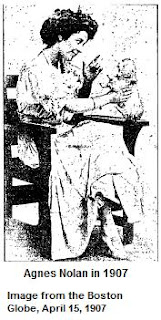
Agnes Nolan in 1907Agnes Nolan was one of 18 children of a Brookline letter carrier and his wife. Her father had his moment in the spotlight in 1905 when no less a figure than President Theodore Roosevelt intervened after John Nolan lost his post office job (and source of support for his large family).

But the real celebrities in the Brookline family were Agnes and three of her eight sisters, all of whom appeared on stage.

Agnes and her sisters Lola, Alice, and Grace were all members of the company of “Yankee Doodle Dandy” George M. Cohan—arguably the most popular entertainer of the period. Agnes' stage career was brief, but she made big news locally and nationally in 1907 when she and Cohan were married.

The marriage—his second and her first—was planned, fittingly enough, for the Fourth of July though it actually occurred on June 29th.

The Nolans of Brookline

John J. Nolan began working for the postal service in Brookline in 1875. He was reportedly the first to deliver mail directly to individual homes in town. (Prior to 1864 postage only paid for post office-to-post office delivery; home delivery began in the big cities and spread slowly to other communities after the Civil War.)

Nolan was also the one to lay out the routes Brookline letter carriers used when free home delivery finally reached town.

In 1899, however, Nolan was dismissed from the postal service for drunkenness. As his son-in-law, Boston American columnist George Holland later described it:

The appropriate figure of speech would be to say that he had crooked his elbow.

Perhaps we could blame it on the monotony of trudging up to the same front doors.

A swinging door was different. Off his route, John Nolan found swinging doors and they opened on a warming atmosphere where, for a time, one could relinquish the responsibilities that came with the largest family in New England.

116 Brooks StreetWhether or not it was the largest in New England, Nolan's family was certainly large. He and his wife Mary had 18 children (17 according to some accounts). Three died very young, but all of the others—with 29 years separating the oldest and youngest—lived with their parents in a succession of Brookline homes.

They were at 116 Brooks Street in 1900 and 38 Gorham Avenue in 1903. Later Brookline addresses for the parents included 149 Winthrop Road and 19 Green Street.

Nolan went to work in the coal business after his dismissal from the postal service, but his plight eventually came to the attention of U.S. Congressman Samuel Powers in whose district the Nolans lived. Powers brought the case to the attention of President Roosevelt in the White House, noting that:

It is claimed that the Department at the time of his discharge promised to reinstate him if his subsequent conduct should justify such action. The accompanying letters and certificates conclusively show that Nolan has been absolutely free from habits of intoxication ever since his discharge.

The congressman also enclosed a photo of the family, which he had advised Nolan to have taken, to show the president that Nolan "is not an adherent to any doctrine of race suicide."

(Roosevelt was said to be obsessed with the concept of "race suicide" a concern that English-speaking whites, through declining birth rates, were not keeping up with immigrants and other minorities. See Chapter VII, "Race Suicide," in Theodore Roosevelt and the Idea of Race by Thomas G. Dyer, LSU Press, 1992).
Nolan Family Portrait
In March 1905, Roosevelt issued an order reinstating Nolan to the postal service. According to Holland, the president telephoned the postmaster personally and Nolan was back on the job the next day.

The Nolan Daughters on Stage

By 1905, Lola, Agnes, and Alice Nolan, who began their performing careers under the stage name of the Merrill Sisters, were part of George M. Cohan's theater company.

Cohan has been called the father of the American musical comedy and "the man who owned Broadway." After beginning his career in vaudeville with his parents and sister, performing as The Four Cohans, he turned to the theater in 1901.

A writer, director, and performer, he produced more than 80 Broadway shows and wrote more than 1,500 songs over four decades.

Pamphlet Promoting Little Johnny JonesLola joined Cohan's company first. Agnes and Alice auditioned for the 1904 New York production of "Little Johnny Jones," Cohan's first Broadway hit. (It was the show that introduced such standards as "Yankee Doodle Boy" and "Give My Regards to Broadway.")

Cohan was reportedly smitten with Agnes' vitality—and the audacity she showed in asking for $25 a week for chorus work, more than the going rate. She and Alice were added to the company. (A fourth sister, Grace, later worked for Cohan as well.)

In February 1907, Cohan divorced his wife, the actress Ethel Levey. In April, it was announced that he and Agnes Nolan would be married on July 4th, Cohan's purported birthday. (Birth records show that he was born on July 3rd, but the "Yankee Doodle Boy" always claimed he was "born on the Fourth of July.")

In the end, the marriage took place a few days ahead of schedule, in Freehold, New Jersey, before a justice of the peace. As the New York Times reported on June 30, 1907:

An automobile accident last Monday detained the couple, who were taking a short trip, for several hours in Freehold, and during that time they decided to get married. They returned to Freehold yesterday and were married by the justice.

Agnes's sister Alice and Cohan's long-time partner, producer Sam Harris, were the only witnesses. Alice Nolan and Sam Harris would marry later that year, and the two couples would build adjacent homes in Great Neck on Long Island.

Agnes Cohan in 1921Agnes Cohan, conforming to the wishes of her husband and her parents, retired from the stage after her marriage. She and Cohan had a son and two daughters.

In 1942, Warner Brothers released Yankee Doodle Dandy, a musical biography of Cohan that won a Best Actor Oscar for James Cagney. Agnes Cohan was not a character in the movie. Cohan had stipulated that the film make no mention of his first wife Ethel Levey, and the filmmakers instead created a composite of the two wives to serve as Cohan's love interest in the picture.

The film was shown to the Cohans in a private screening. George was ill with cancer; he died in November of that year at age 64.

Agnes Cohan outlived her husband by nearly 30 years. She died September 10, 1972 at the age of 89. She had been living in Queens in obscurity and in poor health for 10 years. Neighbors told the New York Times she was devoted to television and had few visitors other than family. Most of the neighbors did not know who she was.

Times reporter Laurie Johnston described Agnes Cohan's funeral. About 60 people attended the service at Our Lady of Martyrs Catholic church in Queens in contrast, noted Johnston, to the thousands who filled the streets around St. Patrick's Cathedral in Manhattan for George Cohan's funeral.

"I wanted to see if there were any celebrities," whispered a woman in purple wool as she slid into a pew and dropped to her knees beside a friend [wrote Johnston]. She was to be disappointed.

A few years before Agnes Cohan's death, the musical biography George M. opened on Broadway. (Joel Grey, like Cagney before him, won a Best Actor award—a Tony—for his portrayal of Cohan.) Agnes Nolan Cohan, as well as Ethel Levey, were restored as characters in the play.

In a 1970 television version of the play, Agnes was played by Blythe Danner, better know to today's audiences, perhaps, as the mother of Gwynneth Paltrow.

Agnes Nolan's mother Mary died in 1921 and her father John in 1929. Several other members of the Nolan family, in addition to the four sisters, had careers or ties to the entertainment industry.
  • Alice Nolan Harris last appeared on stage in a Cohan revue in 1910. She died in 1930 at the age of 42.
  • Loretta (Lola) Nolan, who continued to use the stage name Lola Merrill, married the actor Frank Otto and appeared in an act with him for many years, often in Cohan and Harris productions. The last surviving of the many Nolan children, she died in 1974.
  • Grace Nolan Landy had a brief acting career. She died in 1938 at the age of 47.
  • John F. Nolan, the oldest son, worked in the Boston post office for 28 years before leaving in 1913 to manage the Cohan and Harris Theater in New York. He died in 1923.
  • Raymond Nolan (1893-1967) moved to California and was a still photographer for 20th Century Fox Studios for many years.
  • William Nolan (1892-1953) was an editor at the Douglas Fairbanks Studio and worked on several Fairbanks films including The Thief of Baghdad.
  • Dorothy Nolan Holland (1895-1971), the youngest child, married George Holland who was a playwright and longtime "Boston After Dark" columnist for the Boston American. They continued to live in Brookline.
  • Another brother, Matthew Nolan (1879-1955), also remained in Brookline. He was not in the entertainment business; he was a Brookline firefighter for 45 years before retiring as Acting Deputy Chief in 1947.
Five of the Nolan Sisters

Saturday, June 6, 2009

Dr. Lydia Clements and the Klondike Gold Rush

The Klondike gold rush of the 1890s must have attracted its share of odd characters, but there probably weren't many like Dr. Lydia R. Clements of Brookline.

Dr. Clements, a graduate of the Boston University School of Medicine and the wife of a prominent dentist in town, set out with a party of men and women in the spring of 1898 determined to make her fortune in the gold fields of the Klondike.

"She thinks the practice of medicine should be profitable in that section," reported the Boston Globe at the outset of her expedition (May 8, 1898), "but if it turns out there is not much demand for medical aid, then she will turn to whatever else will net her gold."

"She may, with other women," continued the Globe, "purchase a claim and hire men, or even attempt themselves, to work the claim."

All of the women and some of the men in her party left the expedition before reaching their goal, but Clements persevered and become one of the first white women -- possibly the first from the East -- to cross the Chilkoot Pass into the Klondike region.

She practiced medicine in the city of Dawson and staked out a number of claims, but returned to Brookline six months later having lost $10,000 yet determined to return.

When she did return, in 1900, the driving force was her association with the occult philosophy of Prof. Charles H. Mackay and his West Gate School of Philosophy in Boston. "He has succeeded in influencing this woman in his theory," reported the Globe at the outset of her second journey to the far north (July 1, 1900), "so that she is willing to risk her life and much of her husband's fortune to exploit the theory."

I have been criticized in some quarters of Boston for what was termed my mad adventure of 1898 [Clements said in the Globe]. The same people, and many of them are influential in scientific and literary circles, will receive me with open arms when I return for the second time from the land of the midnight sun.

Guided by what she called Mackay's "power of mind over mind," Clements established herself in the Nome district of Alaska inside the Arctic Circle where she was certain she would make her fortune.

I do not wish you to think that it is the greed for riches that is sending me north [said Clements]. I have a clearly defined and I think laudable object in taking what some of my friends term a reckless venture in search of gold. It is my intention should I, as I expect, be eminently successful in my present undertaking, with my wealth to found a school of philosophy to disseminate the views of Prof. Mackay. It may take a year, it may take two years, but I am thoroughly convinced I will return to Boston a very wealthy woman.

There is no indication that Clements did make her fortune or founded a school, but she did remain in Nome and elsewhere in Alaska for more than a decade, hiring men and mining tin and gold. She retained a Brookline residence at 11 Davis Avenue and travelled back and forth across the continent many times before returning to Brookline for good.

Lydia Clements died in Brookline in February 1927.

Further Reading