Showing posts with label Houses. Show all posts

Wednesday, March 6, 2024

House Numbers Are Where It's At!


                         "Though fog or night the scene encumbers,
                           Why don't all the buildings show their numbers
                                     On lintel, wall, or door?
                          Why can't a house say good and plenty
                          'Hey look at me! I'm Nineteen-twenty,
                                     The joint you're looking for.'"

                                     -- Arthur Guiterman, 1950
 

Street numbers for houses -- and other buildings, too -- serve a fairly simple function. They make it possible to locate a particular building on a particular street. The numbers themselves, with rare exceptions, have no meaning beyond that basic navigational role.


They are a ubiquitous and utilitarian part of our everyday environment. But despite their ordinariness, building numbers can appear in an almost boundless variety of styles and designs, as the images in this post -- all gathered walking around Brookline -- show. 


They come in different fonts and different colors. They are made of different materials. They are displayed as numerals or words, arranged horizontally, vertically, or diagonally. They may have been bought off a rack in a hardware store or designed and created by an architect or graphic designer.


House Numbers Come to Brookline
House numbers were first introduced in Brookline in the 1880s, when mail delivery began in town. (Until then, residents and business owners would pick up their mail at the post office.) They were more common on some of the busier streets at first, though even there the use of numbers could be spotty, as seen in two excerpts from an 1890 town directory.

This page from the 1890 Blue Book of Brookline shows a portion of the Harvard Street listing, with some residences showing house numbers and others with no number.

Another page from the 1890 directory, showing houses on several street, but no house numbers

"Some measure ought to be adopted to compel the numbering of every house in town," opined the Brookline Chronicle in 1888.

Even when numbers were assigned, inconsistency was a source of confusion and complaint in those early years. "The person who has undertaken to number the houses on our street has made a mess of it," wrote one resident in a letter to the Chronicle, also in 1888.

Finally, in 1891, a new bylaw was passed giving the Board of Selectman the authority to order house numbers to be affixed or painted on any building in town.


At least one enterprising businessperson saw an opportunity in the new bylaw. Reuben Chase advertised in the Chronicle, offering signs, apparently of different designs, for sale.

Advertisement, Brookline Chronicle

A Chaotic Condition
Inconsistent enforcement and application continued to plague the town even after the adoption of the building numbering bylaw. "No carrier system can ever become wholly satisfactory so long as the present chaotic condition of house numbers continues" wrote the Chronicle in August 1898.


"The fact is even more apparent than it was a year ago," continued the paper, "that there is no street in the town in which the buildings are properly numbered, while in the newer sections a 'hit or miss' rule of numbering appears to be generally adopted."


Two years later, a competing paper, the Suburban, complained that the numbering system in the town "is confusing in the extreme" and that "something should be done about it at once."


As late as 1918, another Brookline paper, the Townsman, took store owners to task for the lack of numbers on their storefronts. "It has been called to our attention that many of the stores in Old Brookline lack proper identification by street numbers. Would it not be well for the merchants to see their street numbers adorn their store doors? What about it merchants?"


A year later, Town Engineer Henry Varney reported that from 400 to 500 notices were being sent out each year to homeowners who failed to post numbers on their homes.


Later in 1919, the Chronicle came down hard on homeowners who continued to ignore the house numbering by law:


By 1924, the town was able to report that "Practically all occupied buildings are now correctly numbered." Two years later, buildings on Brookline Avenue and Longwood Avenue were renumbered to conform with addresses on those streets across the town line in Boston, but compliance with the bylaw does not seem to be a problem today, even as GPS changes the way we find a particular place, in Brookline or anywhere else.


Unlucky 13?
Triskaidekaphobia -- fear or avoidance of the number 13 -- may be just a bit of whimsy for most people. After all, there's not much you can do about it if you were, say, born on the 13th of any month, let alone on a Friday the 13th. But one arena where the number 13 is mostly avoided is in house and building numbering.


There are even some office and apartment buildings that have no 13th floor. (They do, of course, have a thirteenth floor; it's just numbered 14.)


Even rarer are houses, businesses and other buildings using the number 13 for their address. Developers, builders, and homeowners, superstitious or not, have regularly skipped over that number when assigning addresses in cities and towns, large and small. There are even some reports that having the number 13 as an address lowers the value of a property.


Brookline is no exception when it comes to avoiding this number as an address. Do you know how many locations in Brookline have the number 13? The answer -- cue the Twilight Zone music -- is 13. Even that group seems to avoid the number. There are only 12 buildings on those 13 properties; one -- 13 Aston Road -- is marked "undevelopable" in the town assessor's database. Hmm.

Wednesday, January 31, 2024

Pages of the Past: Diaries of Two 19th Century Brookline Readers


Step into the past and explore the lives of two 19th century Brookline women and the books they read. This presentation will take place at the Larz Anderson Auto Museum on Saturday, February 10th, from 12:30 to 2:00 pm.
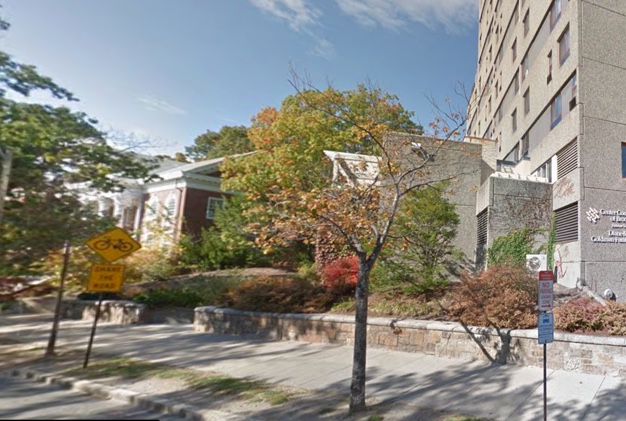
Proceeds ($15 per person) help support the non-profit museum, which is hosting the event. Register here.


Mary Wild raised six children in her home on what is now Weybridge Road, where she lived from the 1820s to the 1850s. Adelaide Faxon lived nearby, on Linden Street, as a teenager in the 1850s. Both houses are still standing. 

The 19th century homes of Mary Wild, left, and Adelaide Faxon, both still standing today.

One thing they had in common is that both were avid readers who documented what they were reading. The Brookline Historical Society has painstakingly transcribed and annotated the diaries of these women, providing insights into the tapestry of life and society in Brookline during the 1850s.


This program offers a look at the books they read and what they tell us about mid-19th century literature and two people who made it a part of their lives.


Diary entries from Mary Wild, top, and Adelaide Faxon, about books they read.

Wednesday, December 14, 2022

Harvard Street, Coolidge Corner: 1912 & 1937

Two of the busiest periods of commercial development in Coolidge Corner took place in the 1910s and 1920s. Perhaps no two photographs demonstrates this change better than these two images of the same stretch of Harvard Street, one from c1912 and the other from 1937.

c1912 photo
West side of Harvard Street
between Beacon Street and Babcock Street (offscreen to the left), c 1912
Postcard view (Click on this and all images for larger views)

1937 photo
Same view, 1937
Photo courtesy of Brookline Preservation Department

The tower of the S.S. Pierce Building at the northwest corner of Harvard and Beacon Streets, constructed in 1898, anchors both images at the far left. (The open-deck tower was damaged in a storm in 1944 and replaced with the current closed tower.) But everything else in the picture has changed by the time of the later photo.

The building immediately to the north of S.S. Pierce is the same in both photos, but has undergone a change of design and of use by 1937.  Built as the Beacon Universalist Church in 1906, it was converted to the Coolidge Corner Theatre, Brookline's first movie house, just four years before the later photo was taken.

Beacon Universalist Church
S.S. Pierce Building and Beacon Universalist Church, c1906


 Coolidge Corner Theatre 1937 Coolidge Corner Theatre 1970s

S.S. Pierce Building and Coolidge Corner Theatre, 1937 and 1970s

But the biggest change is north of the church/theater building, where four wood-frame houses have been replaced with commercial buildings.The difference can be seen in the segments of the two photos below and in the maps from the 1913 and 1927 town atlases. (The purple rectangles indicate the location of the buildings in the photos.)

Four houses and the stores that replaced them
Closer view of this stretch of Harvard Street


1913 map
1913 atlas view
(Yellow buildings are wood-frame structures; pink buildings are brick.)

1927 map
1927 atlas view

The Coolidge Corner retail district was expanding in all directions in this period; on both sides of Harvard Street north and south of Beacon Street and on Beacon east and west of Harvard.

All four houses in the c1912 photo had been replaced by commercial buildings by the mid-1920s. Houses north of these were also replaced by commercial buildings, including the Coolidge Corner Arcade, just visible at the far right of the 1937 photo. (The house it replaced is just outside the frame of the earlier photo.)

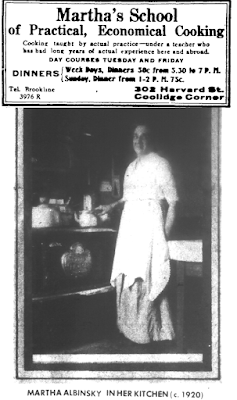
Even before being replaced, some of these and other houses on Harvard Street were put to new uses. The house at 302 Harvard, for example, became a boarding house, lunchroom, and cooking school run by a German immigrant named Martha Albinsky. Her daughter, Gertrude (Albinsky) Millett, wrote about it in the Brookline Chronicle half a century later and included a photo of her mother in her kitchen. (1976 article, at bottom of linked page.)

Brookline Chronicle ad and photo of Martha Albinsky
Ad from 1918 and 1920 photo from 1976 article both from the digitized newspaper collection of the Public LIbrary of Brookline

"The house my mother rented [wrote Millett in 1976] was very suitable to our purpose. It had been used as a party house by Rose Gordon and the large front room was ideal for a public dining room while the rest of the house could be used for boarders...But my mother's desire was to have a real dining room with homecooked meals for it was easy enough for her to cook for five or 20..."

"The homecooked dinner consisting of soup, main course, dessert, tea or coffee was 50 cents, and everyone enjoyed it, particularly the fresh-baked Parker House rolls which were my mother's specialty."

"The dining room was a success from the start, serving anywhere from 10-15 customers every night."

Houses across the street were also put to new uses before being replaced by retail buildings. The house at 299 Harvard became the Coolidge Corner Branch of the Brookline Library, while the house next to it at 303 became a funeral home. Both of these can be seen in the full version of the c1912 photo below. (Streetcar tracks are also gone, while cars are parked at the curb in front of the 1937 stores.)

Harvard Street c1912
Full postcard view of Harvard Street looking south from near Babcock Street, c1912
(Click for larger view)

Today, only two former houses (not counting the colonial Edward Devotion House) remain on Harvard Street north of Beacon; one, at the corner of Williams Street, is used for dental and other offices, and the other, at the corner of Kenwood Street, is now the Chabad Center. The buildings that replaced other houses on Harvard Street north of Beacon continue to thrive as part of the Coolidge Corner and JFK Crossing retail districts.

Wednesday, September 14, 2022

3 Doctors & Their 19th Century Brookline Houses

If you stand on the northeast side of Washington Street about halfway between its intersections with Greenough Street and Weybridge Road you'll be in one angle of a triangle formed by three Brookline houses from three different eras of the 19th century.

Aerial view via Google Maps showing: 1) 26 Weybridge Road (formerly 446 Washington Street); 2) 447 Washington Street; and 3) 432 Washington Street. All three are visible from the spot marked with a star.
Dating these houses based on their architectural styles can be confusing:
  • #1 -- 26 Weybridge Road -- is in the style of the Colonial Revival of the late 19th-early 20th century and appears to be the newest of the three but is actually the oldest, built in 1822. It was redesigned in 1868 and again, as a Colonial Revival home, in 1922. A more recent (2016) renovation restored elements of that 1920s design that had deteriorated or been removed in later years.
  • #2 -- 447 Washington Street -- was built smack dab in the middle of the century, c1850.
  • #3 -- 432 Washington Street has the look of a pre-Revolution house, but only because it was designed as a replica of John Hancock's Beacon Hill mansion, built by his uncle in the 1730s and torn down in 1863. It is actually the newest of the three, built in 1895. 

When the most recent of these -- the Hancock replica -- was built, there was very little around them on the now densely built-up section of this busy thoroughfare between Brookline Village and Washington Square.


The three houses shown on the 1900 Brookline atlas

All three houses were originally the homes of doctors and their families. But the three doctors -- Charles Wild, Charles Wheelwright, and Benjamin Blanchard -- were as different from one another as are their still-standing houses. 

Left to right: Drs. Charles Wild (1795-1864), Charles Wheelwright (1813-1862), and Benjamin Blanchard (1856-1921)

The Wild-Sargent House (1822)

The oldest of the three houses, now known as the Wild-Sargent House, was built in 1822 for Dr. Charles Wild and his wife Mary Johanna (Rhodes) Wild. There are no known photographs of the house showing how it originally looked. The oldest known photo shows the house in 1868, after a post-Civil War renovation by it's fourth owner.

Today's 26 Weybridge Road as it appeared from Washington Street in 1868 after a major redesign. It retained this design for more than 50 years.

The house was remodeled again as part of the Blake Park development of the 1920s.


Image credit:

Public Library of Brookline

Charles Wild (1795-1864) was born in Boston, graduated from Harvard in 1814, and was granted a medical degree in March 1818. (His dissertation was on delerium tremens.) Harriet Woods in her Historical Sketches of Brookline, published in 1874, presented a lengthy profile of Dr. Wild.


Those who can remember the doctor in his prime [wrote Woods], can well recall his tall, well-formed figure, his firm tread, his deep voice which seemed to come from cavernous depths, and eyes which seemed to look from behind his spectacles into and through one.


Woods described the doctor's typical way of announcing his arrival to see a patient:

He had a breezy way of entering a house, stamping off the snow or dust with enough noise for three men, throwing off his overcoat, untying a huge muffler that he wore around his neck, and letting down his black leather pouch with emphasis. There was an indescribable noise he made sometimes with that deep gruff voice of his which cannot be represented in type.


Dr. Wild, widely respected in town for his knowledge, abilities, and advice, was skilled in the mixing and administering of potions, in bloodletting, and in other techniques practiced by the physicians of his day. In 1839, he became interested in the emerging ideas of homeopathy.

The second meeting of New England physicians interested in this new kind of practice took place at the house on Washington Street in 1841. It led to the formation of the Massachusetts Homeopathic Fraternity.

The Wilds' second son, Edward Augustus Wild, was also a doctor, until he lost an arm serving in the Civil War. He later returned to service as a general commanding troops of formerly enslaved African American soldiers.

For much more on the life of the Wild family in their Brookline home, see the 1851-1865 diary of Mary Johanna Wild, digitized by Boston College and annotated by the Brookline Historical Society.


The Candler Cottage (1850)

In 1847, Mary Johanna Wild wrote to her oldest son, Charles, then in Shanghai where he was engaged in the China trade, that

As I sit at the old desk in the study now, I can look out and count more than 30 new houses put up in the last year.


Three years later, another new house, directly across Washington Street from the Wild house, appeared.  A sketch of the house, designed by architect Richard Bond, was included in a book, American Cottage and Villa Architecture. published in 1850. It shows open land around around the house, with Aspinwall Hill rising in the distance on the left.


Image credit: Historic New England

The first owners of the house were Susan Candler and her brother Dr. Charles Wheelwright. They were joined by Susan's five children, ranging in age from 24 to 11, and two Irish-born servants. Susan's husband had died in 1842.


Writing to a nephew in February 1850, Wheelwright said the family, then living in Boston, was looking to find a country house to purchase:

We have concluded to seek placdium quietam in rure felice. There we must be near railroad and omnibuses, we must have open fields and sunny hills....We have found a beautiful place exactly eighteen minutes distant from Worcester Railroad Depot in Boston. It is nearly opposite the Aspinwal place on the road from Brookline to Brighton. It is very expensive but land is increasing in value so rapidly that if we can get it at a fair market price we think we shall buy, Susan and myself conjointly.

 
Family members, wrote Wheelwright, had visited the house and were much pleased with it:


It is really a beautiful place, well back from the road. A cottage with two arched towers and quite high and really airy chambers, fifteen rooms in all, barn, etc., and 300 fruit trees. I shall offer 9500 dollars and fear it will not bring it. I will be sorry to lose it as it offers so many facilities and conveniences not to be found in other places.

Dr. Charles Wheelwright

In the end, they were able to purchase the house and land for $8,500.

Charles Wheelwright was born in Boston in 1813. He graduated from Harvard in 1834 and earned a medical degree there in 1837. In 1839, he joined the U.S. Navy as a surgeon and would remain in naval service for the rest of his life, serving in the Atlantic, the Pacific, and the Gulf of Mexico. In 1859, he was part of Commodore Matthew Perry's expedition to Japan.


At the outbreak of war, Wheelwright was serving in the Brooklyn Navy Yard on a board examining men for their fitness to serve in the Navy. Despite his own poor health, he applied for active duty. He served in Virginia and, later, as fleet surgeon for the Gulf Fleet. He was then assigned to a hospital near the mouth of the Mississippi River in Louisiana, treating troops of the River Squadron.


Suffering from poor working conditions, exhaustion, diarrhea, and general poor health, he died of disease in Pilot Town, Louisiana, on July 30, 1862. He was 49 years old. He is buried in Mount Auburn Cemetery in Cambridge. The house remained in the Candler family through the end of the war.


The Blanchard House (John Hancock House Replica) (1895)

In 1863 the Beacon Hill land containing the former home of John Hancock was sold. Plans to move the house to the Back Bay fell through. Protests against its demolition went unheeded. In August the house was demolished, replaced by two townhouses. (In 1917, the townhouses were replaced by an extension to the State House.)


The former Hancock mansion on Beacon Hill and a  June 1863 broadside that was printed and distributed in Boston in a failed attempt to save the building from demolition. (Credits: house photo, Boston Public Library; broadside, Historic New England)


The loss of the former home of one of Boston's and the nation's Founding Fathers was a factor in the growth of the historic preservation movement. In the decade after its demolition, another landmark of the Revolution, the Old South Meeting House, which had barely survived the Great Boston Fire of 1872, was saved from demolition after the church moved to a new building in the Back Bay. 


At the World's Columbian Exposition in Chicago in 1893, the Massachusetts State Building, designed by the noted Boston firm Peabody & Stearns, was modeled after the demolished Hancock mansion. At the dedication of the building in October 1892, Massachusetts governor William Russell spoke of the symbolic importance of the design:

I think there is something grand and most instructive in these historic buildings. They link the past with the present, with lessons of patriotism, suffering and sacrifice; they speak of men who were patriotic, events which were epoch making and the beginning of a great nation....

This building comes close to the heart of Massachusetts, not merely because it is beautiful in design and correct in proportion, but because it speaks of Hancock, his life and his services, and recalls a great agitation, a struggle for liberty and independence, in which Massachusetts and her ideas were leading to form and develop a great and majestic republic


The Massachusetts building at the World's Columbian Exposition in Chicago, as shown in Campbell's Illustrated history of the World's Columbian Exposition (1894)

The Massachusetts building was itself demolished after the Exposition. (Another building from the Exposition, built for the Van Houten Cocoa Company as a replica of a 16th century Dutch town hall, was purchased by a Brookline resident, Charles Appleton. It was taken apart, brick by brick, and reconstructed on a new street in Brookline. Now known as the Dutch House, it stands on Netherlands Road, near the Muddy River.)


Two years after the end of the Exposition, architect Joseph Everett Chandler designed a new home, also modeled on the Hancock mansion, at the corner of Washington and Greenough Streets in Brookline for Benjamin and Clara Blanchard.


Chandler was an important figure in the Colonial Revival style of architecture that flourished in the U.S. in the late 19th and early 20th centuries. The Blanchard House was the first of four houses he designed that were modeled on the Hancock house and the one that most closely followed the design of the original. 

This photo and floor plan were included in Joseph Chandler's 1916 book The Colonial House

The original stone facade, which Chandler described as "the best of Colonial stonework," was replicated in wood as closely as possible.


The other Chandler houses modeled on the Hancock house include 58 Allerton Road in Brookline and homes in Weston and in Chandler's native Plymouth. He also designed several other buildings in Brookline, including an art gallery for the Blanchards' neighbor Desmond Fitzgerald, now the Church of Christ at 416 Washington Street.


Chandler is probably best known for his restoration of historic buildings, including the Paul Revere House in the North End of Boston and the House of Seven Gables in Salem. (For much more on Chandler and his work, see his 1922 book The Colonial House.

Another still-standing building modeled on the Hancock mansion -- though not designed by Chandler -- is the stone headquarters of the Ticonderoga Historical Society in Ticonderoga, NY, built for the New York State Historical Society in 1926.


Photo credit:
HUP Blanchard, Benjamin S. (1).
Harvard University Archives.

Benjamin Seaver Blanchard graduated from Harvard in 1877 and from Harvard Medical School in 1882. He practiced for a year in Roxbury where, as he later wrote,

 [I] had a fair amount of work, little pecuniary recompense, but plenty of blessings, some curses, and good opportunities to study human nature.


Blanchard came to Brookline in 1883. He lived and had an office at 18 Davis Avenue in Brookline Village. In 1887, he married Clara Fessenden Barnes, and eight years later they bought land from the Blake estate to build their new house.


Blanchard maintained his medical practice out of the Washington Street house. He was also active in town affairs, serving as a Town Meeting Member and a member of the school committee, and as a medical inspector for the schools and the Gymnasium and Baths Committee.

He was a leading figure in the town's efforts to combat various epidemics and threats to community health through inspections and vaccinations. Blanchard died at home of rheumatic fever in 1921. He was 64 years old.


Sunday, July 2, 2017

A House for Sale and a Mystery in Its Past

Financially-ailing Wheelock College is looking for a buyer (according to news reports) for the Victorian house at 295 Kent Street that has served as home to the college's presidents since 1963. I decided to look into the history of the house and, as is often the case, my research led in unexpected directions.

295 Kent Street
295 Kent Street
The house, built around 1872, has had only three owners. Wheelock purchased it from the estate of hotel executive J. Linfield Damon who lived there from 1901 until his death at the age of 95 in 1963.

But it was the original owner of the house, S. Dana Hayes, whose story proved the most interesting. The house was built for him and remained in his family from the time of its construction until its sale to Damon in 1901. But Hayes himself disappeared under mysterious circumstances in 1880 and was never heard from again.

Globe headline on Hayes disappearance
Boston Globe headline, January 30, 1880.

Samuel Dana Hayes, who went by S. Dana,  was born in Roxbury in 1840. His father, Augustus Allen Hayes, was a chemist and one of Massachusetts state assayers of ores and minerals. The younger Hayes studied at his father's alma mater, Norwich University in Vermont, although he did not graduate, and by the 1860s had followed in his father's footsteps as a chemist and state assayer.

The state assayer's office was established by the legislature in 1846. Assayers — there could be more than one  — were to certify the chemical composition of ores and metals submitted to them. They were to be paid "a reasonable compensation by the person securing such assay to be made." Assayers were later given the added responsibility of ensuring that "spirituous and intoxicating liquors [were] of a pure quality, and unadulterated with any mixture, or noxious or poisonous substance."

Hayes quickly established a reputation as one of the leading assayers in the country. He lectured and wrote on chemical properties, testified in court cases (including cases of suspected poisoning) and developed a successful private business certifying the composition of a wide variety of products, including:
  • baking powder
  • mineral water and ginger ale
  • vinegar
  • yeast
  • cocoa
  • whiskey
  • lager beer
  • skin care treatments ("The Queen's Toilet")
  • mineral oil
  • fertilizer
  • cookware and silverware
Advertisements for many of these products in newspapers across the country included endorsements from Hayes, usually noting his official role as a Massachusetts state assayer.

Newspaper ads with Hayes' endorsement
Newspaper ads with product endorsements from S. Dana Hayes. Left to right: Pearl Baking Powder, in the Black Hills Weekly Pioneer, Deadwood, South Dakota; Gaff, Fleischmann & Co. Yeast (yes, it's that Fleischmann's Yeast) in the Boston Post; and Heublein's Lager Beer in the Hartford Courant. (Click image for a larger view.)
One ad, for Hall's Vegetable Sicilian Hair Renewer, noted:

When a discoverer of any scientific subject, asks the co-operation of the learned in science, to test the merit and truth of his discovery by severe tests and practical results, and then to indorse [sic] and recommend it, it is fair to presume it is valuable for the purpose intended. Such has been the course pursued by Mess'rs. Hall & Co., proprietors of Hall's Vegetable Sicilian Hair Renewer. And all those who have tested it (among whom we may mention Dr. A.A. Hayes and S. Dana Hayes, Chemists and State Assayers of Massachusetts ... assert it is the best preparation in use for all cutaneous diseases of the scalp.

Hayes had married a Scottish woman, Margaret Gibson, in Scotland in 1860. In 1877,  few years after moving into the Kent Street home, they adopted a little girl. Three years later, in January 1880, Hayes left Boston for New York and attended to some business for a law firm in a patent infringement case.  That was the last time he was seen or heard from.

Both the Boston Globe and the New York Times reported two weeks later that before disappearing Hayes had made a careful examination of his business, paid all his debts, arranged for his wife to have power of attorney, and left her a note saying he would not be returning but that she would be informed of his whereabouts in the event of his death.

Friends and acquaintances, including his brother, attributed the odd behavior to a temporary "aberration of mind", perhaps brought on by the death of his mother a few months earlier. Business troubles were dismissed as a possible cause, as his business was in good shape. They expected to hear from him shortly.  The Globe correspondent, however, reported that "domestic troubles are really at the bottom of the matter." In any case, he did not return.

Margaret Hayes placed an ad in the New York Herald in August 1881 looking for word of her husband. (It was reproduced in the Boston Globe.)  In the ad, which the Globe titled "Where Is S. Dana Hayes?", she noted that he had "gone West in April last" so perhaps she had obtained additional information since his disappearance 19 months earlier. But there was no new news.

Where Is S. Dana Hayes
Boston Globe, August 4, 1881
Hayes' father Augustus died in June 1882. His will left one third of his estate to S. Dana and his heirs, provided he came forward (or was proved dead) within three months. Otherwise his share would be divided equally between his brother and sister. The family placed a personal notice in a New York paper, reproduced in the Boston Post, urging him to come forward but there is no record of him having responded.

Ad placed after Hayes' father's death
Boston Post, September 14, 1882

Margaret Hayes lived in the Kent Street house on and off until selling it in 1901. (She rented it out and lived elsewhere in Brookline when not living there.) She died some time after 1910. The Hayes' adopted daughter, Hope Beatrice Hayes, graduated from Smith College in 1899, married a florist, and was a school teacher in Pittsfield, Newton, and Pelham, New Hampshire. She died in 1929 at the age of 54.

Product advertisements citing Hayes' stamp of approval continued to appear periodically for years. An ad in the Washington Post for the Forest Glen resort in North Conway, New Hampshire promoting "the purest water in New Hampshire" noted that "S. Dana Hayes, State Chemist of Massachusetts, said this is a remarkably pure and excellent water." That was in 1906, more than a quarter century after Hayes disappeared.


Monday, June 19, 2017

1898: Devotion House Saved from the Flames

One-hundred and nineteen years ago today (June 19, 1898) sparks from a barn fire across Harvard Street threatened the Edward Devotion House in Coolidge Corner. Firefighters were able to douse the flames, saving the then 158-year old house, one of the oldest in town.

The fire began in the new barn on the farm of William J. Griggs, adjacent to the Griggs house at 330 Harvard Street. By the time it was spotted by a boy passing along the street a little after 7:30 in the morning it was too late to save the barn and the Griggs house itself was smoldering in several places.

Devotion House and Griggs farm, 1897
This 1897 map shows the Willliam Griggs house, just below Shailer Street, across the street from the Devotion School and Devotion House. The new barn that burned a year later was built adjacent to the house.

Strong winds carried embers onto the roofs of several nearby houses, including the Devotion House. Neighbors used garden hoses, pails, and fire buckets to fight the fires until firefighters arrived. The Griggs house was saved, and firefighters were stationed at the Devotion House to make sure it did not suffer major damage. (The Town had recently allotted funds toward the preservation of the historic structure.)

Edward Devotion in 1895
The Edward Devotion House as it appeared in 1895, three years before the fire that briefly spread to the house from across Harvard Street

William J. Coolidge
William J. Griggs
Brookline Library photo
Click for larger view
William Griggs (1821-1906) whose family farm occupied the site for many years, lost everything that was in the barn, including four horses, three cow, and five dogs, as well as carriages, wagons, harnesses, a bicycle, and several tons of hay.

Griggs and his brother-in-law David Coolidge founded the Coolidge & Brother store, operated by David's younger brothers William and George, in 1857. The store's location, at the intersection of Harvard and Beacon Streets, became known as Coolidge's Corner and, later, as Coolidge Corner.


Friday, June 16, 2017

Gillette & Sias Mansions, Beacon Street

This stretch of land on the north side of Beacon Street just west of Lancaster Terrace would be unrecognizable today except for the stone wall, which still stands. It is now the site of the apartment building at 1550 Beacon, built for senior housing in the 1970s, and Temple Beth Zion at 1566 Beacon, completed in 1948.

(Note: This article first appeared in Brookline Patch as part of a biweekly series of historical images of Brookline from the Brookline Historical Society and the Public Library of Brookline.)

Gillette & Sias Mansions
 
The two large houses formerly on the site were associated, at different times, with the heads of two well-known consumer product companies. The house on the left was the home from 1907 to 1913 of King C. Gillette, inventor of the safety razor and founder of the company that bears his name. It was torn down in 1944. The house on the right was built by Charles D. Sias, a senior partner in the Chase & Sanborn coffee company. A later owner moved it up the hill to Mason Terrace, where it remains today.

A present-day view of the site, via Google Street View, is below.

1550-1566 Beacon Street Today

Both houses were built after the 1880s expansion of Beacon Street from a narrow country lane to a wide boulevard, designed by Frederick Law Olmsted and with trolleys providing easy access to Boston. The older of the two is the Sias house, built in 1889 for Charles Sias, who began as a salesman with Chase & Sanborn before rising to become senior partner with the firm. It was designed by Arthur Vinal who was also the architect of the Richardsonian Romanesque High Service Building at the Chestnut Hill Reservoir, now condominiums and the Waterworks Museum, and the gatehouse at what is now Fisher Hill Reservoir Park.

The next owner, lumber company executive Frederick McQuestern, had the house moved up the hill to 41 Mason Terrace, shown below.

King Gillette

The Gillette house was built in 1892 for Benjamin Lombard Jr., a banker and real estate executive. It was designed by the architectural firm of Little, Brown, & Moore, which also designed the main house of the Brandegee Estate in South Brookline. King Gillette purchased the house for his family in 1907 and lived there until 1913 when they moved to Los Angeles.

Gillette had first come to Brookline in 1895 when he was a salesman for the Crown Cork Company, maker of disposable bottle caps. It was while living here that he came up with the idea for the safety razor, as described by Gillette himself in a company magazine in 1918:

"I was living in Brookline at No. 2 Marion Terrace at the time [1895],” he wrote, "and as I said before I was consumed with the thought of inventing something that people would use and throw away and buy again. On one particular morning when I started to shave I found my razor dull, and it was not only dull but it was beyond the point of successful stropping and it needed honing, for which it must be taken to a barber or to a cutler. As I stood there with the razor in my hand, my eyes resting on it as lightly as a bird settling down on its nest—the Gillette razor was born.”
It took years of experimentation to solve the technical difficulties involved in producing the kind of razor Gillette had in mind, but a patent was granted in 1904 and sales took off, making Gillette a great financial success and a household name. Three years later he bought the Beacon Street house.

A close look at a section of the stone wall in the old and new photos (below) makes it possible to pick out individual stones. This section is to the right of the tree in the modern image and further to the right in the older one.

Stone Wall

Tuesday, October 21, 2014

High on Aspinwall Hill

The photo below, taken sometime in the first decade of the 20th century, shows Aspinwall Hill from a vantage point on Corey Hill. (See a supersized version of the photo here.)

Aspinwall Hill from Corey Hill

For perspective, note the building with the rounded corner at lower right. It was — and still is —at the southeast corner of Washington and Beacon Streets. Athan's Bakery occupies the first floor today.


The Athans Bakery building, then and now

Several other buildings in the photo are still there today: buildings on Washington Street (just behind the Athan's building) and, successively higher up the hill, on University Road, Winthrop Road, Addington Road, and Colbourne Crescent.

But what was that building with the tower at the top of the hill? It looks like a church or other institutional edifice.


In fact, it was the home of Clarence and Rosamond Esty on Addington Road. The tower, unusual for a private home, was built to take advantage of the house's location at the top of the hill. Here's how the Boston Post described it in 1913:

Few houses in the world have such a magnificent panorama spread out before them as that of Clarence H. Esty, 97 Addington road, Brookline. This house is situated on the top of a hill, and Mr. Esty has bought up all the land immediately surrounding it, so as to avoid all possibility of the view of which he is so proud becoming obstructed. On the top of the house Mr. Esty has built an observation tower, in which is a powerful telescope. From this point of vantage the whole of Boston lies spread out before one, not to mention all the suburbs and the country to the west.

Clarence H. Esty
Clarence Houghton Esty (1854-1917) was born in Ithaca, New York. He earned a law degree from Cornell University, but never practiced. He joined his father and brother in the prosperous leather manufacturing business founded by Clarence's grandfather. Esty married Rosamond Claire Field in 1893 and built the Brookline house for his family in 1897 after retiring from business.

Clarence Esty died in 1917. Rosamond Esty died in 1942. The property was acquired by the Town of Brookline. After  demolition of the house it was turned into Addington Park, renamed Schick Park in 1955.


Schick Park on Addington Road is on the site of the Esty home and observation tower that stood from 1897 until the 1940s.

NOTE: The Aspinwall Hill photo is one of several photos from the collection of Warren Manning, former planting supervisor for Frederick Law Olmsted in Brookline. It was taken after Manning left Olmsted to go out on his own. The photos are held by the Iowa State University Library Special Collections and have been reproduced with their permission.

The building immediately below the tower in the Manning photo is actually across the street from the Esty house, at 94-98 Addington Road, where it still stands.