Showing posts with label Corey Hill. Show all posts

Monday, February 20, 2023

Dr. Cornelius Garland in Brookline

Dr. Cornelius N. Garland, a pioneering Black physician and the founder of the first and only Black hospital in Boston, spent the last 24 years of his life in Brookline, where he lived on Corey Hill from 1928 to 1952. 


Garland's story was featured earlier this month in a piece on Cognoscenti, WBUR's ideas and commentary site, and an interview aired on Radio Boston. The author of the Cognoscenti article, Lisa Gordon, was joined on Radio Boston by Garland's great grandson Dan Reppert.

Dr. Cornelius N. Garland, as shown in the 1912 book The Negro in Medicine, published by the Tuskegee University Press (left); 12 East Springfield Street in the South End, former site of Garland's Plymouth Hospital (center); and Garland's one-time residence on Mason Terrace in Brookline (right)

Gordon began digging into the story while living in an apartment in the South End building that had been Garland's hospital. She and Reppert told how the Alabama native founded Plymouth Hospital in 1908. The hospital employed Black doctors and included a training program for nurses at a time when city hospitals would neither employ Black physicians nor admit Black women to their nursing programs.

The Plymouth Hospital and Nurses Training School continued to operate until 1928. Garland hoped to expand his efforts with a second hospital and had support from the community. His plan was opposed, however, by influential Boston Guardian publisher William Monroe Trotter. Trotter, reported Gordon, "believed a second Black-only hospital would perpetuate existing racial problems" and, instead, "vehemently advocated to integrate city hospitals, starting with Boston City Hospital."

The debate over separate Black hospitals and their effect on the effort to integrate Boston city hospitals drew coverage in Black newspapers around the country, including these in the Pittsburgh Courier, left, and the New York Age, right.

Garland, added Gordon, "recognized that he and Trotter had a similar goal: equity for the Black community." He joined Trotter in lobbying for the integration of Boston City Hospital, "perhaps believing both plans could work in tandem." In 1928, he closed Plymouth Hospital. One year later, City Hospital admitted its first Black students, although it would be 20 years before the first Black physician was added to the staff.


Dr. Garland in Brookline

Cornelius and Margaret Garland lived on West Canton Street in the South End, on the edge of the Back Bay and a 15 minute walk from Plymouth Hospital. In December 1928, after the closing of the hospital, they purchased a newly-built home at 173 Mason Terrace in Brookline. (The deed was in Margaret's name.)


Their daughter, Thelma, then 26, was a French teacher in Baltimore at the time and did not live with her parents in Brookline. (Thelma married James Kelly Smith in August 1929.)


Garland continued to practice medicine in Boston out of an office at the West Canton Street brownstone, while renting the rest of their former home to tenants. He was also involved in many health, social, business, and political organizations and activities, both before and after moving to Brookline.


He was heavily involved in the work of the Boston Tuberculosis Association, promoting good home hygiene practices as a way of combating the disease. (The Boston Globe, in 1937, reported that one section of Roxbury "at one time had the highest mortality rate in the country for Negroes suffering from tuberculosis," but had seen a big improvement in recent years.)

An annual contest sponsored by the Boston Tuberculosis Association gave prizes as a way of encouraging clean yards, attractive gardens, and general sanitary conditions. The first place winner in the 1936 contest, on which Dr. Garland was a judge, just happened to live across the street from his office on West Canton Street. (Boston Globe, October 3, 1936) 

Garland served on boards of many Boston civic associations during his time in Brookline, including the Urban League of Greater Boston and the Boston Chapter of the NAACP.  Locally, he was involved in the medical division of Brookline's civil defense organization during World War II. He continued in medical practice after the war. (A 1948 photograph of him with his granddaughter in Ebony magazine referred to him as "Boston's richest physician.")

His wife, Margaret, was vice president of the League of Women for Community Service in Boston, an organization that grew out of an earlier group that advocated on behalf of Black soldiers returning from service in World War I. (Florida Ruffin Ridley, who moved from Brookline not long before the Garlands arrived, had been on the board of the League with Margaret several years earlier.)

Margaret Garland died in 1945, at the age of 69. Cornelius Garland died in 1952. He was 75.


You can learn much more about Cornelius Garland, his family, and Plymouth Hospital from the following sources:


Sunday, February 20, 2022

19th Century Tobogganing on Corey Hill

A winter storm in Brookline today brings sledders to local hills, carrying all manner of conveyance for children and adults alike: classic Flexible Flyers; modern plastic models in a variety of shapes and colors; even cardboard boxes and purloined cafeteria trays.

130 years ago, it also brought tobogganers to go whizzing down the most celebrated toboggan run in the Boston area: the steep chutes of the Corey Hill Toboggan Club.


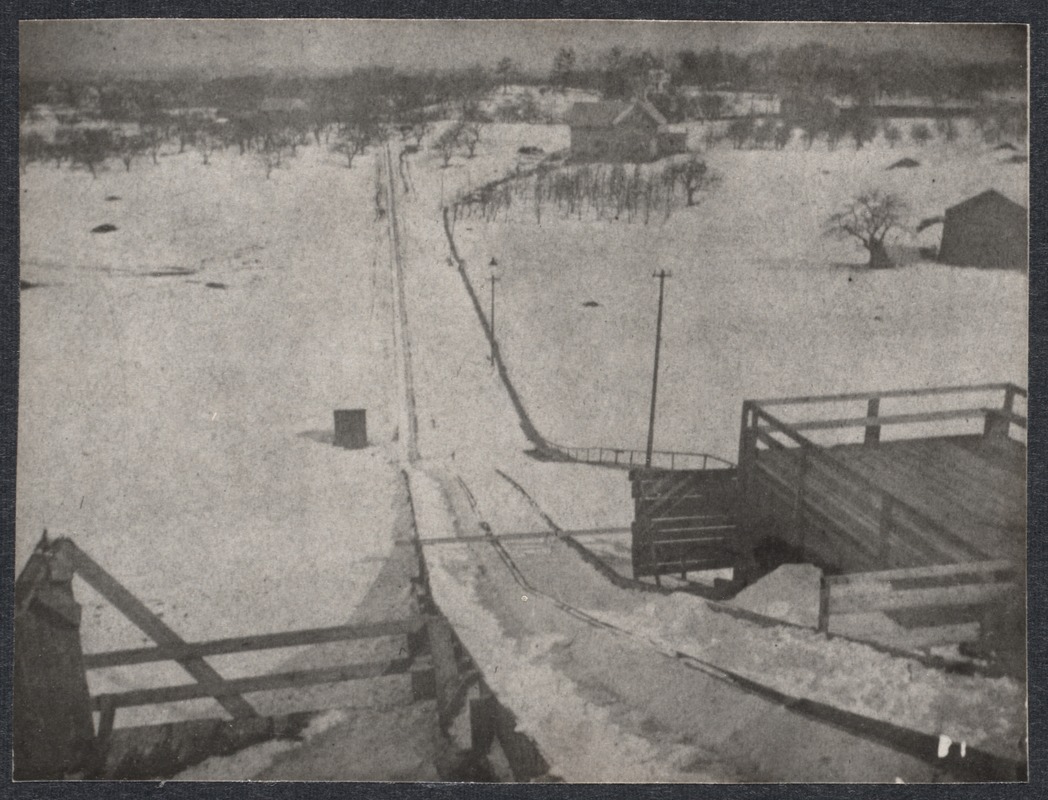
Operating each winter, from December 1886 to February 1895, chutes ran from a clubhouse on Winchester Street across the then undeveloped lower slope of Corey Hill to a spot on Harvard Street approximately where the Chabad Center of Brookline (496 Harvard Street) is today.

Corey Hill toboggan chute, 1886
The toboggan chutes of the Corey Hill Toboggan Club. Looking from Winchester Street toward Harvard Street, 1886. Photo courtesy of the Public Library of Brookline. (Click on image for larger, zoomable view.)

A Canadian Import Comes to Brookline 


Toboggans – and the word toboggan – originated with indigenous peoples of North America, who used them to transport items across snowy landscapes. Recreational tobogganing began in Canada, most notably on Mount Royal in Montreal where the Montreal Toboggan Club opened three slides in 1879.


Tobogganing soon spread across the U.S. border. The Corey Hill Toboggan Club was formed in November 1886, and quickly became known as the best facility in the northeast. 


Construction of a clubhouse and chutes began immediately after the formation of the club. The clubhouse stood approximately where 197-199 Winchester Street is today. By December 1886 there were three chutes in place, one of the three starting from a platform at the top of the clubhouse 12 feet above the level of Winchester Street. That made for a rapid 42-foot drop to the level of the meadow that ran to Harvard Street. 


In early December, the club successfully petitioned the Brookline Electric Light Company to have poles places along Harvard Street to provide power to light the chutes at night. By Christmas, the electric lights were in place.


When a 300-strong contingent of the Montreal snowshoe and toboggan club Le Trappeur  visited Massachusetts in February 1887, members of the three-month old Corey Hill Toboggan Club were their main escort in a large parade through the streets of Boston. 


The Le Trappeur club of Montreal marching down Beacon Street in Boston from the State House as shown in Frank Leslie's Illustrated Newspaper, February 12, 1887


A lack of snow prevented the Canadians from trying the Brookline slides, but they did take back to Montreal an oil painting showing two club members, Massachusetts governor Oliver Ames and 20-year old Florence Peck of Boston, flying down the Corey Hill chute on a toboggan. Peck, whose father was on the executive committee of the club, presented the painting to Montreal mayor HonorĂ© Beaugrand at a State House reception.  


A month later, several members of the Brookline club visited their one-time guests for the winter carnival in Montreal. 
 

The “Best and Most Expensive” Slide  


By the winter of 1887-88, there were at least five toboggan slides in the Boston area. They included a slightly older Brookline club at Wright’s Hill, near Boylston Street and Reservoir Lane, and facilities in Dorchester, Cambridge, and Malden. But, reported the Boston Globe in a lengthy article on tobogganing, “the Corey Hill slide is by far the best and most expensive one.”  


The chutes, reported the Globe, were not as long as some of the others in the area, “but the management finds that it is more pleasing to the members to have them short and steep instead of long and gradual.” In fact, wrote the Globe reporter, the Corey Hill chute was the steepest in the country. 

Tobogganing on Corey Hill, as seen in a later article in the Boston Globe (January 15, 1893)


The club grew to more than 300 members that second winter of its existence, including residents of Brookline, Back Bay, and other parts of Boston and neighboring communities. The clubhouse was enlarged to include a waiting room with a fireplace on the lower floor, a smoking room, bathrooms, a kitchen for preparing meals and refreshments, and a storage area for toboggans so that club members did not have to carry them to the site each time.  


The chutes themselves had water poured on top of the packed snow where it would freeze and provide a smooth sliding surface. A well was sunk and pipe was laid along the length of the chutes to keep them watered. Innovations in later years includes a tilting platform at the top and a motor-driven return chute to bring toboggans back up the hill for additional runs or storage.  


Articles in the Brookline and Boston newspapers described the thrill of taking a toboggan down the Corey Hill chutes. Here’s how the Boston Globe described it in December 1887:


“A push, a rush of cold air, and you fall through space more like a meteor than anything else. It is not a slide; it is a flying hop-step-and-jump to the foot of that 100-foot slope. Even then the speed seems to increase, but the novice feels that the toboggan is sliding over something solid, and that is a crumb of comfort. In quicker time than it takes to read, much less write it, the toboggan flies straight out over the dip or second fall and comes down with a flop, but without wavering in its wild career continues scurrying down the incline.”


Novices, said the Globe, find “their sensations of fright and delight so inextricably mixed that they can’t tell which is uppermost. And the beauty of the whole thing is the sensation does not wear away as your trips become more frequent.”  


An 1893 article in the Boston Post, written under the pseudonym “Amy Robsart,” described one woman’s experience going down the Corey Hill chute this way:  


“I took a long breath and shut my eyes. – ! – !
There were two consecutive bumps half way down that made me open them, and I saw flying bits of Biela’s comet and thousands of starry dazzlements in a flight through the air. That is probably the nearest I shall ever approximate to flying….
My bangs stood up straight, my hat flapped wildly on the firm pivot of my hat pin, there was a trail of hairpins in my wake.
‘Where am I at?’ I inquired a little ruefully when I had been picked out of the snow and had smoothed my ruffled plumage.
But it was fun!
Fun with the keen edge of fear that gives it the fascination that it is.” 


Clothing, Class, and Gender  


Toboggans, toboggan slides or chutes, and the thrill of participating were not the only elements of this popular recreational activity to cross the border from Canada.  Tobogganing fashion also followed the Canadian model. Members of the Corey Hill club, and other clubs, wore outfits modeled on those of Canadian clubs, with each club having its own colors.  

The c1880 photo at left shows men and women of a Montreal toboggan club in their club outfits. (Photo courtesy of the McCord Museum). Similar outfits can be seen in an 1886  advertisement in the Brookline Chronicle, top right, and an illustration of Corey Hill tobogganers in an 1888 story, bottom right. (Click image for a larger view)


More significant were class and gender elements of tobogganing that were common in Canada and were replicated in Brookline and other American communities. As Canadian scholar Gillian Poulter wrote in a 1999 dissertation (later turned into a book) on sport, spectacle, and identity in Montreal:  


“Forming clubs and building slides and club houses was a means by which club members differentiated and separated themselves from the poorer classes. By demarcating specific areas as club property, and by adopting blanket suit costumes, the professional and commercial middle-class tobogganers were in no danger of having to share their slides with ‘the great unwashed,’ who in any case probably had little time and energy to spare for such diversions.”


At Corey Hill, a club membership cost $3, later increased to $5. Club members had to wear their club badge – an example is shown below – to use the toboggan chutes. The club outfits – not required, but common – and the toboggans themselves added additional costs. The club drew members – including at least two Massachusetts governors -- from Brookline as well as the Back Bay and other areas.  

Photo courtesy of the Public Library of Brookline

It’s not known if there were specific ethnic restrictions in the club’s bylaws, but it is worth noting that although Brookline had a substantial, largely working class, Irish-American population by this time there are no Irish surnames shown in the many articles in the Brookline and Boston newspapers that listed officers and participants in the club’s activities  


(The Country Club in Brookline, which was started just four years before the Corey Hill Toboggan Club and had its own history of restrictive membership policies, also had its own toboggan slide during this period.) 


Men and Women Together on the Slopes  


The thrilling ride down a toboggan chute presented opportunities for a kind of closeness not usually considered proper for young couples. As the Toronto literary magazine The Week put it in an 1885 article:  


“When Florence or Charlotte has to be tightly encircled in the grasp of an admiring pilot, down the glittering descent, the pair feel the mutual dependence and responsibility, which often leads them to courtship in earnest.”  


In her dissertation, Gillian Poulter notes that Canadian newspapers sometimes described the sensation of tobogganing for women in what she described as “surprisingly eroticised terms”. The Brookline News, in an article on tobogganing published on Christmas Day, 1886, was more circumspect:. “There are some things about it [tobogganing],” wrote the News, “that never will and never can get into any newspaper.”   


The same article in the News did include a description of another part of tobogganing with particular appeal for young couples: the climb together back up the hill. The article quoted a pamphlet on tobogganing, together with an illustration of “The Uphill Road,”:


"Uphill we clambered, and as I felt the gloved hand of Dick’s younger sister upon my sustaining arm, I wished the climb might have been twice the distance; and right here I want to say that if ever a woman looks fresh and young and irresistibly lovely it is when at the top of a climb up a toboggan slide she stops with her cheeks flushed, her lips parted, and her eyes shining with the exertion [of the climb].”


In January 1888, the Brookline News shared what a couple of magazines had to say about what was on the minds of young couples on the Corey Hill slopes:


"Puck [a humor magazine) says if you have the right kind of girl, the walk up the toboggan slide is just as exciting as the ride down. And sometimes more so. It's a glorious sport both ways."
- Brookline News, January 14, 1888

“Ethel: Which toboggan slide do you like best, Corey’s Hill or Wright’s Hill?
Mabel: Oh ! Corey’s Hill, don’t you? It’s so much steeper that the men have to hold on to – er – the toboggans ever so much tighter.” 
- Brookline News
, January 21, 1888 (Reprinted from the Harvard Lampoon)

Tobogganing Seasons Come and Gone  


Club members and their guests continued to climb Corey Hill to use the club’s chutes through the winter of 1894-95. Many more came out to watch.  As many as 500 people were reported on the slopes at times, with as many as 150 actually going down the chutes.  


A good tobogganing season depended, of course, on having enough snow. Activity rarely began before January, and there were years where very little tobogganing took place. (A January 28, 1888, Brookline Chronicle article noted there had been 30 nights of tobogganing so far that season and that they hoped to break the previous records of 55 nights.)  


Social events at the clubhouse were a big part of the Corey Hill Toboggan Club’s activities, whether there was actually tobogganing or not. There were musical performances by club members, “smokers” (probably male-only social gatherings) and “ladies’ nights.”   


There were carnivals on the slopes, modeled on those that were held in Montreal and elsewhere. (The 1893-94 season, for example, included an “Illumination Night,” with fireworks, fire balloons and bonfires, and a “Fancy Dress Carnival.”) In the last years of the club, these social events received more attention in the local press than the actual tobogganing.  


The winter of 1894-95 was the last to see tobogganing on the chutes of the Corey Hill Toboggan Club. In December 1895, the Brookline Chronicle reported that the club was planning several elaborate entertainments for the next three or four months. But on January 18, 1896, the Chronicle asked “What is the matter with the Corey Hill Toboggan Club this winter? Will the gentle art of harmless chuteing [sic] be allowed to become extinct?”  


That same week, the Boston Post, in a brief article titled “Tobogganing on Corey Hill,” reported:  


“The lovers of tobogganing in the city will probably not have a chance this winter to enjoy the sport at the Corey Hill Toboggan Club. The chute is all falling to pieces and ditches are dug through the field where the chute makes its course.  


A meeting of the directors of the Corey Hill Club was held last Christmas, but nothing definite was done in regard to fixing up the slide. "


The demise of the Corey Hill Toboggan Club was no doubt due to growing residential development in this part of Brookline in the wake of the laying out of the Beacon Street boulevard and the coming of the streetcar a decade earlier.   


By 1897, the club, it’s clubhouse, and its celebrated toboggan chutes were no more. (See the maps below for a detailed view of the change.)  

These segments from the 1893 (top) and 1900 (botom) Brookline atlases show the northwest side of Corey Hill. The approximate location of the toboggan chutes has been added as an orange line. The clubhouse of the Toboggan Club is at the high point on Winchester Street in the 1893 map. 

By 1900, Verndale, Kenwood, Henry (now Russell), and Columbia Streets have been added and there are houses on the lower part of the hill with plots laid out higher up, including on both sides of Winchester Street. The clubhouse is gone. (Click image for a larger view)


Sunday, December 19, 2021

Fire Devastates 129-Year-Old Former Stable on Brookline/Brighton Border

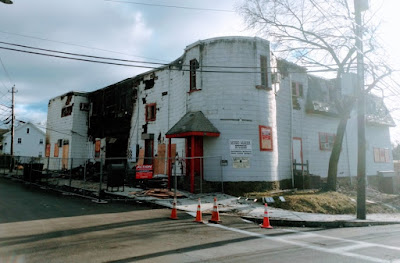
A horrific eight-alarm fire that began early Friday morning tore through a commercial building at the corner of Corey Road and Westbourne Terrace in Brighton, on the border with Brookline. Fortunately, the only injuries (to two Boston firefighters) were minor ones, but the businesses in the building, including music and dance studios, were devastated.

185 Corey road before the fire
185 Corey Road, Westbourne Terrace side, before the fire, as seen on Google Maps. (Click image for larger view)


The building had gone through many changes and many tenants over the years, obscuring its origins. The original building was constructed as a stable in the late 19th century for Eben Jordan Jr., of Jordan Marsh, whose estate covered much of Corey Hill. 


The overall shape of the building, sitting atop a still-existing stone foundation and including the rounded northwest corner, can be seen in the 1893 atlas and a recent aerial view.


185 Corey Road in 1893 atlas and Google Maps aerial view

The 1892 news item below notes that Jordan has received approval from Brookline to built a stable on Westbourne Terrace.

Notice of permit for stable granted to Eben Jordan
Brookline Chronicle, September 10, 1892, p2
 

(The building was mostly in Brookline when it was built, with only the western end in Brighton. The shaded line on the 1893 map, marking the boundary between Brookline and Brighton, passes through the building. Adjustments to the boundary soon after put the structure wholly in Brighton.)


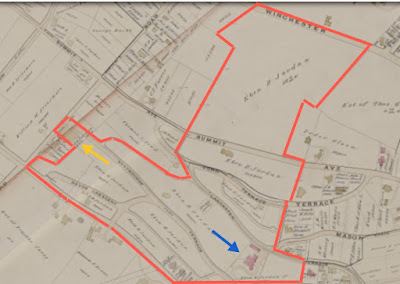
The map below, from another 1893 atlas, shows the western side of Corey Hill. The red outline has been added to show the extent of Eben Jordan's property. Jordan's mansion is indicated by the blue arrow. It was torn down in 1955. The yellow arrow points to the stable at the corner or Corey Road and Westbourne Terrace. 

Map showing Eben Jordan's Corey Hill property in 1893
Outline of Eben Jordan's property on Corey Hill in 1893
(Click image for larger view)


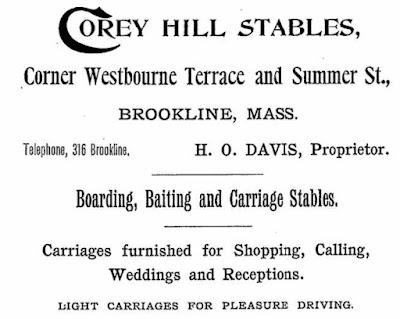
The stable, known as Corey Hill Stables, was operated by several different proprietors over the years. In the Brookline Directory in 1894, H.O. Shaw advertised his services, including boarding of horses and the provision of carriages for shopping, weddings, receptions, and pleasure drives.


Brookline Directory ad, 1894
Brookline Directory, 1894

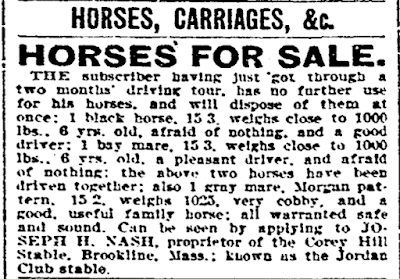
Later proprietors advertised in the Boston papers, offering horses, carriages, and, in winter, sleighs for sale. (The continued use of a Brookline address may have been because it was the mailing address or was considered more prestigious, or both.)

Horses and carriages for sale
Boston Herald, August 30, 1897

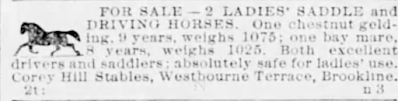
Ad for "ladies saddles and driving horses"
Boston Globe, November 3, 1899

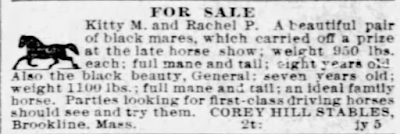
Ad for "a beautiful pair of black mares"
Boston Transcript, July 5, 1901

Sleigh ad
Boston Transcript, January 28, 1905

Paheton buggy ad
Boston Transcript, April 13, 1912

By 1912, automobiles could be hired out as well.

1912 Brookline Directory ad
1912 Brookline Directory

In 1913, the stable was purchased from the Jordan estate by H.P Hood & Sons, which used it through the end of the following decade as a distribution facility for Hood's milk. A 1924 Hood's ad gave the address as 136 Westbourne Terrace.

Brookline Chronicle, October 16, 1924, p8
 

In 1929, the building was sold to the Malone family, whose home and business extended down Corey Road to Washington Street. Bernard Malone ran a successful excavating and grading business. (Among the company's many projects were some of the early buildings of Boston College's new campus in Chestnut Hill, beginning with the excavation and foundation for the first building in 1909.)

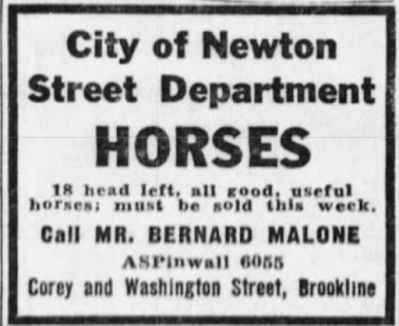
The old stable was not shown in directories during the time it was owned by the Malones, but it was most likely used for both horses and storage. Bernard Malone, who at one time owned a stable on the grounds of the Metropolitan Racing Association's Speedway in Allston, continued to use horses in his business even after the coming of motorized vehicles. As late as 1946, he was selling horses for Newton that the city's street department was no longer using.


Boston Globe ad, March 31, 1946, p

The next occupant of the old stable building, from the late 1940s to the 1970s was the Canter Construction Company, led by Eliot D. Canter. The company constructed numerous buildings in Boston and Cambridge, including 22 buildings for Harvard University, according to Canter's 2005 obituary in the Boston Globe.

Advertisement. Boston Globe, October 6 1957


Canter made several changes to the old stable building, including the removal of a third floor in 1955. In 1971, his real estate company, West Bourne Realty Trust, sought a variance to turn the building into 25 apartments. The request was denied by the Boston building commissioner in 1972 and, on appeal, by the city's Board of Appeals four years later. Canter sold the construction company, which was started by his father, a few years later.


By 1980, the old stable building had passed into the hands of the current owner, John Gately. (Ownership is now listed as Gately's La Salle Realty business.) Gately is a noted dealer in old Cadillacs and Cadillac parts through his Gately Restoration business and at one time had cars and parts in the Corey Road building. 


The building has had numerous tenants in the 40+ years it has been owned by Gately, including, at various times, a career counseling firm, an antiques company, a liquidation company, an auto leasing business, and others. But it has been mostly known since the 1980s for its dance and music studios, including current tenants Music Maker Studios, Brookline Academy of Dance, and Zippah Studios/Zippah Records.


Boston Globe arts listings from 1981 (top), 1982 (middle), 1987 (bottom left), and 1999 (bottom right)

 
Boston Herald news item
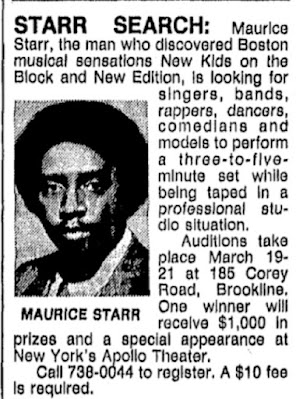
In 1990, music producer Maurice Starr held auditions at 185 Corey Road for aspiring performers. Boston Herald,  February 15, 1990

There was an earlier fire at the building, in 1985, that left the building with broken and missing doors and windows and left it exposed to the elements and to vandals. That brought warnings from Boston's Inspectional Services Department that the building would have to be repaired or razed. Repairs were made (after some delay) and the building has continued in use ever since.


Here's hoping the affected businesses can recover from this crushing blow. But will the old stable building itself, now nearing its 130th year, be rebuilt and continue its long history? We'll have to wait and see.


185 Corey Road after fire
185 Corey Road, after December 2021 fire

Saturday, July 25, 2009

Wheelmen Take the Corey Hill Challenge

Illustration: Bicyclists climb Corey Hill during their visit to Boston for the annual meeting of the League of American Wheelmen. From Harper's Weekly, June 5, 1886Boston was the Hub of bicycling in the United States in the 1880s. The Boston Bicycling Club, the first in the country, was founded in 1878. Five years later, Outing, a Journal of Recreation labeled the city "the bicycling paradise of America." Wheelmen, as they were sometimes called, came from all over to ride "the beautiful roads that have rendered Boston the metropolis of bicycling."

One of the high points in metropolitan Boston-- literally and figuratively -- for local and visiting riders alike was Corey Hill in Brookline. Wheelmen strove to become the first to make it to the top of the hill and, after that barrier was broken in 1883, to set a new record time or simply challenge themselves to conquer the steep incline.

Bicycle manufacturers and sellers even promoted in advertisements the fact that their bicycles had made it to the top of Corey Hill.

Illustration: This bicycle ad in the June 1884 issue of the Yale Literary Magazine notes that the Rudge Light Roadster is the only bicycle that has ever been ridden up Corey Hill
"The hill is one of the steepest and longest in the vicinity of Boston," wrote the Boston Daily Globe on July 29, 1883, shortly after the first successful ascent "and hundreds of wheelmen have unsuccessfully tried to ride up."

The length of Corey Hill is 2300 feet [continued the Globe article], height 199 feet; average grade, one foot in 11.41. On the last 158 feet the average grade is one feet in 7.85 feet, and for the next 170 feet lower down the rise is one foot in every 7.87 feet


Illustration: a Victor Tricycle, top, and Rudge Light Roadster, bottom, were the first tricycle and bicycle to climb Corey HillW.W. Stall, a Boston bicycle and tricycle dealer, was the first to make it to the top, in July 1883. He rode a Victor Tricycle like the one shown in the ad at left.

Later that month, H.D. Corey (fittingly enough) became the first to make the climb on a bicycle, a Rudge Light Roadster similar to the 1887 model pictured at left below. Corey was a noted Boston wheelman. (The following year he would become one of the first to ride a bicycle down Mt. Washington, the highest peak in New England.)

Annual Corey Hill climbs, organized by the Boston Bicycle Club, were held for the next several years. The 1886 event, part of the League of American Wheelman gathering in Boston, attracted particularly large crowds. (See the Harper's Weekly illustration at the top of this story and one from the Boston Globe below.)

Organized climbs were not the only way to attempt the hill, of course. The 1886 Cyclists' Road Book of Boston and Vicinity included Corey Hill as part of Route Five, starting at Trinity Church in the Back Bay. "The view from the top of the hill well repays for the labor of ascending it, on foot if necessary," said the guide, noting that the final, steepest 158 feet "is what generally bowls over the cyclist."

Illustration: Cyclists climb Corey Hill, Boston Globe, May 28, 1886

Monday, June 15, 2009

Brookline in the Flu Pandemic of 1918-19 (Part 1 of 2)

The great flu pandemic of 1918-19 killed tens of millions of people worldwide, including an estimated 45,000 in Massachusetts and 675,000 in the United States. Its impact was felt everywhere, including in Brookline.

More than 125 residents of the town died. Schools were closed for four weeks right after the beginning of the school year. Homes of the afflicted were quarantined. Public gatherings at churches, meeting halls, soda fountains, billiard parlors, bowling alleys, and funerals were banned.

At the same time, quick reaction by local authorities was credited with limiting the impact more than in other communities. And at an open air hospital on Corey Hill, new methods of care were developed, methods that medical personnel then took to facilities elsewhere in the state and around the country.

This first of a two-part look at Brookline in the 1918-19 pandemic tells the story of Camp Brooks, the open air hospital on Summit Avenue. Erected literally overnight in September 1918, the camp became a focal point in Massachusetts' battle against the deadly disease.

Part 2 will look at the impact of the flu pandemic on the town of Brookline as a whole.

Camp Brooks and the Influenza Outbreak of 1918

Boston was one of the epicenters of the pandemic. After first appearing elsewhere in the spring of 1918, influenza erupted late that summer in more virulent form among merchant marine trainees in Boston Harbor. (There were major outbreaks around the same time in the port cities of Freetown, Sierra Leone and Brest, France.)

Noted surgeon William A. Brooks had opened the Brooks Hospital at the corner of Summit Avenue and Lancaster Terrace in 1915. At the time of the flu outbreak Brooks was both Surgeon-General of the Massachusetts State Guard and medical director of the recruiting service of the Shipping Board. He was called in to deal with the sick seamen.

I knew that the hospitals in Boston at that time were pretty well congested [he later wrote], and did not see how we could possibly place as many sick persons as we had.

Under Brooks' direction, the Brookline company of the Massachusetts Guard was called out on the afternoon of September 9, 1918 to erect a tent camp on the east side of Corey Hill between the Brooks Hospital and Corey Hill Park. Town Engineer Henry Varney and other town officials also pitched in. By just after midnight, the camp had been laid out, tents had been set up, sewage connections had been made, lights and water had been turned on, and the first patients had been admitted.

Researchers Richard A. Hobday and John W. Cason, writing about Camp Brooks in the May 2009 issue of the American Journal of Public Health, described conditions at the hospital:

The treatment at Camp Brooks Hospital took place outdoors, with “a maximum of sunshine and of fresh air day and night.” The medical officer in charge, Major Thomas F. Harrington, had studied the history of his patients and found that the worst cases of pneumonia came from the parts of ships that were most badly ventilated. In good weather, patients were taken out of their tents and put in the open. They were kept warm in their beds at night with hot-water bottles and extra blankets and were fed every few hours throughout the course of the fever. Anyone in contact with them had to wear an improvised facemask, which comprised five layers of gauze on a wire frame covering the nose and mouth. The frame was made out of an ordinary gravy strainer, shaped to fit the face of the wearer and to prevent the gauze filter from touching the nostrils or mouth. Nurses and orderlies were instructed to keep their hands away from the outside of the masks as much as possible. A superintendent made sure the masks were replaced every two hours, were properly sterilized, and contained fresh gauze.

Other measures to prevent infection included the wearing of gloves and gowns, including a head covering. Doctors, nurses, and orderlies had to wash their hands in disinfectant after contact with patients and before eating. The use of common drinking cups, towels, and other items was strictly forbidden. Patients’ dishes and utensils were kept separate and put in boiling water after each use. Pneumonia and meningitis patients used paper plates, drinking cups, and napkins; paper bags with gauze were pinned to pillowcases for sputum. Extensive use was made of mouthwash and gargle, and twice daily, the proprietary silver-based antimicrobial ointment Argyrol was applied to nasal mucous membranes to prevent ear infection.

Thirty-five of the 351 patients treated at the hospital died, a much lower rate, according to Brooks, than in indoor hospitals despite the fact that the open air hospital took in some of the worst cases. Only eight of the more than 150 doctors, nurses, aids, orderlies, and other workers at the camp developed influenza, and five of those were thought to have been exposed to it outside the camp.

The combination of fresh air, sunlight, and a "high standard of personal and environmental hygiene" employed by the Camp Brooks staff may have played a large part in their success compared to other hospitals, report Hobday and Cason. And, indeed, those same standards and plan of organization were adopted successfully elsewhere. "[A]s members of 'The Brooks Teaching Units,' these doctors, nurses, and aids have established military hospitals in eight other cities in our Commonwealth," reported the Boston Medical and Surgical Journal in December 1918. "The strict adherence of the members of these hospital personnel to these military orders contributed in very large part to the success of the undertaking."

The Camp Brooks tent hospital remained in place for a little more than a month, until the worst of the epidemic had passed in Boston. A year later, with support from throughout the state, Brooks established the Brooks Cubicle Hospital on Corey Hill to provide a more permanent facility to apply the same principles of treatment that had been used at Camp Brooks.

Further Information

The Influenza Pandemic 1918 (The American Experience, PBS)