Showing posts with label Transportation. Show all posts

Friday, July 26, 2024

Early Automobiles in 19th Century Brookline

In the spring of 1891 an unusual vehicle appeared on the streets of Brookline. 

Fiske Warrens first horseless carriage
It had a body built by local carriage maker Michael Quinlan, with two seats up front and an enclosed wooden box behind. Inside the wooden box was a battery-powered electric motor that had been built at the Holtzer Cabot Electric Company factory on Station Street.

The vehicle had been built for lumber magnate Fiske Warren of Waltham. Warren had seen electric powered horseless carriages in France and wanted one for himself. 

Not everyone was happy to see the new contraption on local streets. The Boston Globe, in 1893, called Warren's vehicle "an uncomfortable fad for public highways and skittish horses," adding that "It is certainly ugly enough to frighten even enlightened humans."

One local resident, Philip Sears, petitioned the Board of Selectmen to ban such vehicles within the town, claiming that "the carriage was as noisy as a steam-roller" and that he narrowly escaped injury when his horse was frightened by Warren's electric carriage." Sears, according to the Boston Transcript "believed that if the carriage is allowed upon the streets his experience is not likely to be the only one of its kind."

Headline: Beyond His Century: A Genius Whose Efforts are Not Appreciated, and That Electrical Carriage Case
Click image for larger view

In 1895 Warren had another vehicle built, one that looked more like what we think of when we think of early automobiles. Holtzer Cabot made the engine for this one, too, and Charles Holtzer took the members of the Board of Selectman for a ride. 

Charles Holtzer (at the wheel) and Brookline's selectman taking a ride in Fiske Warren's 1895 electric automobile 

In May the Boston Herald ran a long article about "the electric road carriage," with a sketch of Warren's new vehicle. "It is not venturing too much," predicted the paper, "to anticipate that eventually the great bulk of our street and highway traffic will be done on carriages propelled by electricity or some other form of power."

In July the Brookline Chronicle noted that "Following close upon the bicycle and the trolley, the horseless carriage is coming into fashion." The tide was clearly turning, in Brookline and elsewhere. The biggest question seemed to be what to call these new forms of transportation.

Headline: Wanted: A Name
Boston Globe, January 26, 1896 (reprinted from New York Herald)

In February 1896 the Board of Selectmen held a hearing in Town Hall to discuss widening Boylston Street from Cypress Street to the Newton line, in part to accommodate the growing use of bicycles as a means of transportation. But not just bicycles:

"Then there is the coming 'horseless carriage'," Alfred Chandler told the board, "already a successful mode of locomotion and of transportation, soon to be applied far and wide over our great domain."


"The manufacture of these vehicles on an extended scale for park and general usage has already begun," Chandler continued. "It would be folly to disregard this factor in building new thoroughfares. Bicycles and horseless carriages demand more room on our highways to secure comfort and safety for all who use them." 


There was even a plan, noted in an illustrated 1899 article, to bring motorized bus service to town, though it did not end up being implemented.

Headline: The National Transportation Company's Public Automobile
Brookline Chronicle, May 27, 1899
Click image for larger view

By the turn of the century, automobiles were increasingly seen in Brookline, as they were in other U.S. cities and towns. (The 1904 Brookline directory, the first to list automobile owners, showed 175 households owning a total of 225 vehicles. By contrast, there were almost twice as many owners of horses, with most owning more than one and several more than a dozen.)

This page from the 1904 Brookline Directory shows some of the town's automobile owners, along with ads for the Peerless Motor Car Co. and the Brookline Automotive Garage.


Along with these early cars came early car accidents, like these, reported by in the local press:

"The vehicle was overturned and badly damaged. The gentelmen escaped in safety.
Brookline Chronicle, July 15, 1899


"The carriage swerved in the direction of the curbing and, striking it, the automobile turned completely over"
The Suburban, July 20, 1899

Accidents or not, automobiles had begun their long run in Brookline.

Thursday, September 2, 2021

113-Year-Old Brookline Electric Car Wins Award

Brookline's history with electric cars goes back to --- well, pretty much back to the beginnings of electric vehicles in the United States. The first non-experimental electric car made in the U.S. was built in Brookline in 1891, with a body by local carriage maker Michael Quinlan and an engine by the Holtzer-Cabot Electric Company on Station Street.


Twenty years later, in December 1911, when the Boston Globe listed all of the electric automobile charging stations in Massachusetts, Brookline had eight of them, more than any community except Boston. By that time, Larz and Isabel Anderson had two electrics among their growing collection of automobiles: a 1905 British-made Electromobile; and a 1908 Bailey Electric Phaeton Victoria made by the S.R. Bailey Company in Amesbury, Massachusetts. 


1905 Electromobile and 1908 Bailey. Photos courtesy of Larz Anderson Automobile Museum

Both cars are still in Brookline, part of the collection kept in the former Anderson Carriage House and maintained by the Larz Anderson Auto Museum. Last month, the Bailey was honored at a California auto show -- the Pebble Beach Concours d’Elegance --  as the "Most Well-Preserved Pre-War Vehicle" at the show.

The 1908 Bailey at Palm Springs, left, and Larz Anderson Auto Museum Executive Director Sheldon Steele with the auto and its award at the Pebble Beach Concours d’Elegance, August 15, 2021.

The Bailey was Isabel Anderson's favorite car, according to the Museum. It was advertised as being self-driven, fitting for Anderson who was the first woman to get a driver's license in Massachusetts. It did have a place in the back for a footman to accompany her on drives.


The Larz Anderson Auto Museum is open Tuesday through Saturday from 10 am to 4 pm and SUnday form 9 am to 3 pm.


Sunday, September 29, 2019

Ghosts & Shadows of Automobile Row

If you missed my 9/15 conversation with WBUR’s Sharon Brody about Commonwealth Avenue’s Automobile Row in Boston and Brookline, the talk/slideshow is now available on the station's YouTube channel: https://www.youtube.com/watch?v=XYpoghQ1laU&t=1s

Ghosts & Shadows of Boston's (and Brookline's) Automobile Row

WBUR Talk & Fuller Building

Friday, July 27, 2018

Seeing Double? 2 Bridges at Cottage Farm

The BU Bridge over the Charles River (formerly the Cottage Farm Bridge) is closed to traffic until mid-August this summer while the replacement for the adjacent Commonwealth Avenue bridge over the Mass Pike is being completed. The aerial photo below shows the river crossing in 1925. But why are there two bridges crossing the Charles?


aerial view of Cottage Farm bridges, 1925
1925 view of the Charles River waterfront between today's Boston University and Cambridge.
(Boston Public Library via Digital Commonwealth. Click for zoomable view)
The closer of the two bridges is a temporary bridge opened in October 1923 to carry traffic over the river while a new Cottage Farm Bridge was built to replace an earlier wooden bridge built in 1896. Disputes over the location and design of the new bridge delayed demolition of the older bridge until 1926. It was still standing — and still carrying traffic — upriver from the temporary bridge at the time of this photo.

Cottage Farm Bridge 1923, Boston Globe
Boston Globe, October 10, 1923

The temporary bridge ran from St. Mary's Street in Brookline across Commonwealth Avenue and through what is now Marsh Plaza at Boston University. B.U. had already begun purchasing the land for its Charles River campus by this time but construction of the current buildings had not yet taken place. Billboards facing Comm Ave. stand at the edge of the mostly vacant land in the photo. (Click the images below for a closer view.)

Commonwealth Avenue billboard

The old Cottage Farm Bridge was finally closed to traffic in November 1926, three years after the temporary bridge was opened. Demolition of the old bridge and construction of the current bridge took another two years. The new bridge finally opened to traffic in August 1928.

The temporary bridge at St. Mary's continued to be used as a second crossing until 1929 when it was taken down.

A couple of side notes:
  1. The name "Cottage Farm" comes from the many English cottage-style homes, inspired by the writings of Andrew Jackson Downing, that were built in the neighborhood in the mid-19th century. One of these, built by Amos Lawrence in 1851, is now Sloane House, the home of Boston University's president.
  2. The riverfront property that is now the center of the B.U. Charles River campus was once part of Brookline not Boston. It was given to Boston by the Commonwealth in 1874 to connect the Brighton neighborhood to the rest of the city. The Town of Brighton voted that year to be annexed to Boston; Brookline voters on the same day rejected annexation in favor of remaining an independent town.
Charles River waterfront, 1855 map
This portion of an 1855 map of Brookline shows the Cottage Farm area including the 1896 bridge, the Amos Lawrence property, and Commonwealth Avenue (then called Brighton Avenue). The riverfront, which was given to Boston in 1874, was later expanded by filling in part of the Charles River.
(Map from the Norman B. Leventhal Collection, Boston Public Library)


Sunday, August 7, 2016

Virginia Aiken, Teenage Dealer of Electric Cars

On Memorial Day in 1912 a parade of 125 electric cars and trucks made its way from Brookline Avenue through the Back Bay to downtown Boston. At the head of the parade, as she had been in a smaller procession the year before, was 17-year old Virginia E. Aiken of Brookline.

Aiken was the niece of Day Baker, the head of the Electric Vehicle Club of Boston, with whom she lived on Winthrop Road. But the former Runkle School student was no mere figurehead. She was New England representative of the Buffalo-based Babcock Electric Carriage Company, responsible for sales throughout the six-state region.
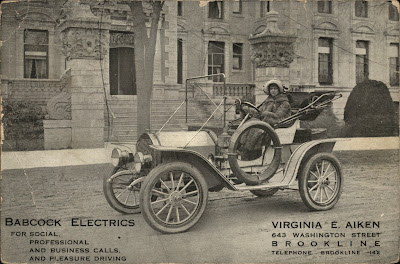
Virginia Aiken promotional postcard
Promotional postcard for Virginia Aiken, Babcock Electrics
(Click image for larger view)
Aiken operated out of the Brandon Garage at 643 Washington Street, where she maintained an office, employed a stenographer and a bookkeeper, and kept several models of Babcock Electrics to demonstrate to prospective buyers.

1912 ad for Virginia Aiken's Babcock Electrics
Ad for Virginia Aiken's Babcock Electric dealership, Boston Post, May 9, 1912
1913 Map showing location of the Brandon Garage
The Brandon Garage at 643 Washington Street was Virginia Aiken's base of operation.
Source: WardMaps LLC
How did a teenage Brookline girl arrive at such an unusual situation for her age and gender more than a century ago?

Virginia Aiken
The Automobile Journal, 1912

Virginia Elise Aiken was born in Philadelphia on April 10, 1895, the daughter of Frank E. and Ada (West) Aiken. Her father was a freight inspector and her mother was a stenographer. Her father's father, Frank Eugene Aiken Sr., was a well-known actor and theater owner active mostly in Chicago, but at other times in Philadelphia and New York.

Aiken spent most of her childhood in Chicago. In 1910 or 1911 she moved to Brookline to live with her father's sister Viola and Viola's husband Day Baker and to take advantage of the better educational opportunities in the Boston area. They lived at 145 Winthrop Road. Virginia enrolled at the Runkle School and later at Miss Haskell's School for Girls on Marlborough Street.

Day Baker was New England agent for an electric truck manufacturer and a prominent advocate for electric vehicles. His efforts brought him into contact with Thomas Edison and he became New England representative of the Edison Storage Battery Company which made batteries for automobiles and trucks. (Edison's 22-year old son Charles was one of the ushers at an 18th birthday dance thrown for Aiken by her aunt and uncle at Brookline's Gardner Hall.)

A lengthy 1912 profile of Aiken in The Automobile Journal told how she obtained a license and drove thousands of miles, most of them in electrics. And as the Boston Globe reported:

For some months she has been seen in her pearl gray Victoria around the congested streets of the city, driving in and out among carriages, wagons, street cars and great trucks, or on the streets and boulevards of the suburbs. People have stopped and wondered at the ease and grace with which she handled her automobile, but she always smilingly disclaims any especial skill and replies "You know, it's no trouble to operate; you don't have to crank it, nor do you have a whole lot of levers about which to think: it is so simple to run—it's electric."

But her interest in cars, reported The Automobile Journal, went beyond driving.

Now, Miss Aiken is practical and she began to study the electric carriage with keen enthusiasm. Instead of merely giving attention to the maintenance and care she went back to rudiments and systematically acquired knowledge concerning the battery and the motor. She studied electrical subjects carefully and mastered each with its particular reference to vehicles. She was fortunate in having her uncle as an adviser and under his direction she was able to apply her knowledge to good advantage.

Constantly using the electric machines she met with all conditions that might be encountered and it was with extreme satisfaction that she solved all problems and successfully met every situation. The girl did not hesitate to work about the cars whenever necessary. She found delight in mechanical work and did it surprisingly well.

When Francis Babcock, founder of the Babcock Electric Carriage Company, visited Boston and met Aiken he suggested she become his New England agent and helped set her up in business. Aiken told the Boston Globe she planned to use the profits from the business to pay for her education.

The budding entrepreneur also understood the value of good marketing. She put half of the profits of her first sale into promotion, including newspaper advertisements and engraved notes. "[T]his, and her energetic work, [reported The Automobile Journal] brought to her other customers."

Electric vehicles were sometimes marketed specifically to women, and Aiken's unusual position as a female agent may have helped. She was interviewed by the Boston Post for a July 1912  article that ran under the headline "Miss Aiken's Advice to Women Motorists."

"Why, yes, [she told the reporter] I know it does you good to ride in an electric—it has done me good—don't I look the model healthy electric young woman? Seriously, I do believe that it gives one good health, a good appetite and good control of one's nerves to operate an electric vehicle.

I have in mind a Newton lady who has one of our cars—she drives it herself, charges it with a mercury arc rectifier in her own little garage and looks after her battery herself. She takes great enjoyment in looking after all these little details herself. The out-of-door air exercise that she gets in caring for her car and the long rides which she takes almost daily keep her in the best of health.

No, you newspaper men cannot too strongly urge the driving of electric automobiles by the ladies of Boston as a health-giving and enjoyable method of regaining and keeping health, but it does not end with the health question. The convenience of making calls, shopping, attending church and social functions are all points that are worthy of mention—but of course good health is always a strong argument.

The 1912 advertisement below for Aiken's display at the Boston Auto Show illustrates how Babcock Electrics were marketed especially to women. ("The Runabout for Misses. The Victoria for Ladies".)
Boston Post ad for Virginia Aiken's dealership
Ad for Virginia Aiken's display at the Boston Auto Show Boston Post, March 3, 1912

Many articles about Aiken were published in 1912, in the Boston newspapers and in trade publications like The Automobile Journal, Motor Age, and Electrical World. But her dealership was apparently short-lived. A later article in The Automobile Journal about her Fall 1912 exhibit at the electrical show at Mechanics Hall in Boston, said

While Miss Aiken will retain an interest in the Buffalo electric, it is her intention, after the electric show, to devote the most of her time to studies and music, believing that the proportions to which she has brought the business warrant placing it in the hands of a large automobile sales establishment. Full details of this move will be announced later.

I have not been able to find any such later announcement but there were no further mentions of her dealership after 1912.

Engagement announcement Boston Post
Boston Post, March 30, 1918
In 1918, Aiken's engagement to a Harvard Medical School graduate named Lawrence Weld Smith was announced in a brief article in the Boston Post. The announcement noted that, in addition to Miss Haskell's School (a college preparatory school for girls in the Back Bay), she had attended the Farmer School of Cookery (founded by Fanny Farmer). By 1918, she was back in Chicago where, the article said, she was active in Red Cross work.

The Aiken-Smith marriage never happened. Instead, on Christmas Eve 1919 in Chicago, Aiken married a Swiss immigrant named Robert (or Roberto) Tranquillo Pellandini. They had a daughter, born in Chicago in 1921, and lived for several years in Mexico where Robert Pellandini's family had business interests. (Virginia Pellandini took Swiss citizenship and had to reapply for U.S. citizenship when they returned in 1925.)

The Pellandinis were frequently on the move. They lived, at various times, in Chicago, Mexico City, Easton, Brockton, and Lincoln, Massachusetts, and Lorain, Ohio, before settling in Hot Springs, Arkansas. Robert had several jobs, as listed in directories and census records, including sales manager for a shovel and tool company and accountant with the Ford Motor Company. No further career information is listed for Virginia.

Robert Pellandini died in 1980. Virginia Aiken Pellandini died, at age 92, in Hot Springs in 1987.
Gravesite of Robert and Virginia (Aiken) Pellandini
Memorial Gardens Cemetery, Hot Springs, Arkansas

References

Sunday, April 12, 2015

Blacksmith Shop to Auto Garage to Teen Center

New Life and an Old Story at 40 Aspinwall Avenue
40 Aspinwall Avenue before and after
40 Aspinwall Avenue before and after its conversion to the Brookline Teen Center
Brookline’s 2014 Preservation Awards ceremony took place last November at the Brookline Teen Center on Aspinwall Avenue. The Teen Center itself was one of the recipients, recognized for its adaptive reuse of a nearly century old garage. If you haven’t seen it, you should. It’s a gem, inside and out, a tribute to all who worked on it: founders Paul and Saskia Epstein and their community supporters; the architects and builders; the staff; and the Brookline teens who helped design it.

Their efforts have given new life to an old garage built in 1916 for Frank Turner, a blacksmith and horseshoer who may himself have arrived in Boston as a teenager, a stowaway from Northern Ireland on a British cargo ship in 1883.

Turner was born Francis Turner in Drumnavaddy, near Belfast, in 1866, the son of a weaver and his wife.  It can't be said for certain when he arrived in Boston, but the only immigration record matching his name, age, and birthplace was that of a Frank Turner, 17, one of four stowaways on the S.S. Illyria arriving from Liverpool in October 1883.
Turner ship's manifest
Frank Turner, age 17, is the last of four passengers marked "Stowaways" on this 1883 ship's manifest
By 1892 he was living in Boston’s South End and working as a blacksmith near Castle Square.  He was the co-owner of the Turner & Lyons blacksmith shop on Ferdinand Street (now the southern part of Arlington Street).

Listing for Frank Turner in 1899 Boston Directory
He married another Irish immigrant, Nora Cronin, a dressmaker, in 1901 and became a U.S. citizen in 1902.

Nora and Frank Turner
Nora and Frank Turner in an undated studio photograph
Photo courtesy of Ronald Turner
The Turners had moved to Roxbury by 1906. That year, Turner’s partner, Joseph H. Lyons, died and Turner came to Brookline to work in the blacksmith and horseshoeing shop of P.J. Burns in Brookline Village.

P.J. Burns blacksmith shopAd for P.J. Burns blacksmith shop

The Burns shop stood at 152 Washington Street next to the firehouse at the foot of High Street. It moved down the street to 87 Washington when the current firehouse was built on the site in 1908.

Four years later, Turner was in business for himself again, and he and his wife and their son Harold became Brookline residents. In January 1912 they purchased the 42 Aspinwall Avenue home of blacksmith T. W. Burlingame and the wood frame blacksmith shop behind it.

Turner home with sign in alley
Frank and Nora Turner’s home at 42 Aspinwall Avenue (right) with the alley leading to the wood frame blacksmith shop at #40. The sign says “Frank Turner. Scientific Horseshoeing. Carriage and Wagon Repairing.” (Photo courtesy of Ronald Turner)

1913 Frank Turner, Horseshoer ad
Advertisement from the 1913 Brookline Blue Book directory
Construction notice for 40 Aspinwall Avenue garage
Notice in The American Contractor, February 26, 1916
By this time the automobile was rapidly replacing horse-drawn wagons and carriages. In 1916 Turner replaced the wood frame shop with the brick auto garage that houses the Teen Center today. The architect was George Nelson Meserve, a prolific designer of commercial and residential buildings in Boston, Brookline, and elsewhere.

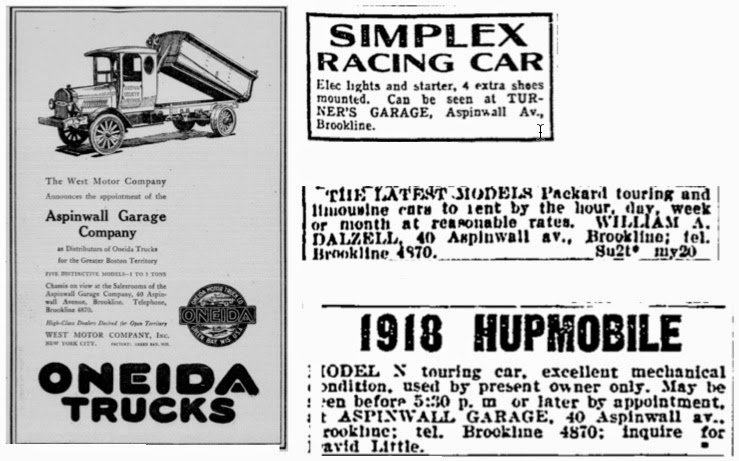
The garage, known variously as Turner’s Garage and the Aspinwall Garage, offered automobile storage and repairs and sold Socony (Standard Oil Co. of NY) gasoline.  Manufacturers and private owners also offered vehicles for sale and lease through the garage, as seen in the ads below.
Ads for Turner's Garage
Ads from Boston Post (left), 1919, and Boston Globe (right) top to bottom 1917, 1917, 1919
Frank and Nora Turner sold the house and garage in 1924 and moved to 29 Auburn Street. Frank then worked as an auto mechanic at the Hinchcliffe Motor Car Co. (900 Commonwealth Avenue in Brookline), New England distributor for Jordan automobiles.

Nora died of pneumonia in 1926. The following year, Frank moved to California with his two sons. He owned an oil well in southern California with his son Harold for a time. Frank Turner died in 1944 at the age of 78.

Dexter Garage ad, 1932
Brookline Directory ad, 1932
The garage passed through two owners in five years after Turner before being purchased by Frank S. Dexter in 1928. He would own it for a decade and a half. Dexter was also the first proprietor of the garage who did not live in the house in front of it at 42 Aspinwall.
     
Later businesses in the garage building included the B&B Corrugated Box Co. after World War II; the Hayes & Shea auto service company in the 1960s (they tore down the house in front of the garage); and International Tire in the 1980s. Brookline Auto Body and Kenmore Auto Sales were the most recent occupants before the conversion to the Teen Center.

Ads from businesses at 40 Aspinwall Avenue

Frank Turner and his successors may be long gone, but the Teen Center renovation has retained several links to the building’s past in place (below), including an “Auto Body Repairs” sign on one wall, an original steel beam (hanging over the “Auto Body Café”) with the inscription “From the A.L. Smith Iron Works, Chelsea”, and yellow parking space lines on the floor by the pool table.

Auto repair sign in Teen Center
Steel beam in Teen Center

Parking spot lines on Teen Center floor
(A version of this article appeared earlier in the Brookline Historical Society members newsletter)

Sunday, June 16, 2013

Yoo Hoo! Red Cab!

Spend a lot of time looking at old Brookline newspapers, like I do, and your eye will inevitably wander from the articles you're reading to the advertisements for local businesses. These ads, available as far back as the 1870s, paint a picture of the evolving commercial life that has long been a central part of Brookline's identity.

I've been collecting dozens of these ads, taken from newspaper microfilm and from town directories, and plan to feature them from time to time. I'll focus on a theme: a particular time period; a retail location; a category of business; or whatever catches my fancy.

First up, Red Cab and a wonderful series of ads that appeared in the paper beginning in the late 1930/early 1940s.

Red Cab ads from the 1939-1941

The design motif in these Brookline Chronicle ads from 1939-1941 was carried through in a frame used for changing ad messages in subsequent years.

More 1940s Red Cab ads

Here's an earlier Red Cab ad, from 1937, with another below with a similar design.

Red Cab ad, 1937

Red Cab ad: "Be Safe"

Red Cab, of course, is still around—and has even retained the -5000 part of their phone number—as seen in this image from the newer advertising medium of the Web.
Red Cab website image

Tuesday, May 22, 2012

Charging Electric Cars in Brookline: Then and Now


Electric car charging stations were installed in two locations in Brookline in October 2011.  But did you know that 100 years ago there were four times as many such stations in town?

Photo of electric car being charged at Corey Hill Garage, 1915
This photo of an electric car being charged at the Corey Hill Garage on Winchester Street appeared in the April 3, 1915 issue of Electrical Review and Western Electrician

The Boston Globe, under the headline "Charging Stations in Bay State," on December 10, 1911 listed all of the locations in Massachusetts for charging electric vehicles.

"That the electric vehicle is destined to have a large sale in this section is evidenced by the large number of charging stations now available in Massachusetts for them," [reported the Globe].

Brookline, with eight stations, was second only to Boston in the number of charging stations in the state. (Boston had 14.) Most of the facilities in the state were provided by electric utilities and municipal power plants, but all eight in Brookline (and all but one in Boston) were at commercial garages.

The full list of Brookline charging stations in the 1911 Globe article included:
  • Beaconsfield Garage, 1731 Beacon Street
  • Brandon Garage, 643 Washington Street
  • Brookline Garage, 50 Washington Street
  • A.E. Carpenter Garage, 112 Corey Road
  • Central Garage, 45 Washington Street
  • Chestnut Hill Auto Garage, 199 Commonwealth Avenue
  • Coolidge Corner Garage, 33 Marion Street
  • Corey Hill Garage, 54 Winchester Street
The two charging stations installed in October 2011 are in the Town Hall parking lot (shown below) and the town parking lot at Babcock and John Streets in Coolidge Corner.

Electric car charging station in Town Hall parking lot Electric car charging station in Town Hall parking lot

Tuesday, May 15, 2012

Brookline Bikes: Sites to See on Beacon Street


The annual Brookline Bikes bicycle parade takes place this Sunday, May 20th.  It's a great event and an opportunity to ride the entire length of the historic Beacon Street boulevard in Brookline unimpeded by automobiles.

The Brookline Historical Society will have a table set up in Amory Park, the starting and ending point for the parade, with information about the development of Beacon Street.  Stop by before or after the ride and check it out.

Shown below are some of the architectural and historical sights you'll see as you ride down Beacon Street. (Photos of Beacon Street landmarks in the past can be viewed on the Brookline Historical Society Web site.)

Pelham Hall (Outbound, at Pleasant Street) Pelham Hall was built as a residential hotel in 1926 as part of a burst of new construction in and around Coolidge Corner.

S.S. Pierce Building (Outbound, at Harvard Street). The S.S. Pierce building, the symbol of Coolidge Corner if not of Brookline itself, was built from 1898-99 on the site of the original Coolidge Brothers store.

The second story of the Pierce Building, now offices, was originally Whitney Hall. Named for Beacon Street developer Henry Whitney, it was used for concerts, lectures, dances, meetings, and other events.  The original tower was taller.  Damaged in a 1944 hurricane, it was remodeled afterward to its current design.  The S.S. Pierce Company continued to occupy the lower floor until the 1960s and the building is still generally called the S.S. Pierce Building, even by residents who didn’t arrive in Brookline until much later.


MBTA Shelters (Both sides at Harvard Street) The tile-roofed shelters for the T, at Coolidge Corner, are the original structures built by Henry Whitney’s West End Railway in 1901. Remodeled a few years ago, they are the only original shelters that remain.

The Stoneholm (Outbound, between Short Street and Lancaster Terrace). The Stoneholm is a magnificent French Renaissance chateau style apartment building that opened in 1909 with such amenities as marble fireplaces, parquet floors, and crystal chandeliers. It was designed by Arthur Bowditch, who lived on Pill Hill.


Chinese Christian Church (Inbound, between Strathmore and Dean Roads). This neo-Gothic church was designed by Shepley, Rutan & Coolidge in 1910. Built for the Leyden Congregational Church, it was bought by the Chinese Christian Church of New England in 1975.


All Saints Church.  (Inbound, at Dean Road). All Saints Church, designed by the architectural firm of Cram, Wentworth, and Goodhue, replaced a temporary wooden church on the site with the completion of the nave in 1899.

The Beaconsfield Terraces (including Richter Terrace,  Inbound at Dean Road and Frances Terrace, Inbound at Tappan Street). 
The Beaconsfield Terraces were one of the more unusual developments to follow the widening of Beacon Street. Built by Eugene Knapp, a wool merchant, in the early 1890s, the terraces were an early condominium arrangement in which people owned their units but shared ownership of 6-acre park, stables, a playhouse (known as the casino), tennis courts, and a playground. A bell system connected the houses to the stables so that people could call for their horse and carriage. A central heating plant heated all of the buildings. Today, only the residence buildings remain.


Athans Building
 (Inbound at Washington Street). This commercial block was built in 1898 with stores, offices, and a hall for dances and concerts.


Richmond Court. (Inbound, east of St. Paul Street). 
Richmond Court was one of the firstpossibly the firstcourtyard apartment buildings in the country. Built in 1898, it is set back and separated from the noise and bustle of Beacon Street by an iron fence, brick and stone posts, a fountain, and private gardens. Richmond Court was designed by Ralph Adams Cram who went on to design All Saints Church, further out on Beacon Street, as well as the Cathedral of St. John the Divine in New York, and many buildings at West Point and Princeton University.


Temple Ohabei Shalom (Inbound at Kent Street). Temple Ohabei Shalom was the first Jewish congregation in Boston, formed in 1842 by immigrant German Jews. The congregation moved to Brookline and this domed temple in 1927.