Wednesday, May 11, 2011

Brookline Bikes: Sights to See on Beacon Street

The annual Brookline Bikes bicycle parade takes place this Sunday, May 15th.  It's a great event and an opportunity to ride the entire length of the historic Beacon Street boulevard in Brookline unimpeded by automobiles.

The Brookline Historical Society will have a table set up in Amory Park, the starting and ending point for the parade, with information about the development of Beacon Street.  Stop by before or after the ride and check it out.

Shown below are some of the architectural and historical sights you'll see as you ride down Beacon Street. (Photos of Beacon Street landmarks in the past can be viewed on the Brookline Historical Society Web site.)

Pelham Hall (Outbound, at Pleasant Street) Pelham Hall was built as a residential hotel in 1926 as part of a burst of new construction in and around Coolidge Corner.

S.S. Pierce Building (Outbound, at Harvard Street). The S.S. Pierce building, the symbol of Coolidge Corner if not of Brookline itself, was built from 1898-99 on the site of the original Coolidge Brothers store.

The second story of the Pierce Building, now offices, was originally Whitney Hall. Named for Beacon Street developer Henry Whitney, it was used for concerts, lectures, dances, meetings, and other events.  The original tower was taller.  Damaged in a 1944 hurricane, it was remodeled afterward to its current design.  The S.S. Pierce Company continued to occupy the lower floor until the 1960s and the building is still generally called the S.S. Pierce Building, even by residents who didn’t arrive in Brookline until much later.


MBTA Shelters (Both sides at Harvard Street) The tile-roofed shelters for the T, at Coolidge Corner, are the original structures built by Henry Whitney’s West End Railway in 1901. Remodeled a few years ago, they are the only original shelters that remain.

The Stoneholm (Outbound, between Short Street and Lancaster Terrace). The Stoneholm is a magnificent French Renaissance chateau style apartment building that opened in 1909 with such amenities as marble fireplaces, parquet floors, and crystal chandeliers. It was designed by Arthur Bowditch, who lived on Pill Hill.


Chinese Christian Church (Inbound, between Strathmore and Dean Roads). This neo-Gothic church was designed by Shepley, Rutan & Coolidge in 1910. Built for the Leyden Congregational Church, it was bought by the Chinese Christian Church of New England in 1975.


All Saints Church.  (Inbound, at Dean Road). All Saints Church, designed by the architectural firm of Cram, Wentworth, and Goodhue, replaced a temporary wooden church on the site with the completion of the nave in 1899.

The Beaconsfield Terraces (including Richter Terrace,  Inbound at Dean Road and Frances Terrace, Inbound at Tappan Street).
The Beaconsfield Terraces were one of the more unusual developments to follow the widening of Beacon Street. Built by Eugene Knapp, a wool merchant, in the early 1890s, the terraces were an early condominium arrangement in which people owned their units but shared ownership of 6-acre park, stables, a playhouse (known as the casino), tennis courts, and a playground. A bell system connected the houses to the stables so that people could call for their horse and carriage. A central heating plant heated all of the buildings. Today, only the residence buildings remain.


Athans Building
(Inbound at Washington Street). This commercial block was built in 1898 with stores, offices, and a hall for dances and concerts.
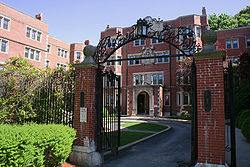


Richmond Court. (Inbound, east of St. Paul Street).
Richmond Court was one of the firstpossibly the firstcourtyard apartment buildings in the country. Built in 1898, it is set back and separated from the noise and bustle of Beacon Street by an iron fence, brick and stone posts, a fountain, and private gardens. Richmond Court was designed by Ralph Adams Cram who went on to design All Saints Church, further out on Beacon Street, as well as the Cathedral of St. John the Divine in New York, and many buildings at West Point and Princeton University.


Temple Ohabei Shalom (Inbound at Kent Street). Temple Ohabei Shalom was the first Jewish congregation in Boston, formed in 1842 by immigrant German Jews. The congregation moved to Brookline and this domed temple in 1927.


Monday, May 9, 2011

Invention & Innovation: A Walking Tour of New Ideas Born in Brookline

Did you know that King C. Gillette got the inspiration for the safety razor while shaving in his Brookline home one morning? 

Or that the birth control pill was developed by Dr. John Rock at the Free Hospital for Women overlooking the Muddy River? 


Or that one of the world’s first electric cars was built at the Holtzer-Cabot Electric Company on Station Street? 


Join me this Sunday, May 15th, at 2 pm to learn about these and other advancements made by 19th and 20th century inventors and innovators living or working in Brookline


The tour begins at the Brookline Village MBTA Station and will cover approximately 2 miles in 1-1/2 hours. Free and open to the public. 

Sunday, May 1, 2011

A Tree Falls in Brookline: The Aspinwall Elm, 1863

In honor of Arbor Day, April 29th (officially proclaimed in Brookline by the Board of Selectmen last Friday), Muddy River Moments presents the story of the Aspinwall Elm, the most celebrated tree to grow—and fall—in Brookline.

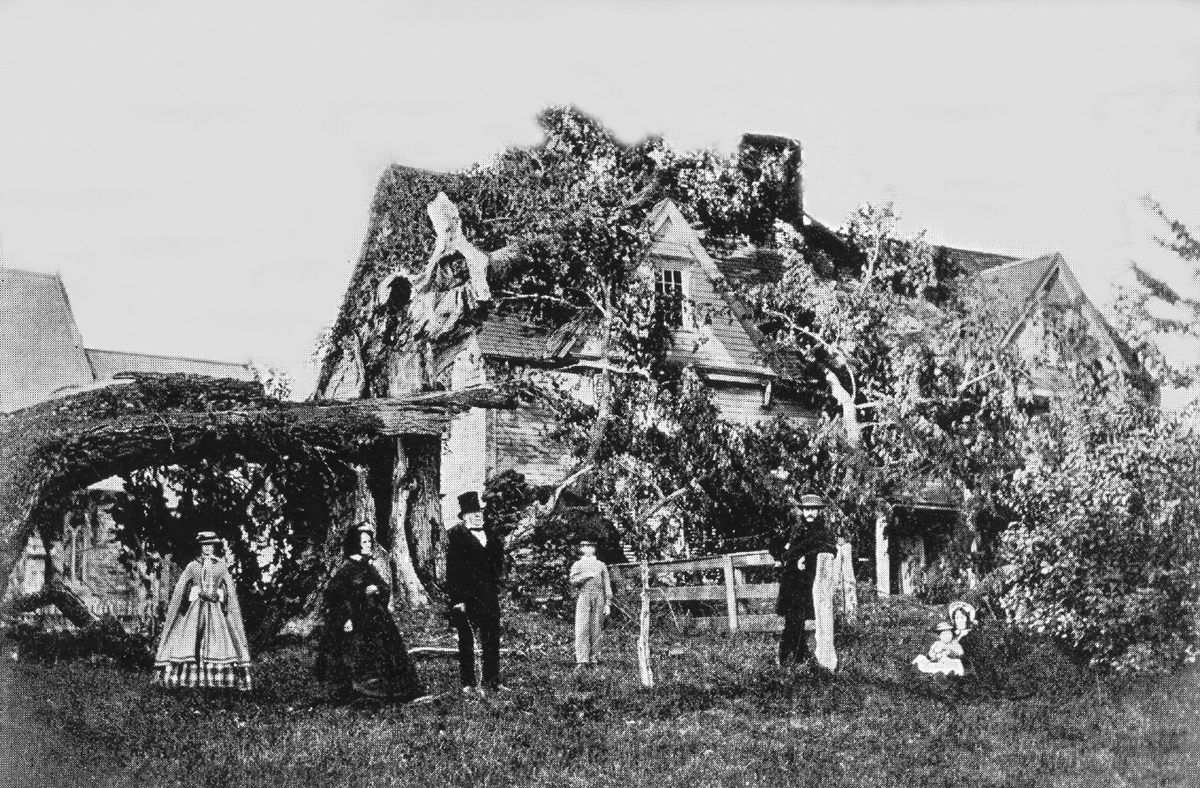
Three generations of the Aspinwall family pose before the family home and the remains of the celebrated Aspinwall Elm after it came down in a gale in September 1863
Three generations of the Aspinwall family pose before the family home and the remains of the celebrated Aspinwall Elm after it came down in a gale in September 1863. (Brookline Historical Society photo)

When 19th century Bostonians talked about great elm trees, there were three that usually came to mind: the Great Elm on Boston Common; the Washington Elm on Cambridge Common; and the Aspinwall Elm, towering over the Aspinwall family home in Brookline Village.

The Aspinwall Elm was, by most accounts, the largest of these.  The circumference of its massive trunk (as reported in The North American Review in 1844) had been measured in 1837 at 26 feet 5 inches at ground level and 16 feet 8 inches five feet up. Its branches (according to the 1846 edition of Dr. George B. Emerson's report on the trees and shrubs of Massachusetts) at one time extended 104 feet from southeast to northwest, and 95 from northeast to southwest.

The tree stood on what is now Aspinwall Avenue alongside the home built by Peter Aspinwall in 1660.  (The site was opposite that of St. Paul's Episcopal Church, which was built nearly two centuries later, in 1851.) Tradition had it that Peter Aspinwall planted the tree in 1656, though other stories date it somewhat later than that and attribute its planting to Peter's son Samuel or to Samuel Clark, who lived with the Aspinwalls as a boy.

This photo of the Aspinwall House and the Aspinwall Elm was published in The Aspinwall Genealogy published by Algernon Aikin Aspinwall in 1901

Mary W. Poor, daughter of the Rev. John Pierce, recalled the tree in her 1903 recollection of Brookline in the 1820s.

Every one spoke of it as " Beautiful Brookline." This was partly due to the rolling and well wooded surface and to the splendid elms of uncommon size and picturesque shape that fairly embowered the village and a great part of the town. The queen of these noble trees was the "Aspinwall elm," which stood at the southwest corner of the old "Aspinwall house" very near the site of the Episcopal church.

Half the tree fell in 1844.  Eleven years later, J.C. Warren, president of the Boston Society of Natural History, examined the Aspinwall Elm while writing a book about the Great Elm on Boston Common.

I have examined this tree [wrote Warren], and find that its annual foliage has been almost wholly devoured by the canker-worm, in common with many other trees in the low land of Brookline. It appears at this time like a frightful skeleton ; and there is a question whether it will ever recover from the shock it has received. In its death, we shall have to deplore the loss of one of the finest natural ornaments of this part of the country.

Warren was right to be concerned.  Eight years later, on September 18, 1863, the rest of the tree came down in a gale, crashing on top of the 200-year old house and punching a hole in the roof.  Three generations of the family posed in front of the house with the toppled tree.  (Click here for a larger view of the image above.)

The loss of the Aspinwall Elm was big news, and not just locally. Word of its demise was mentioned in newspapers as far away as Wisconsin.

The stump of the giant elm remained for some time after.  In 1873, in his speech dedicating Brookline's new Town Hall, Robert C. Winthrop paid tribute to the Aspinwall Elm:

Of the venerable elm, which overshadowed [the Aspinwall House] certainly for more than a hundred and fifty years, if indeed it was not coeval with Columbus, nothing remains but the antique roots, and a few feet of massive but mutilated trunk. They are almost the last relics of the old Muddy River Hamlet, and I wish they could be enclosed and inscribed as a monument of the remote past. What an inspiring stump that would be for an open-air speech on some historical anniversary ! If nothing else can be done, I trust that enough of it may be secured as a desk for this very platform. If it were here at this moment, my manuscript would have a most congenial resting place, — more precious than the most skillful carving or veneering of Oak, or Maple, or Satin-Wood.

The Aspinwall House, in poor shape at the time of Winthrop's speech, was itself torn down in 1891.  The land was acquired by the town in 1914 for a park.  Expanded in 1972, it is now the Billy Ward Playground.

BillyWard Playground
The Billy Ward Playground on the site of the Aspinwall House and the Aspinwall Elm.

Thursday, March 10, 2011

Brookline, Allston-Brighton and the Renewal of Boston

Help celebrate the 110th birthday of the Brookline Historical Society with guest speaker Ted Clarke, author of Brookline, Allston-Brighton and the Renewal of Boston.  Sunday, March 13th, at 2 pm at Hunneman Hall, Brookline Public Library
Beacon Street at Coolidge Corner as laid out by Henry Whitney and Frederick Law Olmsted
(Image from the collection of the Brookline Historical Society)
In October of 1873, voters in the neighboring towns of Brookline and Brighton cast ballots on whether or not to accept annexation into the City of Boston. Brighton voted Yes, while Brookline voted No, and the decision had long-term repercussions for both towns and for Boston itself.

Join Ted Clarke, author of the new book Brookline, Allston-Brighton and the Renewal of Boston for a look at the different paths taken by these two communities following the annexation vote. Clarke, a local historian and former Summit Avenue resident, will talk about the development of Brookline and Brighton after 1873, with a focus on the local work of Henry Whitney and Frederick Law Olmsted.

The program is free and open to the public. Refreshments will be served.

This is the Annual Meeting of the Brookline Historical Society. The presentation will be preceded by a brief business meeting.
The Brookline Public Library is at 361 Washington Street.

Tuesday, November 23, 2010

"Brookline Biscuits" for Thanksgiving

Care to add a little local flavor to your Thanksgiving meal this year?  Try adding Brookline Biscuits to your holiday table as recommended by the Boston Cooking-School a century ago.
Brookline Biscuits as shown in the November 1907 Boston Cooking-School Magazine
Brookline Biscuits as shown in the Boston Cooking-School Magazine in 1907

The November 1907 issue of the Boston Cooking-School Magazine of Culinary Science and Domestic Economics provided Thanskgiving menus for five different settings.  "Brookline Biscuit" was included in two of the five: the "City Home" and "Country Home" Thanksgiving meals.
1907 Thanksgiving Menus with Brookline Biscuit
1907 Thanksgiving Menus (Click for larger view)

Most of the recipes for the menus were provided by the magazine's long-time editor Janet McKenzie Hill.  But the recipe for Brookline Biscuit was attributed to "C.J." This was most likely Charlotte J. Clark (née Wills), a teacher at the Boston Cooking-School and the former assistant to Fannie Farmer when Farmer was the school's principal. (Farmer had left to open her own school in 1902.)

It's not clear what, if any, connection Clark—or the biscuits—had to Brookline.  The recipe (uncredited to Clark) was used again in Janet McKenzie Hill's 1916 Nyal Cook Book ("Practical recipes that have been tested in actual use") published by the Detroit-based Nyal drugstore chain.

Nyal Cook Book cover

Here's the  recipe for Brookline Biscuit, as it appeared in 1907 and again nine years later. Give it a try, and let me know how it works out.

Have a pint of sifted flour in a bowl; into this rub two level tablespoonfuls of butter. Scald one cup of milk and when lukewarm add one-fourth a cake of compressed yeast, dissolved in one-fourth a cup of lukewarm water.  Stir this into the flour and set to rise overnight.

In the morning work in sufficient flour to make a dough and knead it until it is elastic and does not stick to the fingers. Let rise until very light, then take from the bowl to the bread board, without working, and roll out into a rectangular sheet longer than it is wide, and half an inch thick. Spread softened butter upon this and fold the dough evenly, to have three layers.

With a sharp knife, dipped in flour, cut the dough into strips three-fourths an inch wide. Take hold of a strip at the ends, pull gently to lengthen it, then twist the ends in opposite directions and form the shape of the figure eight, joining the two ends underneath. 

Place the biscuits in buttered pans so that they will not touch, and when light bake in a rather hot oven to a delicate brown.  The recipe makes two dozen biscuit.


Links

From "Feeding America" The Historic American Cookbook Project" at Michigan State University


Monday, November 15, 2010

Brookline and the Invention of the Safety Razor

King C. Gillette
King C. Gillette as he appeared in
John William Denehy's bicentennial
history of Brookline (1906)
On this date (November 15th) in 1904, King C. Gillette of Brookline was awarded a patent for a disposable safety razor. He had applied for the patent three years earlier, and first came up with the idea six years before that while shaving in his Brookline home.

Here's how Gillette recalled it in a February 1918 article in the company magazine The Gillette Blade:

I was living in Brookline at No. 2 Marion Terrace at the time [1895], and as I said before I was consumed with the thought of inventing something that people would use and throw away and buy again. On one particular morning when I started to shave I found my razor dull, and it was not only dull but it was beyond the point of successful stropping and it needed honing, for which it must be taken to a barber or to a cutler. As I stood there with the razor in my hand, my eyes resting on it as lightly as a bird settling down on its nest--the Gillette razor was born.

Years of experimentation failed to solve the technical difficulties involved in producing the kind of razor Gillette had in mind.  MIT-trained engineer William Nickerson came to the rescue, joining Gillette in 1901 and perfecting the manufacturing process.  (In the December 1918 issue of The Gillette Blade Nickerson described seeing an early version of Gillette's razor for the first time in the home of Henry Sachs on University Road in Brookline.)

Drawing of Razor for Patent Awarded to Gillette in 1904
Drawing for Patent 775,134 awarded to King C. Gillette in 1904

Sales took off in 1904, the year the patent was awarded, with 90,000 razors sold through the end of the year (according to the Dictionary of American Biography).  With the continued success of the Gillette Safety Razor Company, Gillette and his family moved in 1907 to a large home at 1566 Beacon Street, near Lancaster Terrace.  They lived there for only six years before moving to California in 1913.  King C. Gillette died in Los Angeles in 1932.
Gillette home at 1566 Beacon Street
This house at 1566 Beacon Street was the home of the King C. Gillette family from 1907 to 1913.  It was torn down in 1944.

Further Reading

Friday, October 8, 2010

Separating the Trash a Century Ago

In honor of the first week of single-stream recycling in Brookline, Muddy River Moments offers a look back at how residents of the town a hundred years ago had to separate their trash for pick up.

The following is from the town's health regulations of 1918:

Article III. Waste Material—Garbage
  • Section 1. All waste material set out for removal by the town shall be kept in separate receptacles.
  • Sec. 2. One or more of such receptacles shall be used exclusively for garbage or swill and shall be water-tight, have tight fitting covers, and be kept clean and free from deposits of garbage.  (An underground garbage receptacle is urgently recommended.)
  • Sec. 3. A second receptacle or receptacles, preferably made of iron, shall be used exclusively for ashes, tin cans, bottles, and other noncombustible waste.
  • Sec. 4. A third separate set of receptacles shall be used exclusively for dry combustible waste, such as paper, old shoes, house-sweepings, and other such waste material as it is customary for the town to remove.
  • Sec. 5. No person shall overhaul the contents of receptacles of waste material set upon the sidewalks to be removed by the town.
  • Sec. 6. No person shall throw upon the sidewalk, or into any public street or catch-basin, any paper, tin cans, house-sweepings, lawn-rakings, old shoes, orange peel, banana skin, dead animal, or other waste material.