Thursday, May 27, 2010

Got Milk? Shhhh!

Town Meeting last night gave Brookline police new powers to control "loud and unruly gatherings," with a measure aimed mostly at parties involving alcohol-fueled college students in rental housing in North Brookline. The new bylaw passed 183-3, capping the efforts of a group of North Brookline residents and their supporters calling themselves "Sleepless in Brookline."

A little over a hundred years ago, bottled beverages were at the center of another effort to curtail noise in Brookline.  But the liquid culprit on that occasion was not alcohol, but. . .

 . . . Milk.

Cartoon: The Milkman of Noiseless Town

A group of citizens -- "the early-morning-sleep-loving fraternity" the Boston Daily Globe called them -- stated their objections to "the rattling of milk wagons over the cobblestones, the shouting from one to another of the milkmen, and the banging of back doors and the unnecessary clanging of milk bottles" (among other nuisances).

On August 1, 1904, the Board of Health sent letters to every milk dealer who made deliveries in town, asking each

to carefully inspect and, if necessary, alter his wagons with reference to preventing rattling and other loud noise, and also to instruct the drivers to drive slowly when near dwelling houses, to avoid cobblestone gutters, to handle the cans and bottles quietly, to refrain from shouting, and in all other ways to do their work without unnecessary noise.

Selectman also heard concerns about the noisy gears of streetcars, the horns of automobiles, and the barking of dogs.  (Dog owners were told to keep their dogs from barking in the early morning which [said the Globe] "will leave the rooster the sole time-honored right to express his sentiments at such a time."

The newspaper found all the commotion about noise fairly amusing.  The story ("Noise crusade begun by prominent men of Brookline. Milkmen requested not to disturb sleepers") ran on the front page of the August 5th edition with a lightly mocking cartoon ("Brookline, The Silent Suburb") at the top.  (Click on the page below for a larger view.)


Boston Globe Front Page, August 5, 1904

Saturday, April 3, 2010

Baseball Hall of Famer and Pioneering Sports Promoter George Wright

George Wright in the uniform of the Boston Red Stockings in the 1870s(In honor of the Opening Day of the 2010 baseball season, Muddy River Musings looks at George Wright, the only member of the Baseball Hall of Fame buried in Brookline.)

Baseball Hall of Famer George Wright, who is buried in Holyhood Cemetery in Brookline (although he never lived in Brookline), was perhaps the game's first real star. He was the shortstop and leading hitter on the undefeated Cincinnati Red Stockings of 1869, the first all-professional baseball team.

He moved to Boston in 1871 with the Red Stockings and his older brother Harry—captain and manager of the team—and won five league championships with Boston.

Wright was also an ambassador for the game. He was part of two teams that helped bring the game to the West in the 1860s. He joined trips to England in 1874 and around the world in 1888 to demonstrate the sport. Wright even umpired an exhibition game at the 1912 Summer Olympics in Stockholm, Sweden.

But his accomplishments in the national pastime, which earned him selection to the Hall of Fame soon after his death in 1937, don't tell the whole story of George Wright's impact on American sports.

Wright had a long post-baseball career as one of the nation's top cricket players at the Longwood Cricket Club in Brookline. As head of the Wright & Ditson sporting goods company in Boston, he helped popularize both tennis and ice hockey in the United States.

Perhaps most significantly, Wright played a key role in introducing golf to the U.S. and was sometimes called "the father of American golf."


Born Into a Sporting Family

George Wright was born in New York City in 1847. His father Sam, a professional cricket player, had emigrated from England in 1836 with his wife Annie and their young son Harry. The family moved to Hoboken, New Jersey in 1857, and the Wright brothers played cricket and the new game of "base ball" on the Elysian Fields of that city.

Starting at age 15, Wright played with baseball teams from New York, Philadelphia, and Washington. In 1867, he was on the Washington Nationals team that made the first tour of an eastern club to the cities of the "West": Columbus, Louisville, Indianapolis, Cincinnati, Chicago, and St. Louis. Among the teams they beat (by a score of 53-10) was brother Harry's Cincinnati Red Stockings. (Harry had gone to Cincinnati in 1865 to manage a cricket club, but was soon leading one of the city's top baseball teams as well.)

Determined to match the powerful eastern teams, Harry Wright and Red Stockings owner Aaron Champion brought together the first all-professional—or at least first openly all-professional—team for the 1869 season. George Wright, signed to play shortstop, was the highest paid player with an annual salary of $1,400. Wright, reported the St. Louis Republican, was

the beau-ideal of base-ball players. His fielding exhibits science at every point, his picking, throwing and strategy could not be excelled, and he is plucky in facing balls of every description.
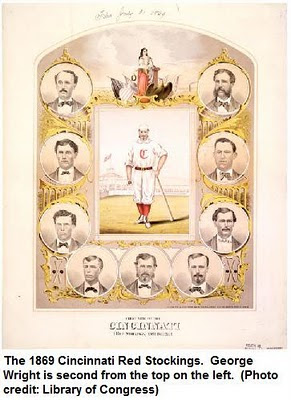
The Cincinnati Red Stockings of 1869The Red Stockings went through the 1869 season undefeated. They were invited to the White House to meet with President Grant. In September they traveled to California for games on the West Coast. (The Transcontinental Railroad had only been completed a few months before. The players reportedly slept with pistols under their pillows out of fear of Indian attacks on the train.)

After another successful season in 1870, the Cincinnati club broke up. Harry Wright started a new team in Boston, bringing along brother George and several other players (as well as the Red Stockings name.) The team dominated the National Association, sometimes considered the first professional baseball league, winning the championship in all five years of its existence (1871-1875), before joining the new National League in 1876.

George Wright left the Boston team to lead the rival Providence club in 1878. He ended his National League career in 1882.

Beyond Baseball: Man of Many Sports

1883 ad for Wright & Ditson sporting goods
Not long after coming to Boston, Wright went into the sporting goods business as a sidelight to his athletic career. Joining forces with fellow merchant Henry Ditson, he built a successful business that lasted long after the end of his playing career. (Wright & Ditson was eventually absorbed into the sporting goods empire of Wright's former Boston teammate A.G. Spalding.)

Wright & Ditson carried equipment for all kinds of sporting and recreational activities popular with Americans. But it also brought Wright into contact with new kinds of athletic endeavors, most notably the game of golf, largely unknown in America at the time.

Wright's first exposure to golf came when he ordered a set of clubs and balls from an English catalog. They arrived without rules or instructions, and Wright, with no knowledge of the game, left them on display in his store on Washington Street in Boston. There they caught the eye of a visiting Scotsman who explained the game and later sent Wright a copy of the rules.

1909 Wright & Ditson ad for golf clubs and ballsIn December 1890, Wright and a group of friends set out for Franklin Park to try the game. Stopped by a policeman, they obtained a permit from the parks commission and returned, laying out a nine-hole course using tomato cans for the holes. They played two rounds, reportedly the first rounds of golf ever played in New England.

A few years later, Franklin Park became the site of the second municipal golf course in the U.S., still in use today. Another municipal course, designed by Donald Ross in Hyde Park in the 1930s, was named the George Wright Golf Course in honor of Wright's pioneering promotion of the sport.)

Wright & Ditson became a leading seller of golf clubs. Brookline's Francis Ouimet got his first club from Wright & Ditson. (His older brother Wilfred traded used golf balls for the club.) In 1911, Ouimet got a job as a clerk at Wright's store, and Wright was generous in his support of the young golfer's burgeoning amateur career.

By the time Francis came to work for him [wrote Mark Frost in The Greatest Game Ever Played], George Wright knew all about the young man's potential in the game and took a personal interest in the ex-Country Club caddie. As a former professional athlete, he understood only too well the pressures a gifted young player faced as he neared adulthood, searching for the limits of how far his talent could take him.

Wright, who had given his young clerk time off from the store, was in the gallery in Brookline in 1913 when Ouimet won his historic upset victory over Britons Harry Vardon and Ted Ray at the U.S Open at the Country Club. He continued to promote (and play) golf into his 80s.

Wright's interest in athletics extended into other sports as well.

In 1894, Wright helped organize a set of ice hockey and ice polo matches in Canada between Canadian athletes and a team of U.S. collegians from Harvard, Yale, Brown, and Cornell. (Ice polo, popular in the U.S., was similar to hockey but played with rounded mallets and a rubber ball.)

After watching a few contests [wrote David Fleitz in More Ghosts in the Gallery], George recognized that hockey was the superior game, so he set his company to work promoting the Canadian sport and manufacturing its equipment. By the dawn of the 20th century, hockey had supplanted ice polo in popularity, with George Wright providing a major impetus to its growth in the United States.


In 1898, Wright brought a group of top Eastern tennis players to California to help promote the sport on the West Coast. The players included Dwight Davis, for whom the Davis Cup is named, as well as Holcombe Ward and Brookline's Malcolm Whitman. (Ward and Whitman would be Davis' teammates on the first Davis Cup squad in 1900.) Also on the trip was Wright's son Beals who was then the national interscholastic champion and would, like the other three, later be elected to the International Tennis Hall of Fame. (Wright's son Irving was also a tennis player and served as president of the Longwood Cricket Club.)
Wright with Eastern and Western tennis players on 1898 California trip
Baseball Ambassador

While exploring, promoting, and playing other sports, Wright remained closely involved with baseball. As noted above, he was part of two early trips to the West in the 1860s to help promote the game. In 1874, the Wright brothers joined Albert Spalding, their Boston Red Stockings teammates, and the Philadephia Athletics on a trip to England to demonstrate the American game. (Old cricketers George and Harry Wright also helped the Americans surprise local cricket teams by beating them at their own game.)

Wright joined Spalding again in 1888-89 for a celebrated round-the-world barnstorming trip that brought baseball to Australia, Ceylon, Egypt, Italy, France, England, and Ireland. (Wright helped build a canvas batting cage on board ship so the players could practice without losing balls overboard.)

Swedish poster advertising exhibition baseball game at the 1912 Olympics in StockholmIn 1912, the Swedish hosts of the Summer Olympic Games in Stockholm asked the American Olympic Committee to arrange an exhibition baseball game against a Swedish team. The Americans secured uniforms and equipment for two teams. Players were recruited from the American track and field athletes. George Wright, then 65, was brought along as umpire and coach.

The playing of the exhibition games had to wait until the American athletes were finished competing in their events. Jim Thorpe, fresh off his gold medal wins in the pentathalon and decathalon, played in the second of the two games.

Wright, in addition to umpiring the first game, helped coach the Swedish players in the finer points of baseball.


George Wright demonstrating batting for Swedish players
Wright was a member of the Mills Commission which in 1908 famously and erroneously attributed the invention of baseball to Abner Doubleday in Cooperstown, New York in 1839. As Dan Okrent and Steve Wulf wrote in their book Baseball Anecdotes, Wright should have known better. On the other hand, it is likely that Wright's presence on the Mills Commission was largely symbolic. According to Okrent and Wulf, he never attended any of the meetings.

He did continue attending games, including a return to Cincinnati during the 1919 World Series. He became the oldest living ex-major leaguer in 1935.
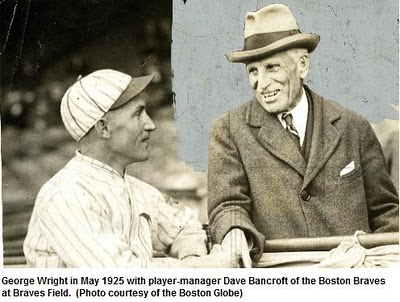
Wright with Boston Braves player-manager Dave Bancroft in 1925George Wright died at his home Dorchester on August 21, 1937 at the age of 90. He was buried in Holyhood Cemetery in Brookline. Four months after his death, Wright was selected to the Baseball Hall of Fame as one of the pioneers of the game.

Grave of George WrightGeorge Wright's Hall of Fame plaque

Sunday, March 21, 2010

The Big Dig of 1848

The Big Dig of 1848:
The Brookline Reservoir & the Cochituate Aqueduct

Annual Meeting of the Brookline Historical Society
Sunday, March 28, 2010, at 2 pm
Hunneman Hall, Brookline Public Library, 361 Washington Street
Brookline Reservoir and GatehouseThe Cochituate Aqueduct, built between 1846 and 1848,
brought clean water 15 miles from Lake Cochituate
to the Brookline Reservoir for distribution to the City of Boston.

Join architectural historian Dennis DeWitt
for the story of the reservoir and its historic gatehouse
and their role in one of the largest public works projects of its time.

Refreshments will be served

The program will be preceded by a brief business meeting.

For more information, call 617-566-5747
http://brooklinehistoricalsociety.org

Monday, December 28, 2009

From Snow Sculptures to the Paris Salon and Beyond

1893 sketch of Henry Hudson Kitson and Theo Alice Ruggles at work in their studioHenry Hudson Kitson and Theo Alice Ruggles at work in their studio in 1893. This sketch, which first appeared in The Illustrated American, was reproduced in a June 25, 1893 Boston Globe article—"Tale of Art and Love"—that described their partnership and forthcoming marriage. (Click on image for a larger view.)

In 1885, 14-year old Theo Alice Ruggles made a snow sculpture in the yard of her family's Brookline home on Harvey Street (now 30 Upland Road). This was no ordinary snowman. It showed a recumbent horse in the act of rising from the ground, and it attracted notice in the neighborhood and beyond. People from Boston were said to make the trip out to Brookline just to see it.

Encouraged by admiring visitors, Ruggles' parents tried unsuccessfully to enroll her in art school before finding a young sculptor, Henry Hudson Kitson, willing to take her on as a student. It marked the beginning of a journey that would lead in just a few years to the Paris Salon, to partnership and marriage with Kitson, and to recognition as one of the most accomplished woman sculptors of her day.

1893 portrait of Theo Alice RugglesPerhaps most remarkably for a woman in that era, Theo Ruggles Kitson became one of the leading sculptors of war memorials in the United States, with statues, busts, and reliefs on display from coast to coast commemorating the Civil War, the Spanish-American War, and World War I.

Theo Alice Ruggles was born January 29, 1871. She was the daughter of Cyrus W. and Anna H. Ruggles. Her father, a successful businessman, was also Brookline's postmaster and the station master in town for the Boston & Albany Railroad. As a young girl, Theo enjoyed sculpting images out of clay at the family's summer home and letting them bake in the sun.

In the wake of the attention the snow sculpture brought to Ruggles and her work that winter of 1885 her parents sought a place for her in the school of the Museum of Fine Arts. The school turned her down as too young, as did other art schools and several private tutors.

1888 sketch of Henry Hudson KitsonHenry Hudson Kitson, who became her teacher and later her husband, was a native of England who had come to the United States as a teenager. He was 20 years old when he began working with Ruggles. When a commission took Kitson to Paris in 1887, his young student—accompanied by her mother—followed so that she could continue her studies.

In Paris, Ruggles learned from and worked with Kitson and also studied with French artists, including Pascal-Adolphe-Jean Dagnan-Bouveret and Gustave Courtois. In 1888, she had one of her sculptures accepted for the Paris Salon and the following year, while still a teenager, she became the first American woman sculptor to receive an award at the Salon.

Kitson and Ruggles were married in 1893, after their return to the United States. She had four works exhibited that year at the Columbian Exhibition in Chicago. In 1895, she became the first woman (and youngest member) in the new National Sculpture Society.

A Harper's magazine profile published that year said of her:

Though one of the youngest women who are known through their work in the art world, Mrs. Kitson has had the most successful career of any woman who has undertaken the profession of sculpture.


The Volunteer: Theo Ruggles Kitson's Massachusetts Memorial at the Vicksburg National Military ParkTheo Ruggles Kitson (as she became known) completed her first military sculpture—a statue of Revolutionary War naval hero Esek Hopkins in Providence, Rhode Island—in 1897.

Her 1902 Civil War monument ("The Volunteer") in Newburyport, Massachusetts became the model for the Massachusetts memorial at the Vicksburg National Military Park in Mississippi (shown at left). The first monument erected at Vicksburg, it was also the first of more than 60 statues, busts, and reliefs created by Kitson for the Vicksburg park between 1903 and 1920 .

The Boston Globe saw "The Volunteer" as a new kind of statue:

....a departure from the conventional soldier, which stands on a variety of pedestals in cemeteries and parks at 'present arms' or some other parade ground attitude. The figure is as much a departure from such figures as is the real American volunteer soldier from all previous soldiers in any land.


This spirit of volunteerism, continued the Globe,

is manifest in every line of the figure and it is really remarkable that a woman should be the first to note and portray in sculpture this strong characteristic of the American volunteer soldier, when it is the very thing that every foreign military critic first notices and always has noticed and commented upon. The trouble has been that the traditional solider of sculpture has been too hard to pull away from and Mrs. Kitson was the first who had the courage to give exact expression to the very qualities for which the volunteer soldier has always stood.

Author Polly Welts Kaufman, in her book National Parks and the Woman's Voice: A History (University of New Mexico Press, 2006), saw a different motivation in her description of the dedication of the Vicksburg statue :

Theo Kitson saw her Civil War sculptures as providing an opportunity for reconciliation and healing, not for the commemoration of heroism. Kitson herself was chosen to unveil the statue, but she insisted that a Confederate woman assist her in the unveiling. Alice Cole, the daughter of a Confederate soldier, joined her.

Kitson was also responsible for the first Civil War monument to feature a woman serving the troops. A memorial to nurse Mary Bickerdyke showing "Mother Bickerdyke" serving water to a wounded Union soldier, it stands in Galesburg, Illinois.

Theo Ruggles Kitson's statue of Civil War nurse Mary BickerdykeTheo Ruggles Kitson's statue of Civil War nurse Mary Bickerdyke stands in front of the courthouse in Galeburg, Illinois.

In 1904, Kitson received a commission from the University of Minnesota for a statue memorializing graduates of the university who were killed in the Spanish-American War. Dedicated in 1906, it became known as "The Hiker." The Gorham Company of Rhode Island made dozens of casts of this statue, including some after Kitson's death. Examples of "The Hiker" can be found today in several New England cities and towns and in other parts of the country, including Pennsylvania, New Jersey, New York, Virginia, Maryland, Louisiana, Tennessee, Ohio, Michigan, Texas, Arizona, and California.

The Hiker: Wakefield, MA version of Kitson's most famous and widely-reproduced statue commemorating the Spanish-American WarThis version of Theo Ruggles Kitson's most well-known statue "The Hiker"one of dozens around the countrystands in Wakefield, Massachusetts.

Other examples of Kitson's work in Boston include memorials to Thaddeus Kosciuszko in the Public Garden and (with her husband) to Patrick Collins, second Irish-American mayor of Boston, in the Back Bay.

Theo and Henry Kitson separated in 1909, though they never divorced. She continued to work, out of studios in Framingham and elsewhere. She also contributed, along with other notable women, to columns in the Boston Globe about such issues as women's education. Theo Ruggles Kitson died in Boston in 1932.


A Local Sculptor for a Local Hero
Albert Edward Scott, a Brookline newsboy and graduate of the Devotion School, was the youngest American soldier to be killed in World War I. Scott, known as "Scotty," lied about his age to join the army at 15 and was killed in France in 1918 at the age of 16.

Scotty's fellow newsboys raised $2,000 for a plaque in his honor. Brookline native Theo Alice Ruggles, well known by then for her war memorials, was chosen to create the Scotty memorial to be placed in the wall of Town Hall.
Kitson's plaque in memory of Brookline's Albert Edward Scott, youngest U.S. soldier to die in World War I
The plaque was dedicated on October 29,1921. William Jennings Bryan, former secretary of state and Democratic presidential nominee, was the main speaker. The 300-strong Keith Boys Band was brought up from New York on a Navy destroyer to perform. The Boston School Committee gave newsboys the afternoon off to attend the ceremony, and the Boston Elevated agreed to transport all newsboys to the ceremony and back home for free with their newsboy badges.

Kitson's plaque, based on a painting by Gale Hoskins, depicts the death of Scott in the woods west of Paris. It was removed from the old Town Hall when the building was replaced in the 1960s and now sits on the back side of a later memorial to Brookline soldiers who gave their lives in war.


Additional Photo Credits
"The Volunteer"

Sunday, November 8, 2009

In the Line of Fire: November 15th at 2 pm

In the Line of Fire:
Brookline Police Who Gave Their Lives
in Service to the Town

Fall Meeting of the Brookline Historical Society

Sunday, November 15, 2009, at 2 pm
at Brookline Town Hall, 333 Washington Street
(Refreshments will be served)

Boston Globe 1904: Murder of Joseph McMurrayIn the long history of the Brookline Police Department, two officers -- Joseph McMurray in 1904 and Joseph O'Brien in 1930 -- were shot and killed in the line of duty while responding to crimes.

Brookline Detective Kenneth McHugh, a 31-year veteran of the police force and unofficial department historian, has conducted extensive research into the cases of these two officers. Det. McHugh will tell their tales in an illustrated presentation as part of the Fall Meeting of the Brookline Historical Society.

Following the meeting, Det. McHugh will lead a tour of the Public Safety Building, headquarters of the Brookline Police and Fire Departments.
Brookline Public Safety Building
PLUS….


The Fall Meeting will also include a demonstration of the Historical Society Web site, first place winner in this year's New England Museum Association's Publication Awards Competition. http://brooklinehistoricalsociety.org
Brookline Historical Society Web Site

Monday, November 2, 2009

November 1915: Brookline Votes for Representative Town Meeting

On this date in 1915 Brookline Town Meeting as we now know it was voted into existence.

On November 2, 1915 Brookline's voters overwhelmingly approved a change from traditional town meeting to a limited or representative town meeting in which "town meeting members" are elected by voters to represent them in the town's legislative body.

Brookline thus became the first town in Massachusetts to adopt this variation on the traditional New England open town meeting. (In an open town meeting any registered voter in attendance can participate in decisions.)

Today, 39 of Massachusetts' 298 towns operate under the representative town meeting system. The others retain the traditional open meeting format. (There are also 53 municipalities in the Commonwealth with a city form of government.)

Representative town meeting was proposed as early as 1897 by Brookline's Alfred D. Chandler (1847-1923) as a means of dealing with the growth of the town's population. By 1915, Chandler later wrote, only about 20% of the electorate could fit in the 800-seat Town Hall where town meetings were held.

The town meetings were therefore controlled by the first to arrive, or the strongest, and often by the least responsible, creating a situation that sapped the 'vital feature of the town system of government' which has so long been recognized and is practicable in small towns, but is unavoidably lost in large towns.

Alfred D. ChandlerChandler's proposal was taken under consideration in Brookline in 1900 but not adopted. Instead, Newport, Rhode Island in 1906 took up the idea and became the first municipality in New England to install a representative town meeting form of government. (Chandler served as a consultant to Newport.)

Members of Newport's 195-member Legislative Council came to Brookline in 1914 to describe their experience as Brookline debated whether to follow their lead. In January 1915 a petition was presented to the state legislature, and later that year the legislature passed "An Act to Provide for Precinct Voting, Limited Town Meetings, Meeting Members, a Referendum, and an Annual Moderator in the Town of Brookline."

The final step—approval by the town's electorate—took place in November by a vote of 3,191 to 1,180. The final town meeting under the old format took place on December 15, 1915, two days after a plan dividing the town into nine precincts for the new system was formally adopted.

On March 7, 1916 voters elected 27 town meeting members from each of the nine precincts. Stormy weather and a lack of competitive races for town-wide offices kept turnout to 40% of registered voters, reported the Boston Globe .

In addition to the 243 precinct representatives, the new legislative body would include: any state senators and representatives living in town; members of the Board of Selectmen; the town moderator, town clerk, and town treasurer; and the chairs of the Board of Assessors, the School Committee, the Library Trustees, the Walnut Hills Cemetery Board, the Water Board, the Parks Commission, the Planning Board, the Tree Planting Committee, the Gymnasium and Baths Committee, and the Registrars of Voters.

Interior of 1873 Town HallThe first town meeting under the new format took place on March 21, 1916 in Town Hall. A railing across the width of the meeting hall restricted the front part of the room to town meeting members. (Brookline police checked their credentials before letting them through.)

The nearly 400 seats reserved for spectators were packed. (Any registered voter could speak, though only town meeting members could vote.) "The efficient manner in which Brookline's first meeting, under the new limited town meeting act was conducted in Town Hall last evening, influenced a great many of the citizens in the belief that the experiment will be successful," reported the Boston Globe.

Also among the spectators were representatives from other towns who were considering the new format for their own communities.

Representative town meeting continues to be the form of government used by Brookline today. There are now 16 precincts with 15 town meeting members each. Town meeting today also includes members of the Board of Selectmen, the town clerk and moderator, and any state senators or representatives who live in town.

LINKS

* The portrait of Alfred D. Chandler is from A History of Brookline, Massachusetts, from the First Settlement of Muddy River Until the Present Time: 1630-1906 published in commemoration of the 200th anniversary of the town. Chandler's grandson, Albert D. Chandler Jr. (1918-2007) was a professor of business history who Fortune magazine called “America’s preeminent business historian.”

Saturday, October 3, 2009

Dial Phones in Brookline: A New England First

Photo: An early dial telephoneBefore smart phones, before cell phones, before keypads and answering machines and area codes, before much of what think of when we think of telephones today, Brookline played a part in the introduction of a major innovation in telephone technology.

At midnight on the night of July 14, 1923, some 1,800 customers of the Aspinwall exchange office on Marion Street become the first in New England to be able to make calls themselves without having to speak first to an operator.

The customers had been supplied with new dial telephones (like the one at left). Phone company representatives visited people's homes to show them how to use the new devices, and instructions were distributed in flyers and through the newspapers.

The method is very simple [according to instructions published in the local paper]. You remove the receiver from the hook and listen for a steady humming sound known as the dial-tone, which is the equivalent of the operator's "Number, please?" After hearing this dial-tone, which comes on the line almost as soon as you place the receiver to your ear, you place your finger in the hole through which the first letter of the central office designation appears and turn the dial around to the finger stop. Then remove the finger and let the dial return to rest.

The newsreel below shows how the dialing method was explained to customers in another city several years later.


Direct dialing was made possible by new automated switching technology installed in the Marion Street exchange office. Prior to the change, callers would tell an operator the number they wanted to call, and the operator, plugging jacks into switchboards, would manually make the connection for them.

Photo: The old Marion Street telephone exchange officePhotos: the entrance arch from the exchange office as it appears today
Automated switching equipment was available as early as 1896, but the dominant Bell System resisted the change. Bell's first dial phones were installed in Norfolk, Virginia in 1919, four years before Brookline. The new equipment spread slowly to other parts of the country. The last manual phones in the U.S. were not converted to dial until 1978.


Further Reading