Thursday, April 12, 2012

Brookline's Titanic Survivor: Elizabeth Eustis

Elizabeth M. Eustis
This photo of Elizabeth Eustis
appeared in the Daily Sketch,
a British newspaper, a few days
after the sinking of the Titanic.
Elizabeth M. Eustis of Brookline (left) and her sister Martha (Eustis) Stephenson of Haverford, Pennsylvania spent the late winter and early spring of 1912 touring the Mediterranean and southern Europe. On April 10th, they boarded RMS Titanic at Cherbourg, France for the voyage home. (The ship had begun its maiden voyage in Southampton, England earlier that day.)

Eustis, 54, and Stephenson, 52, were the daughters of William Tracy Eustis and Martha (Dutton) Eustis. Their father, who died in 1906, had a long career in the millinery, oil, and financial industries. Their mother, who died in 1900, was the daughter of Henry Worthington Dutton, founder of the Boston Evening Transcript.

The sisters were in first class cabin D20. They attended services on the morning of April 14th, according to an account of their experience they later wrote, and remarked that the hymn "For Those in Peril on the Sea" had not been sung. They spent the afternoon reading and had tea on deck and a walk before dinner. In the evening, they attended a musical program and sat before a fire in the lounge before going down to Deck D where they sat with John B. Thayer and his wife Marian, Haverford neighbors of Stephenson's. (Thayer was Second Vice President of the Pennsylvania Railroad.)

Eustis and Stephenson went to bed a little before 11. About an hour later, the ship hit the iceberg. "I was sound asleep when at quarter before twelve I was awakened by a terrible jar with ripping and cutting noise which lasted a few moments," recalled Stephenson. "We both were much frightened, sitting up in our beds and turning on the electricity."

They dressed, though they did not hurry. Leaving their stateroom to go on deck, they left the lights and heat on, expecting to return before long. When they did return a short time after, it was under directions from a steward to get their life vests. Returning to the deck, they were placed in Lifeboat #4 along with other women and children passengers and a small number of crewmen and lowered onto the sea.

Most of those on the boat were from first class. Marian Thayer was there—her husband did not survive—as was another Haverford neighbor, Eleanor Widener. (Widener's husband and son did not survive; the Harry Elkins Widener Library at Harvard was built with a bequest from Widener as a memorial to her son, a 1907 graduate of the school.) Also on board was Madeleine Astor, wife of John Jacob Astor, and Florence (Thayer) Cumings, whose father, George Thayer, lived in Brookline. Neither Astor's nor Cumings' husband survived.

Three men were pulled from the water onto the lifeboat. One was drunk and had a bottle of brandy that was thrown overboard.

After getting in these three men they told how fast she was going and we all implored them to pull for our lives to get out from the suction when she should go down [wrote Stephenson]. The lights on the ship burned till just before she went. When the call came that she was going I covered my face and then heard someone call, 'She 's broken.' After what seemed a long time I turned my head only to see the stern almost perpendicular in the air so that the full outline of the blades of the propeller showed above the water. She then gave her final plunge and the air was filled with cries.

Five more men were pulled from the icy water. Two of them died in the boat before it was rescued by the CarpathiaOn board the rescue ship, the two sisters shared a small room that had been used as a dressing room with Florence Cumings and and Madeleine Astor's maid. Upon arriving in New York, they were met by family members. Stephenson left for Philadelphia that night. Eustis spent the night at the Belmont Hotel with her brother Tracy and others before returning to Boston and Brookline the next day.

Item about the Titanic in the Brookline Chronicle
The rescue of Elizabeth Eustis and her sister was noted in the Brookline Chronicle after news of the Titanic disaster reached Boston

Martha Stephenson, who had also survived the San Francisco earthquake in 1906, died in 1934. Her sister Elizabeth Mussey Eustis remained an active member of Brookline society for many years. She died at her home at 1020 Beacon Street in 1936.

Link:
"The Titanic: Our Story" by Martha E. Stephenson and Elizabeth M. Eustis
Affidavit of Emily Ryerson, rescued with her children and maid on Lifeboat #4

Wednesday, April 11, 2012

Patriots Day: "William Dawes" in Brookline

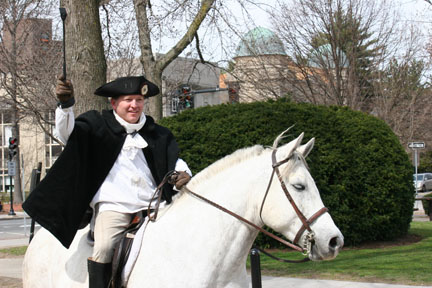
Join us at the Devotion House on Patriots Day, April 16th, for an open house and the annual visit of "William Dawes" in a recreation of Dawes' ride through Brookline on his way to Lexington in 1775.  House tours, music and activities begin at 9:30, followed by the expected arrival of Dawes on horseback at 10:50.

Sunday, January 29, 2012

1865: A Good Sidewalk Was Hard to Find

From the Report of a Committee on the Repair of Roads in Brookline, 1865:

The condition of that portion of the road devoted exclusively to pedestrians, is, in such a town as Brookline, as important as that of the carriage-way. Most of the persons in this town conduct their daily business in Boston, and reach the city by other means than their own conveyances. These persons, therefore, are for the most part compelled to walk, in Brookline, to and from the railroad, horse-car, or omnibus; and the town is therefore bound to furnish them, at all seasons of the year, an easy and cleanly path to travel on. That they do not have this, during the whole of the winter and early spring, and during continued wet weather at other seasons, is a well-known fact. 

. . . . With attention to the repair of the existing sidewalks, and the construction of additions to them, the town might, in a few years, have permanently good sidewalks on every principal street.  And it would no longer be the case that ladies, young children, and invalids, would be prevented by the state of the path, from taking necessary walking exercise.  And persons liking Brookline scenery and Brookline society, would have more inducement to settle in the town, from the increased facilities for enjoying these great advantages.

Plank sidewalks, like this one shown on Beacon Street east of Englewood Avenue in the 1880s, were laid in Brookline as early as the 1850s.
(Brookline Historical Society lantern slide)

Sunday, December 25, 2011

An Early View of Christmas in Brookline

Mary W. Poor, who was born in Brookline in 1820, was the daughter of the Rev. John Pierce, minister of the First Parish Church.  Her "Recollections of Brookline," read before the Historical Society in 1903, included this passage about Christmas at the time of her childhood.

As Brookline has changed outwardly, so have its manners and customs. In those old days there was no attention paid to Christmas beyond saying, "I wish you a merry Christmas!" to the members of the family when we first met them in the morning. We never dreamed of its being made merrier than any other day. The schools went on as usual and no one expected a Christmas gift. We had New Year's presents instead. I never heard of Santa Claus till I was sixteen and then he was mentioned by a lady from New York. We knew that Catholic and Episcopal churches were dressed with evergreens at Christmas, and sometimes went to Boston to see them on that day.

 For more on the celebration of Christmas in early Massachusetts—it was outlawed from 1659 to 1681 and was not recognized as an official holiday until 1856—see this "Mass Moment" from the Massachusetts Foundation for the Humanities.

Monday, June 20, 2011

Remembering Brookline's Civil War Dead

NOTE: This is an expanded version, with illustrations, of an article that first appeared in the Brookline TAB and its Wicked Local Web site.

Brookline’s 1884 memorial to its Civil War dead was restored, reinstalled, and rededicated in the lobby of Town Hall on Memorial Day. If you haven’t gone to see it, you should.
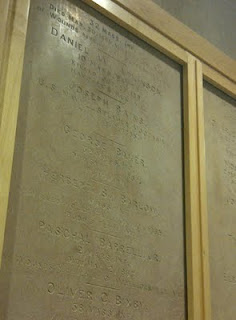
Civil War Memorial
Photo courtesy of Jesse Mermell
Unlike the town’s more visible statue of an anonymous bugler on his horse, these seven tablets of pink Tennessee marble pay tribute to individual men, their names chiseled into stone along with their units and the dates and places of their deaths.

There are 72 in all, soldiers and sailors who died at such places as Antietam, Gettysburg, Fredericksburg, Chancellorsville, the Wilderness, and the notorious Confederate prison at Andersonville, Georgia.

A century and a half ago, news of these storied places arrived in Brookline not just as part of the broad saga of the war but also as terrible news for families living in streets (and maybe a few houses) that are familiar to us today. That gives more meaning to the names of these places and takes us back to Brookline at the time of the Civil War.

Inspired by the rededication, I’ve been digging deeper, piecing together fragments that tell who these men were and what happened to them. A few—officers and members of prominent families—were easy; their stories were documented at the time and have been preserved in books, letters, and other sources.
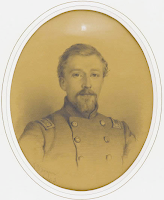
Sketch of Wilder Dwight, 1862
Wilder Dwight, 18622
(Click for larger view)
Wilder Dwight, for example, was a Harvard-educated lawyer and a lieutenant colonel in the infantry. Mortally wounded at Antietam but in too much pain to be moved, he lay on the ground as battle raged around him and added these words to a letter, stained with his blood, that he had begun writing that morning:

DEAREST MOTHER,--I am wounded so as to be helpless. Good by, if so it must be. I think I die in victory. God defend our country. I trust in God, and love you all to the last. Our troops have left the part of the field where I lay.1

On the opposite page he added “All is well with those that have faith.” Dwight was carried to the rear that evening and died the following day at age 29. He was buried in Forest Hills Cemetery, along with his brother, Howard, who was killed in Louisiana eight months later.

Charles L. Chandler3
Charles L. Chandler, a civil engineer, was a lieutenant colonel of Massachusetts troops. Wounded in Virginia in May 1864, he fell into Confederate hands. Two weeks later, his mother Eliza received a letter from a fellow officer that told how, under a flag of truce, a Confederate colonel came to him with news of Chandler’s death.

He lived for some hours [the officer wrote], and was kindly cared for by Colonel Harris, who has his watch, money, diary, and photograph of young lady. . . Colonel Harris said, Lieutenant-Colonel Chandler died happy, and desired him to give his love, etc., to all his family and friends.3

Chandler’s belongings were returned to his family after the war, but his body was never recovered. He was 24 years old when he died.

Painting showing Charles Chandler in the action in which he gave his life
This painting, "Even To Hell Itself" by Donna J. Neary, shows Lt. Col. Charles L. Chandler, center, in the action at the North Anna River in Virginia where he was mortally wounded.  It was made for the North Anna Battlefield Park. Used by permission of the artist.
Credit: Donna J. Neary, Heritage Studio

Unlike Dwight and Chandler, most of the men whose names are on the memorial were working men—carpenters, blacksmiths, laborers, shoemakers, and clerks—including several Irish immigrants and sons of immigrants.
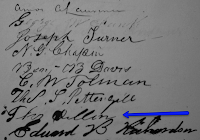
Thomas Dillon's signature
Thomas Dillon's signature4

Thomas Dillon came to Brookline from Armagh, Ireland. A teamster like his father, he enlisted in Wilder Dwight’s regiment in 1862 at age 31 and, like Dwight, was killed at Antietam. Dillon’s company commander remembered:

One of the men of my company killed at Sharpsburgh, the other day, lived in Brookline, and had been out here only about six weeks; his name was Thomas Dillon, and he was a good, faithful fellow...A letter came for him two days after his death, which I think, under the circumstances, was one of the most affecting things I ever read... I do not know of anything that has brought the horrors of the war more plainly before me than this letter. I have written to the father of Dillon, telling him of his son's death.5

Daniel Webster Atkinson, a 25-year old journeyman carpenter, fell during the siege of Petersburg in October 1864. Atkinson was a tall man with blue eyes, light hair, and fair skin, according to an August 1862 list of enrollees in the 10th Battery of Massachusetts Light Artillery.  (At six-feet one-and-a-quarter inches, Atkinson was the tallest of the 26 men listed and one of only two over six feet.)

John Billings, a comrade who wrote a history of the regiment, called Atkinson

.... a brave soldier, a professed Christian and true man...As the troops halted from time to time, he was several times seen, apart from the column, reading the Scriptures, or on his knees in prayer.6

Atkinson, wrote Billings, escaped serious injury in July 1864 when he fell asleep and walked off a pontoon bridge while crossing the Appomattox River "providentially alighting in one of the boats" supporting the bridge.

His luck ran out three months later at Hatcher's Run, Virginia, where he was shot and killed and "thus sealed with his blood the cause he had upheld from the beginning with peculiar earnestness."  Atkinson, noted Billings, had told fellow soldiers he did not expect to survive the war and, on the morning of the day he died "had given directions to some of his more intimate comrades in regard to the disposal of his effects in case he should fall."

Site where the 10th Battery stood, as seen in 1896
Site of the action in which Daniel Atkinson was killed, as it looked in 1896.  From  Billings' History of the Tenth Massachusetts Battery of Light Artillery in the War of the Rebellion, p. 366.

Five months after the battle, Billings and his fellow artillerymen passed by the place where Atkinson had fallen and found a grave on the spot.

Satisfied that it was his, there being no others near, we hastily inscribed his name, battery, and date of death on a rough board, with satisfaction at being thus able to mark his remains for future removal, before passing on with the column.

John W. Clark was one of the older Brookline men to die in the war. A mason, he was 39 when he enlisted in September 1861. After the battle of Antietam Clark’s unit was recuperating with others in Bakersville, Maryland, when President Lincoln came to review the troops and receive their cheers. It’s unlikely that Clark saw him. Diarrhea caused by water from a stream that ran through the camp had put many of the troops on sick call, and Clark was probably among them. He died of disease two days after Lincoln’s visit.

The only son of the pastor of Brookline’s Baptist Church, Samuel Lamson was a 23-year-old paymaster’s clerk on board the paddlewheel steamboat Ruth as it came down the Mississippi River in August 1863 carrying soldiers, civilians, and two and a half million dollars in cash — the payroll for General Grant’s army besieging Vicksburg. Near Cairo, Illinois, the steamer caught fire and sank. (Sabotage was suspected.) Twenty-six people died. Two eyewitnesses recalled seeing Lamson, who couldn’t swim, jumping reluctantly into the water clutching a window shutter. His body was recovered two weeks later.

Burning of the Steamer Ruth
The burning of the steamer Ruth as shown in Frank Leslie's Illustrated Newspaper
These are just six of the Brookline men who died in the Civil War. (Stories of some of the others will be forthcoming.) I wish I could learn more about how they lived, not just how they died. But the restored memorial keeps their names alive, and telling their stories reminds us how deeply Brookline was affected by the war and what the town lost 150 years ago.


NOTES
1Life and Letters of Wilder Dwight, Lieut.-Col, Second Mass. Inf. Vols. (1868)
2Sketch of Wilder Dwight drawn by Private Francis D'Avignon, a French-born artist serving with the First Massachusetts Infantry.  Image source: Heritage Auctions
3Lt.-Col. Charles Lyon Chandler (1864)
4On April 22, 1861 -- 10 days after the attack on Fort Sumter and three days after a mob of Confederate sympathizers attacked a Massachusetts regiment as it passed through Baltimore -- more than 200 Brookline men enrolled "for the purpose of acquiring a knowledge of military drill and discipline" offered by the town.  Dillon was one of the first to sign up.  A little over a year later he enlisted in the Second Massachusetts Infantry Regiment.
5Letter from Charles Fessenden Morse, September 26, 1862, in Letters Written During the Civil War, 1861-1865 (1898)
6The History of the Tenth Massachusetts Battery of Light Artillery in the War of the Rebellion. Formerly of the Third Corps, and afterwards of Hancock's Second Corps, Army of the Potomac. 1862-1865 (1881) [Photo is from 1909 edition]

Wednesday, May 11, 2011

Brookline Bikes: Sights to See on Beacon Street

The annual Brookline Bikes bicycle parade takes place this Sunday, May 15th.  It's a great event and an opportunity to ride the entire length of the historic Beacon Street boulevard in Brookline unimpeded by automobiles.

The Brookline Historical Society will have a table set up in Amory Park, the starting and ending point for the parade, with information about the development of Beacon Street.  Stop by before or after the ride and check it out.

Shown below are some of the architectural and historical sights you'll see as you ride down Beacon Street. (Photos of Beacon Street landmarks in the past can be viewed on the Brookline Historical Society Web site.)

Pelham Hall (Outbound, at Pleasant Street) Pelham Hall was built as a residential hotel in 1926 as part of a burst of new construction in and around Coolidge Corner.

S.S. Pierce Building (Outbound, at Harvard Street). The S.S. Pierce building, the symbol of Coolidge Corner if not of Brookline itself, was built from 1898-99 on the site of the original Coolidge Brothers store.

The second story of the Pierce Building, now offices, was originally Whitney Hall. Named for Beacon Street developer Henry Whitney, it was used for concerts, lectures, dances, meetings, and other events.  The original tower was taller.  Damaged in a 1944 hurricane, it was remodeled afterward to its current design.  The S.S. Pierce Company continued to occupy the lower floor until the 1960s and the building is still generally called the S.S. Pierce Building, even by residents who didn’t arrive in Brookline until much later.


MBTA Shelters (Both sides at Harvard Street) The tile-roofed shelters for the T, at Coolidge Corner, are the original structures built by Henry Whitney’s West End Railway in 1901. Remodeled a few years ago, they are the only original shelters that remain.

The Stoneholm (Outbound, between Short Street and Lancaster Terrace). The Stoneholm is a magnificent French Renaissance chateau style apartment building that opened in 1909 with such amenities as marble fireplaces, parquet floors, and crystal chandeliers. It was designed by Arthur Bowditch, who lived on Pill Hill.


Chinese Christian Church (Inbound, between Strathmore and Dean Roads). This neo-Gothic church was designed by Shepley, Rutan & Coolidge in 1910. Built for the Leyden Congregational Church, it was bought by the Chinese Christian Church of New England in 1975.


All Saints Church.  (Inbound, at Dean Road). All Saints Church, designed by the architectural firm of Cram, Wentworth, and Goodhue, replaced a temporary wooden church on the site with the completion of the nave in 1899.

The Beaconsfield Terraces (including Richter Terrace,  Inbound at Dean Road and Frances Terrace, Inbound at Tappan Street).
The Beaconsfield Terraces were one of the more unusual developments to follow the widening of Beacon Street. Built by Eugene Knapp, a wool merchant, in the early 1890s, the terraces were an early condominium arrangement in which people owned their units but shared ownership of 6-acre park, stables, a playhouse (known as the casino), tennis courts, and a playground. A bell system connected the houses to the stables so that people could call for their horse and carriage. A central heating plant heated all of the buildings. Today, only the residence buildings remain.


Athans Building
(Inbound at Washington Street). This commercial block was built in 1898 with stores, offices, and a hall for dances and concerts.


Richmond Court. (Inbound, east of St. Paul Street).
Richmond Court was one of the firstpossibly the firstcourtyard apartment buildings in the country. Built in 1898, it is set back and separated from the noise and bustle of Beacon Street by an iron fence, brick and stone posts, a fountain, and private gardens. Richmond Court was designed by Ralph Adams Cram who went on to design All Saints Church, further out on Beacon Street, as well as the Cathedral of St. John the Divine in New York, and many buildings at West Point and Princeton University.


Temple Ohabei Shalom (Inbound at Kent Street). Temple Ohabei Shalom was the first Jewish congregation in Boston, formed in 1842 by immigrant German Jews. The congregation moved to Brookline and this domed temple in 1927.


Monday, May 9, 2011

Invention & Innovation: A Walking Tour of New Ideas Born in Brookline

Did you know that King C. Gillette got the inspiration for the safety razor while shaving in his Brookline home one morning? 

Or that the birth control pill was developed by Dr. John Rock at the Free Hospital for Women overlooking the Muddy River? 


Or that one of the world’s first electric cars was built at the Holtzer-Cabot Electric Company on Station Street? 


Join me this Sunday, May 15th, at 2 pm to learn about these and other advancements made by 19th and 20th century inventors and innovators living or working in Brookline


The tour begins at the Brookline Village MBTA Station and will cover approximately 2 miles in 1-1/2 hours. Free and open to the public.